+1 (415) 234 7510
 +971 52 901 6677
 +91 8780928142
 WhatsApp
 Email
Email




































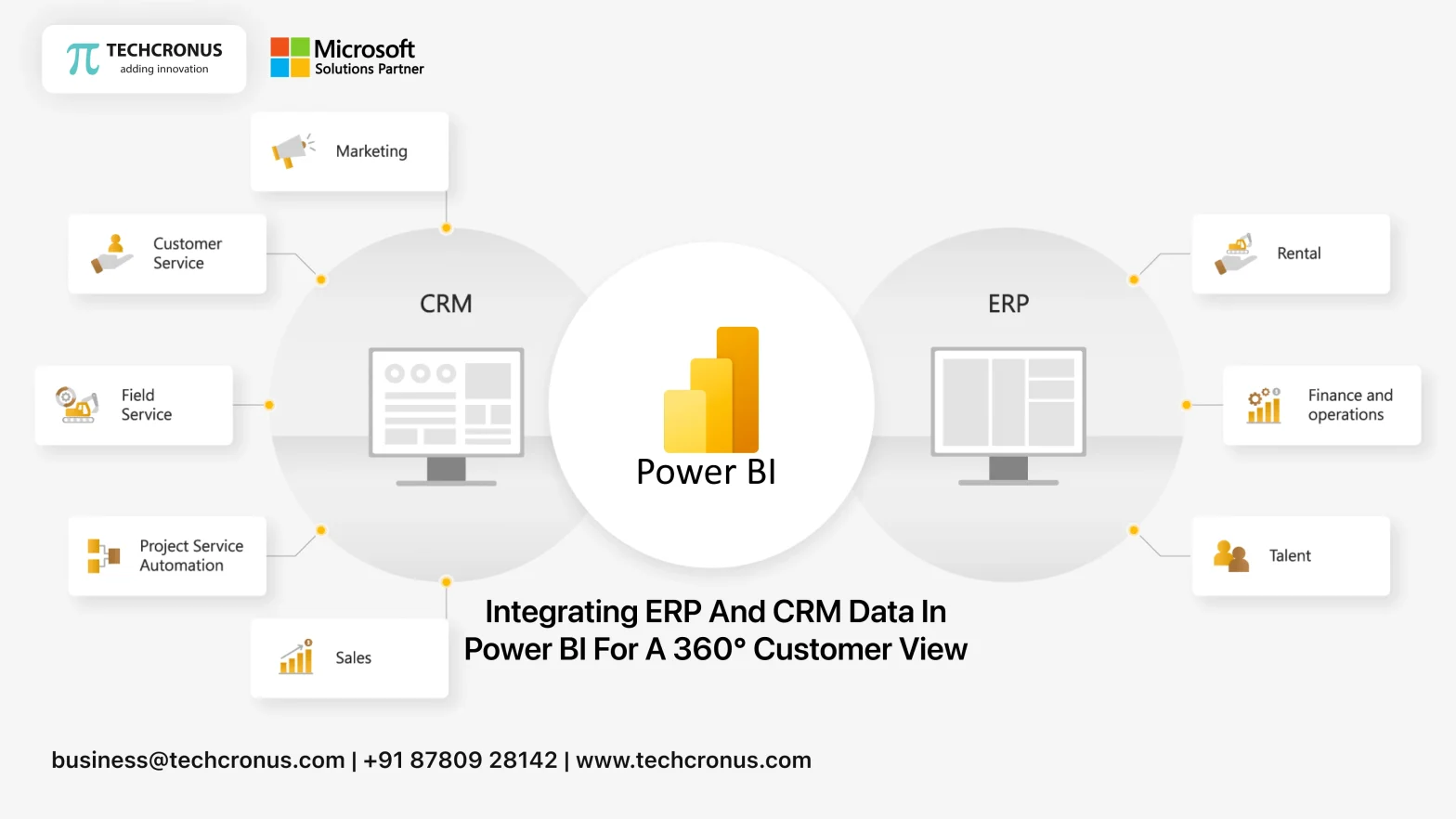
Table of Contents
Most businesses today are drowning in data but starving for clarity. Sales teams live inside CRM dashboards. Finance depends on ERP reports. Marketing pulls numbers from scattered tools. Leadership? They’re forced to make decisions based on fragmented snapshots, not the full picture.
This is exactly where Power BI integration becomes a business growth weapon.
If your organization operates across the US, UK, Middle East, or Australia, you already know how complex customer journeys have become. Before we go further, check out these stats:
- Companies using advanced analytics are 5x more likely to make faster decisions (McKinsey & Company)
- Poor data quality costs organizations an average of $12.9 million annually (Gartner)
- Organizations that integrate data across systems see up to 20–30% increase in revenue efficiency (Forrester)
- 73% of enterprise data goes unused for analytics (Forrester)
- Companies with unified customer data achieve 2.5x higher customer retention rates (Aberdeen Group)
- Data-driven organizations are 23x more likely to acquire customers (McKinsey & Company)
In simple words, without unified visibility, revenue leaks quietly. Opportunities go unnoticed. Customer experience suffers. Let’s fix that.
The Real Problem – Disconnected Systems = Disconnected Decisions
ERP systems track transactions, billing, inventory, and operations. CRM systems track leads, conversations, and customer relationships. Both are critical, but when they don’t connect to each other, you lose context.
You might know who bought from you (ERP) and who interacted with your brand (CRM), but you don’t know what actually drives revenue.
For example, a SaaS company in the US was generating thousands of leads monthly. Their CRM showed strong engagement, but their ERP told a different story: low conversion into paid customers. Once they implemented business intelligence data integration, they discovered that most high-engagement leads were from low-intent channels. Marketing spend was immediately reallocated, increasing revenue within a quarter.
This is why business intelligence data integration is a fundamental decision.
Why Power BI is the Right Engine for This Transformation
Microsoft’s ecosystem gives you a powerful advantage. With Power BI integration, you can bring ERP and CRM data into one unified dashboard that updates in real time.
But this isn’t just about connecting tools. It’s about building intelligence that drives action.
A retail chain in the UK used integration with Power BI to connect its ERP billing system with CRM customer journeys. What they uncovered was simple but powerful: repeat buyers were interacting with support before every purchase. By optimizing that support experience, they increased repeat purchases by over 30%.
That’s what smart Power BI integrations can do.
What a 360° Customer View Actually Means
A true 360° customer view is not a buzzword. It’s a competitive advantage that directly impacts revenue. With Power BI data integration, you can easily…
- Track every touchpoint from first interaction to final payment
- Understand customer lifetime value in real time
- Identify churn signals before customers leave
Consider a logistics company in the Middle East. Their ERP tracked invoices and shipments, while CRM tracked client interactions. After implementing Power BI data integration, they identified that delayed responses to client queries were directly linked to late payments. Fixing the response time improved cash flow within months.
The Role of ERP + CRM Integration in Revenue Growth
Businesses often underestimate how much revenue is lost due to poor data alignment.
Without structured BI integration services, teams operate in isolation. Sales pushes volume, marketing pushes visibility, and finance chases payments, without alignment.
A manufacturing firm in Australia implemented Power BI integration services to unify ERP and CRM data. The insight? Their highest revenue clients were referrals. This changed their entire acquisition strategy, doubling ROI on marketing spend.
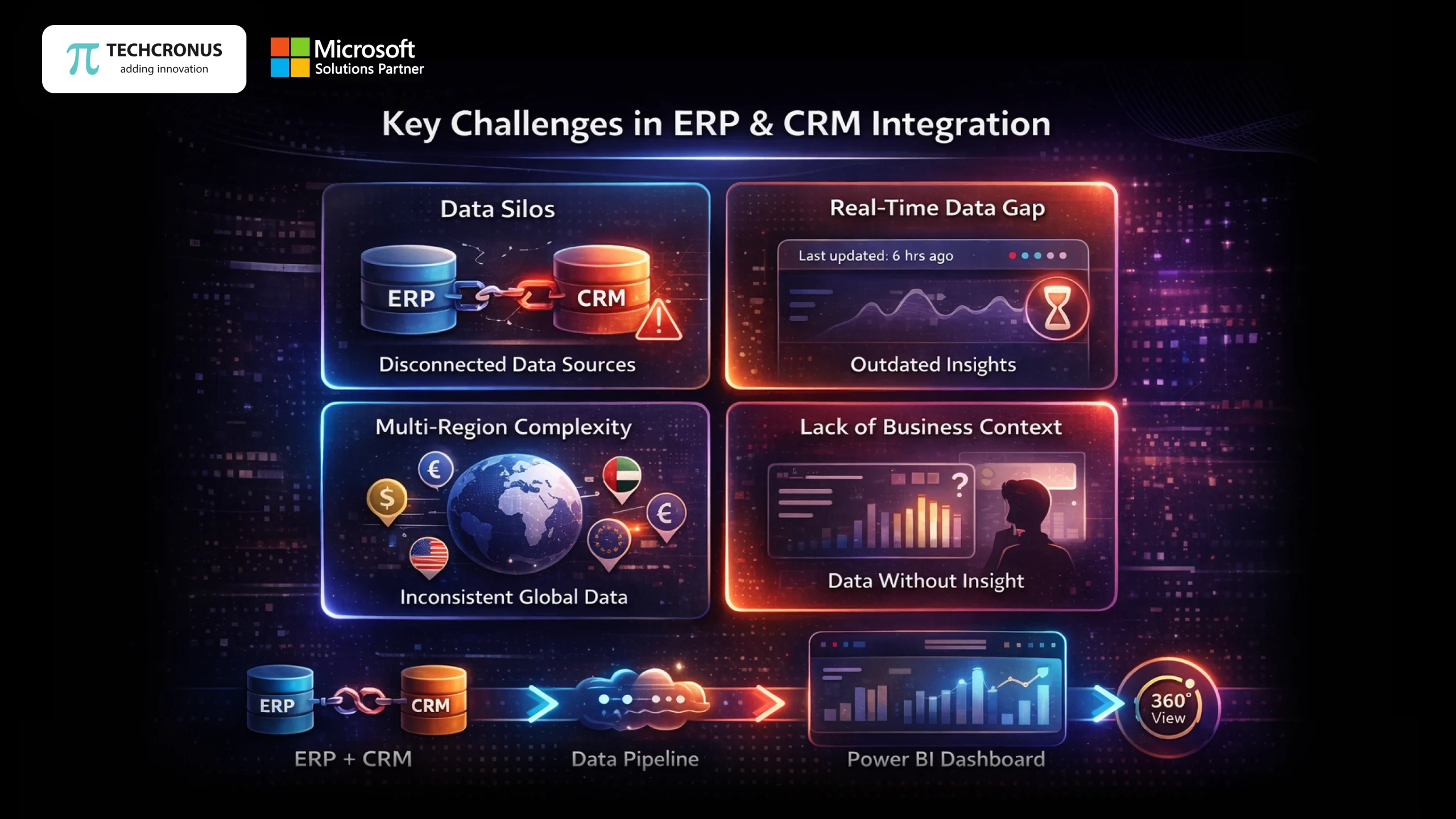
Key Challenges in ERP and CRM Integration (And How to Solve Them)
Let’s be real, because this is where most projects fail.
Data Silos and Inconsistent Formats
ERP and CRM systems rarely speak the same language. Without proper mapping, insights become unreliable.
The solution – Build structured pipelines using business intelligence data integration that cleans, standardizes, and aligns data before visualization.
Real-Time Data Gaps
Outdated dashboards lead to outdated decisions.
The Fix – Use automated workflows within Power BI data integration to ensure decision-makers always see live data.
Multi-Region Complexity
Operating across the US, UK, Middle East, or Australia adds layers of complexity—currencies, compliance, and customer behavior.
The Solution – Scalable Power BI integrations that adapt to regional data variations without breaking consistency.
Lack of Business Context
Many integrations fail because they focus only on technical connections.
The Fix – Work with experts offering BI integration services who design dashboards around decision-making, not just data display.”Moreover, even the most deeply integrated dashboard will fail to gain leadership adoption if it lacks an intuitive UI/UX design that presents complex data simply and clearly.”
What a High-Impact Power BI Dashboard Should Actually Deliver
A dashboard should drive action rather than showing shwta’s wrong or just throwing numbers at you. With strong Power BI integration, your dashboard must answer:
- Which leads are most likely to convert into revenue?
- Which customers are becoming less engaged over time?
- Where is revenue getting stuck in the pipeline?
- Which regions are underperforming and why?
A fintech company in the UK used integration with Power BI to uncover that most deal delays were happening at the contract stage. By simplifying contracts, they reduced deal closure time by 22%. That’s the difference between data and insight.
Why Global Businesses Need This Now
Markets are more competitive than ever. Customers expect personalization. Leaders demand faster, sharper decisions. Without Power BI integration services, you are practically invisible in a data-driven market.
Across the Middle East, digital transformation is accelerating rapidly.
Across Australia, businesses are optimizing operations to stay competitive globally.
In the US and UK, data maturity is already a baseline expectation. If your data isn’t unified through Power BI integrations, your competitors already have the edge.
The Techcronus Advantage: From Data Chaos to Revenue Clarity
Among the top Power BI consulting firms in the world, Techcronus builds intelligence layers that drive decisions. Our approach to Power BI integration focuses on:
- Aligning ERP and CRM data with real business goals
- Designing dashboards that leadership actually uses
- Building scalable systems for global operations
- Delivering measurable ROI, not just reports
A real example: A global distributor struggled with mismatched sales and finance data. Techcronus implemented BI integration services, aligning CRM deal stages with ERP invoicing. Within weeks, leadership could clearly see revenue bottlenecks and fix them. Check out the Power BI Premium vs Pro cost by clicking the link.
Common Mistakes That Kill ROI
Even with the right tools, execution matters. Avoid these traps:
-
- Treating Power BI integrations as a one-time setup instead of an evolving system
- Ignoring data quality during business intelligence data integration
- Building dashboards without clear business questions
- Choosing generic solutions instead of tailored Power BI integration services
- Mistaken that the Power BI for Mac is tough to integrate with your current tools.
What This Means for Your Business
When done right, Power BI data integration directly impacts growth:
- Sales teams close faster with better insights
- Marketing spends smarter with real ROI visibility
- Finance predicts cash flow more accurately
- Leadership makes decisions with confidence
And when you scale this using Power BI integration, your entire organization moves in one direction with clarity. So do not get stuck in the trap of low-cost ERP and CRM; check out the Power BI pricing 2026 today.
Clarity is the New Competitive Advantage
If your ERP and CRM are still disconnected, you are operating on partial truth and partial truth is expensive. With the right BI integration, backed by expert-led Power BI integration services, you unlock growth and business transformation. Because in today’s market, the companies that win are not the ones with more data. They are the ones who understand it better and act on it faster. So schedule a free consultation call with Techcronus today.