+1 (415) 234 7510
 +971 52 901 6677
 +91 8780928142
 WhatsApp
 Email
Email
































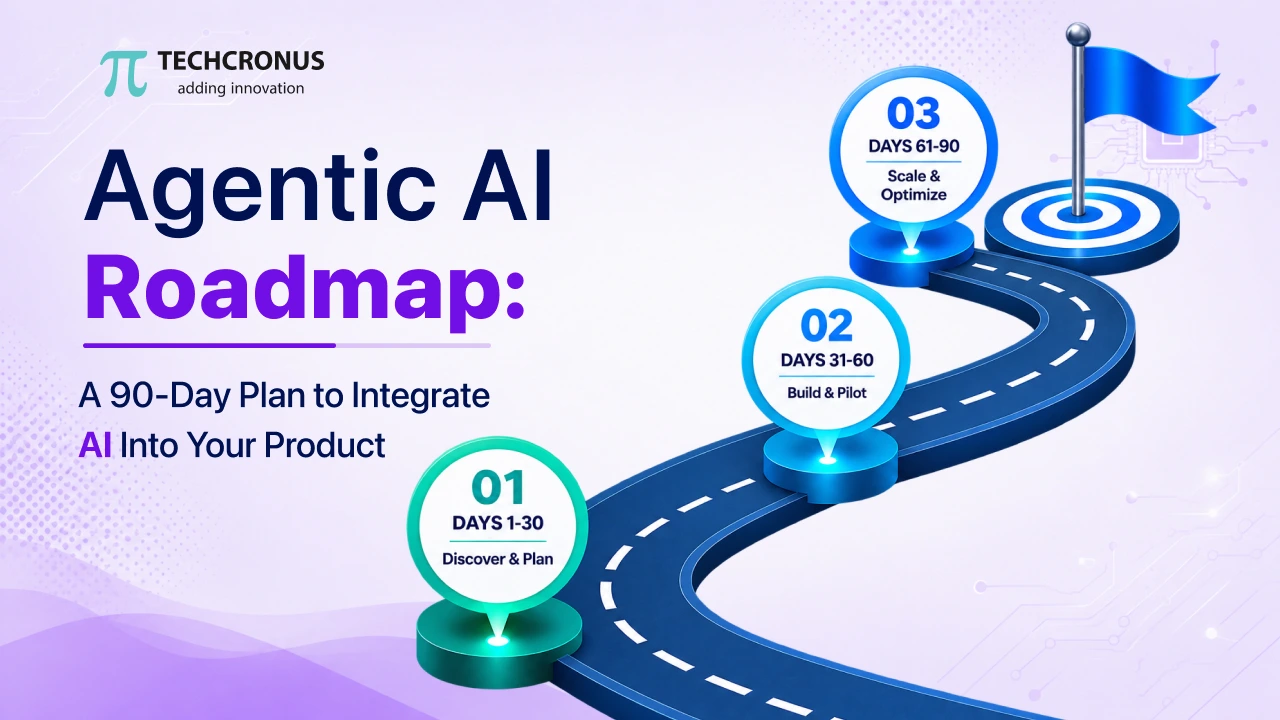
Table of Contents
Software buyers no longer ask whether your product has AI. They ask whether it acts on its own. That shift is why an Agentic AI roadmap has become the most requested planning document among CTOs and product leaders this year and why teams without one are already losing deals to competitors that automate, not just assist.
The market data backs up the urgency.
- Gartner projects that by the end of 2026, 40% of enterprise applications will include task-specific AI agents, up from under 5% a year earlier.
- The global AI agents market is on pace to hit $10.9–12.1 billion this year, growing at a 44–46% CAGR through 2030.
- A recent CrewAI survey of 500 senior executives found 100% plan to expand Agentic AI use this year, with nearly three-quarters calling it a strategic imperative.
Yet adoption and success are two different stories.
McKinsey’s research shows almost two-thirds of enterprises have experimented with AI agents, but fewer than 10% have scaled them into anything that delivers measurable value.
That gap is exactly what a structured Agentic AI roadmap is built to close. That’s why we built this 90-day plan for product leaders at Techcronus who are done experimenting and ready to ship.
Why Most Agentic AI Projects Stall
Before the plan, it’s worth naming the failure pattern. Gartner predicts more than 40% of Agentic AI projects will be cancelled by 2027. That would be mostly due to unclear business value, uncontrolled cost, and weak governance. And not because the models weren’t capable enough.
Separate research puts scaled agent adoption at roughly 23% of organizations, even though 88% of companies already use AI somewhere in the business.
The pattern is consistent: teams jump straight to building an agent instead of following a disciplined Agentic AI learning path that de-risks each stage data readiness, workflow scoping, governance, and integration before writing production code. Skipping that sequence is the biggest predictor of a cancelled pilot.
Days 1–30: Discovery, Scoping and Readiness
The first month is not about building anything. It’s about choosing the right problem and proving your data and systems can support Agentic AI Implementation before you commit engineering time.
Week 1–2: Audit and prioritize. Map every repetitive, multi-step workflow across customer support, operations and internal tooling. Score each by volume, error cost, and data availability. Enterprises that named a clear owner and success metric before building saw an average ROI of 171% from deployed agents— nearly double the return of teams that skipped this step.
Week 3: Data and systems readiness. Agentic systems require clean APIs, structured data and permissioning — not just a good model. This is where budgets get underestimated most; industry benchmarks show 40–60% of total agent development cost goes toward integrations and compliance layers, not the model itself.
Week 4: Governance framework. Define who approves autonomous actions, what a human-in-the-loop checkpoint looks like, and how you’ll monitor for drift or error. Teams that build governance from day one, rather than retrofitting it, are the ones that reach production, closing the gap between the 79% of enterprises that have adopted agents in some form and the roughly 31% that actually run them in production today.
If your team is still building internal expertise, this is also the stage to formalize an Agentic AI learning path for engineers — covering tool orchestration, memory systems and multi-step reasoning so implementation doesn’t stall waiting on skills.
Days 31–60: Build and Pilot
With scope and governance locked, the second month moves into a proof-of-concept aimed at one high-impact use case, not five ambitious ones.
Weeks 5–6: Build the PoC. Focus on a single workflow with clear inputs, tools, and success criteria. Keeping scope tight is what contains cost before it expands — this is also where questions about Agentic AI development cost become concrete, since PoC scope directly drives your total build estimate.
Week 7: Integration testing. Connect the agent to real (or sandboxed) systems: CRM, ERP, ticketing, or internal databases. This is where most AI Agent Development timelines slip, because integration complexity is consistently underestimated relative to model selection. Engineers who followed a structured Agentic AI learning path during discovery tend to catch these integration gaps earlier, since orchestration patterns are already familiar rather than learned on the fly.
Week 8: Controlled pilot. Run the agent alongside human operators, not in place of them. Track task completion rate, escalation frequency, and time-to-resolution. Median time-to-value for agent deployments currently sits around 5.1 months industry-wide, so an eight-week pilot checkpoint should show an early directional signal, not full ROI. Set that expectation with stakeholders now.
Days 61–90: Scale, Govern and Measure
The final month determines whether your project joins the 31% running in production or the majority still stuck at the pilot stage. A well-run 90-day Agentic AI implementation roadmap ends with this reconciliation, not the pilot demo.
Week 9–10: Expand scope carefully. Add a second and third workflow only after the first is stable. Sequential rollout, not parallel, is what separates a durable 90-day Agentic AI implementation roadmap from one that collapses under governance debt.
Week 11: Monitoring and cost controls. Establish ongoing observability for token usage, latency, and failure rates. Annual maintenance typically runs 15–30% of the original development cost. Teams evaluating the full Agentic AI implementation cost should factor this recurring spend in from the outset, not as an afterthought.
Week 12: Executive review. Present completion metrics against your Week 1 success criteria. Deloitte’s 2026 State of AI in the Enterprise report found that nearly three-quarters of companies whose most advanced AI Agent Development initiatives had clear success metrics met or exceeded ROI targets, with about 20% seeing returns over 30%.
Teams are asking how much Agentic AI development costs. Should have a real number by now, not an estimate — Week 12 is when projected and actual spend get reconciled. Product leaders comparing vendors often research the cost to implement Agentic AI in business operations before requesting a quote, a useful gut-check before scoping your own plan.
How to Implement Agentic AI in Existing Software
A recurring question from product leads is how to implement Agentic AI in existing software without a full rebuild. The answer is almost always incremental: wrap agentic capability around existing APIs and data layers rather than replacing the core product.
Enterprise deployments built this way commonly run 50,000–200,000, reflecting reasoning, orchestration and guardrail work layered onto what already exists. Teams that master how to implement Agentic AI in existing software early avoid the costlier path of rebuilding around the agent later.

How Much Does Agentic AI Development Cost?
Budgets vary widely by scope. Proof-of-concept work typically starts in the low five figures, MVPs run higher, and full enterprise deployment can reach six figures once integrations, compliance, and monitoring are included. How much does Agentic AI development cost? depends less on the model you choose and more on integration depth and governance requirements — exactly why the discovery phase in Days 1–30 matters so much.
How Do You Choose an Agentic AI Development Company?
Look for a partner that leads with discovery and governance, not just model integration — one who can show a track record of moving pilots into production. Ask for references on time-to-production, not time-to-demo, since that predicts whether your investment survives past the pilot stage. Ultimately, an Agentic AI development company comes down to whether it can show a completed 90-day cycle, not a slide deck.
Why Choose Techcronus as Your AI Development Company
- Delivering enterprise technology solutions since 2010, with a proven track record.
- Successfully completed 1000+ projects for startups and enterprises.
- Trusted by global brands: Starbucks, Unilever and IKEA.
- Official Microsoft Partner with deep Dynamics 365 expertise.
- Reach across Dubai, the USA, Australia, and India for global understanding and outreach.
- Full-stack AI: strategy, POC, MVP, deployment, optimization.
- Builds AI agents using AutoGen Studio and CrewAI tools.

Start Your 90-Day AI Implementation Plan Now
The data is consistent across every major research firm this year: Agentic AI adoption is no longer optional, but most projects still fail to reach production. A disciplined Agentic AI roadmap sequencing discovery, piloting, and governed scaling — is what separates the 23% seeing real ROI from the majority stuck in pilot purgatory.
Techcronus works with product and engineering leaders to build that roadmap and execute it inside one 90-day cycle, from first workflow audit to production launch. Schedule a Free Consultation Call to Find Out What AI Plan will suit you.
FAQs:
1. What is an Agentic AI roadmap?
An Agentic AI roadmap is a strategic plan that guides organizations through the process of adopting, implementing, and scaling AI agents. It typically covers discovery, workflow selection, governance, development, integration, testing, deployment, and ongoing optimization to ensure measurable business outcomes.
2. How long does it take to implement Agentic AI?
The timeline depends on the complexity of the use case and integrations. Most organizations can complete a proof of concept within 30–60 days and move to production within 90 days when following a structured Agentic AI implementation roadmap.
3. What is the difference between Generative AI and Agentic AI?
Generative AI focuses on creating content such as text, images, or code based on user prompts. Agentic AI goes a step further by autonomously planning, reasoning, making decisions, and executing multi-step tasks across systems and applications.
4. How much does Agentic AI development cost?
Agentic AI development costs vary based on project scope, integrations, compliance requirements, and deployment complexity. A proof of concept may start in the low five figures, while enterprise-grade implementations can reach six figures due to advanced integrations, governance, and monitoring requirements.
5. How can Agentic AI be integrated into existing software?
Most organizations implement Agentic AI by connecting AI agents to existing APIs, databases, CRMs, ERPs, and business applications. This approach allows businesses to add autonomous capabilities without rebuilding their entire software ecosystem.
6. What are the biggest challenges in Agentic AI implementation?
Common challenges include poor data quality, unclear business objectives, lack of governance, integration complexity, security concerns, and insufficient monitoring. A structured implementation roadmap helps mitigate these risks.
7. Which industries benefit the most from Agentic AI?
Agentic AI can deliver value across multiple industries, including healthcare, finance, manufacturing, retail, logistics, customer service, SaaS, and professional services. Any organization with repetitive, data-driven workflows can benefit from AI agents.