+1 (415) 234 7510
 +971 52 901 6677
 +91 8780928142
 WhatsApp
 Email
Email


































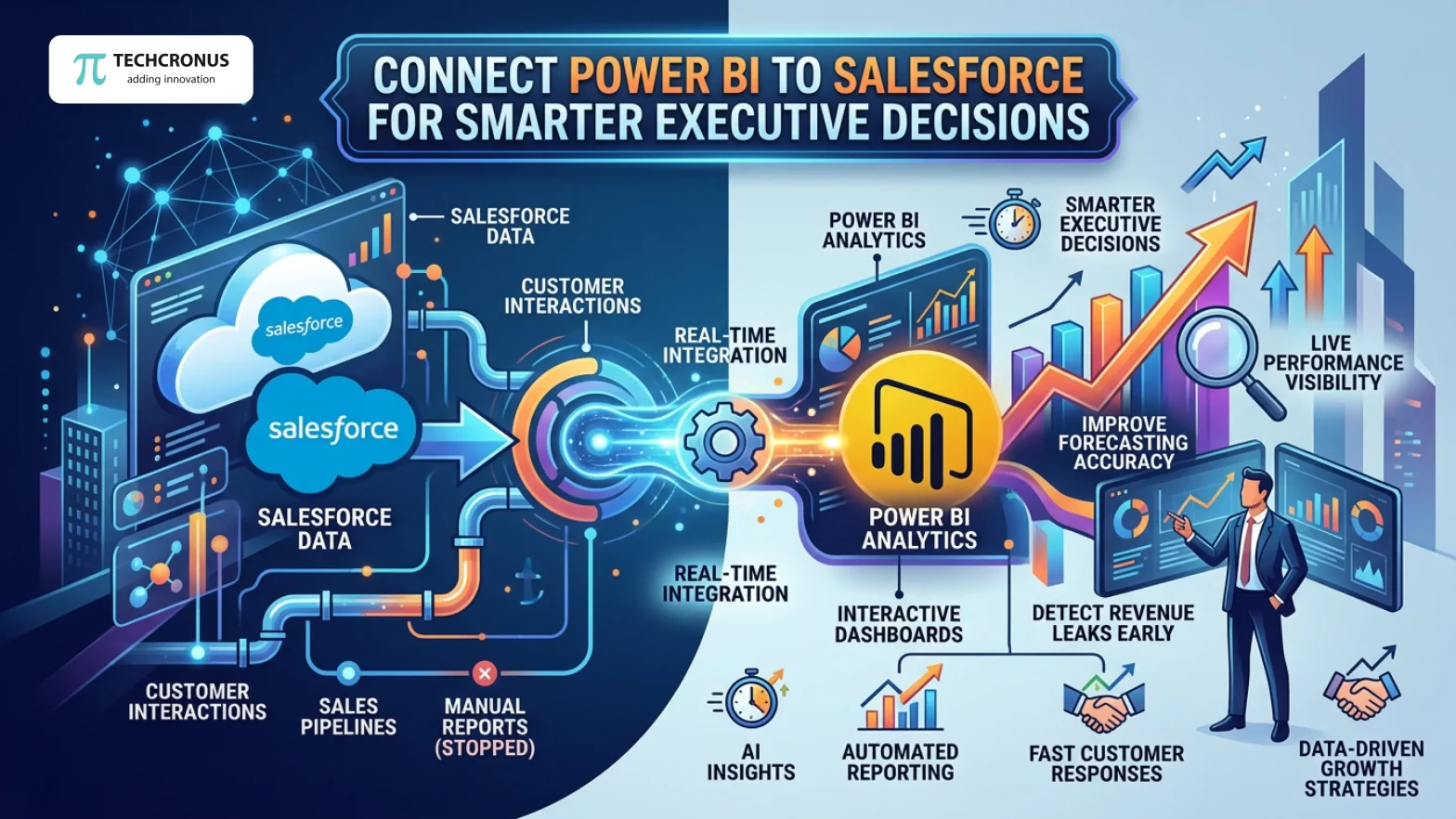
Table of Contents
I speak with founders, CIOs, and sales directors across the US, UK, Dubai, Australia, and the Middle East almost every week. Most of them believe their CRM systems are working perfectly until they discover hidden revenue leaks, delayed reporting cycles, disconnected customer insights and poor forecasting accuracy.
That is exactly why Power BI Salesforce Integration has become a boardroom-level discussion instead of just another IT project.
- According to Salesforce research, high-performing sales teams are 2.8 times more likely to use analytics extensively in their decision-making processes.
- Microsoft reports that businesses using advanced analytics tools improve operational efficiency significantly faster than competitors.
Companies delaying integration strategies today are already losing speed against data-driven organizations.
As a co-founder at Techcronus, I have personally seen businesses lose enterprise deals simply because decision-makers did not have access to real-time dashboards. In highly competitive markets like London, New York, Dubai, Sydney, and Abu Dhabi, delayed visibility directly impacts revenue growth. I will now explain why and how to connect Salesforce to Power BI.
Actual Problem Most Businesses Ignore
Most organizations use Salesforce for customer management and another platform for analytics. The problem begins when teams manually export spreadsheets, combine fragmented reports, and spend hours validating inconsistent data. By the time reports reach leadership teams, the information is already outdated.
This is where Power BI Salesforce solutions completely transform operations.
Instead of relying on static CRM reports, businesses gain live dashboards, predictive insights and centralized reporting visibility. When you connect Power BI to Salesforce, Sales managers can identify weak pipelines instantly. Executives can monitor KPIs in real time. Marketing teams can track campaign performance without waiting days for reporting updates.
Businesses that still rely on disconnected systems are facing three major risks:
- Slower executive decision-making
- Poor sales forecasting accuracy
- Missed customer engagement opportunities
I recently worked with a retail enterprise in Dubai that managed operations across multiple countries. Their reporting cycle consumed nearly four days every week. After implementing Power BI in Salesforce, their leadership team began tracking live customer acquisition metrics instantly.
Within three months:
- Reporting delays reduced by 80%
- Campaign optimization improved significantly
- Regional sales visibility increased dramatically
- Leadership response time became faster
That is the difference intelligent integration creates after you link Salesforce to Power BI.
Why Global Enterprises Are Prioritizing Analytics Integration
Modern businesses no longer compete only on products or pricing. They compete on speed, visibility and customer intelligence.
Companies implementing Power BI Salesforce Integration strategies are gaining advantages because they can:
- Monitor business performance in real time
- Detect sales bottlenecks early
- Improve forecasting accuracy
- Deliver faster customer responses
- Reduce manual reporting dependencies
- Create data-driven growth strategies
According to IDC research, organizations using business intelligence effectively can improve decision-making speed by nearly 5 times compared to traditional reporting systems.
This growing urgency explains why demand for Salesforce Power BI Integration services has increased rapidly across enterprise markets.
What Makes Power BI and Salesforce So Powerful Together
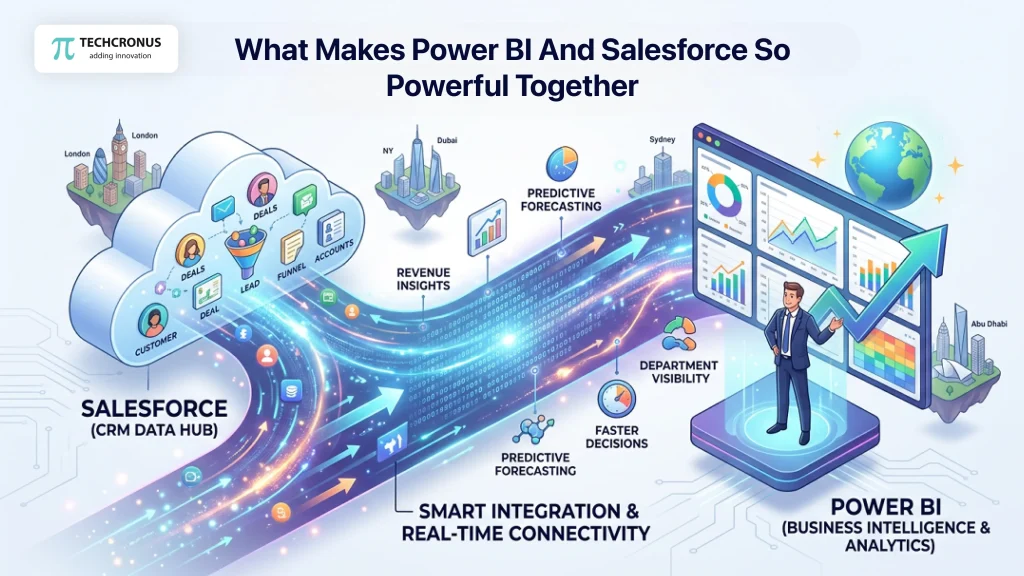
Salesforce stores valuable customer and sales data. Microsoft Power BI converts that data into actionable business intelligence.
When businesses implement Power BI Integration with Salesforce, they unlock:
- Interactive dashboards
- Automated reporting
- AI-powered forecasting
- Multi-source analytics
- Revenue trend analysis
- Customer behavior tracking
- Cross-department visibility
Without advanced analytics, most CRM systems only provide operational information. Businesses need strategic intelligence to scale effectively.
Why Power BI Salesforce Connection is impotant? I often explain this to CEOs in a very simple way. Your CRM tells you what happened. Your analytics platform tells you why it happened and what will happen next. That difference changes how businesses grow.
The Growing Demand for Real-Time Reporting
Executives today cannot afford weekly reporting delays.
One manufacturing client in Australia approached us after losing visibility into distributor performance across multiple territories. Their teams were spending hours compiling manual reports from disconnected systems.
After implementing a customized Power BI Salesforce Connector, their regional leadership teams started monitoring live sales activity, customer engagement, and operational metrics from centralized dashboards.
The impact was immediate.
- Faster strategic decisions
- Reduced reporting workload
- Improved sales accountability
- Better revenue forecasting
This is exactly why enterprise demand for Salesforce Power BI Connector solutions continues to increase globally.
Why Native CRM Reporting Is No Longer Enough
Many companies ask me whether they should continue using only Salesforce dashboards.
My answer is always direct – Native CRM reports are useful for operational visibility. But modern enterprises need predictive intelligence, centralized reporting, and executive-level analytics.
When businesses connect Power BI to Salesforce, they gain:
- Advanced visualization capabilities
- Interactive executive dashboards
- Department-wide analytics visibility
- AI-driven insights
- Better business forecasting
Organizations that delay modernization and ignore the Power BI Salesforce Connector often discover problems too late.
I have seen companies realize customer churn patterns only after quarterly revenue losses became visible. Now that is what I will call EXPENSIVE.
Check our Power BI pricing 2026 Guide here, and you will know that your delay is more expensive!
How Integration Improves Executive Decision-Making
One of the biggest hidden benefits of Salesforce to Power BI implementation is decision speed. Executives no longer wait for analysts to prepare manual reports.
Instead, they access live dashboards showing:
- Sales pipeline movement
- Territory performance
- Revenue forecasting
- Customer retention trends
- Marketing ROI
- Service response metrics
This creates faster leadership alignment and stronger operational control.
At Techcronus, we frequently discover that employees spend nearly 30% of their reporting time manually consolidating spreadsheets. A well-planned Power BI Salesforce Connection eliminates repetitive reporting tasks and improves productivity across departments.
Why Businesses Are Investing Aggressively in Business Intelligence
The market is shifting rapidly toward intelligent automation and predictive analytics.
That is why demand for BI for Salesforce solutions continues growing across industries, including:
- Healthcare
- Retail
- Logistics
- Manufacturing
- Financial services
- Professional consulting
Companies no longer want isolated data systems. They want connected ecosystems where sales, operations, finance, and customer support teams work from unified business intelligence dashboards.
Another major trend involves the ability to Embed Power BI in Salesforce directly inside user workflows. This allows employees to access analytics without switching platforms repeatedly. Sales managers can monitor live targets. Leadership teams can track KPIs instantly. Service teams can analyze customer issues in real time. In short, Salesforce Power BI Connector boosts your business operation efficiency.
Security, Automation, and Scalability Matter More Than Ever
Clients often ask us how to connect Salesforce to Power BI securely without risking data governance issues. Remember, security is not optional anymore.
At Techcronus, we design enterprise-grade integration frameworks with:
- Secure authentication protocols
- Role-based dashboard access
- Compliance-focused architectures
- Scalable cloud integrations
- Automated data synchronization
Automation is another major business differentiator. Using Power Automate Salesforce Connector workflows. This reduces delays and improves organizational responsiveness significantly. Businesses can automate:
- Alerts
- Approvals
- Notifications
- Reporting triggers
- Workflow escalations
The Companies Winning Tomorrow Are Acting Today
I have personally seen organizations transform growth trajectories after modernizing their analytics infrastructure.
Businesses using Power BI Salesforce capabilities intelligently are making faster decisions, improving customer retention, and forecasting revenue more accurately.
Similarly, enterprises adopting Power BI in Salesforce ecosystems are reducing operational inefficiencies while strengthening executive visibility.
The companies delaying digital transformation are already falling behind competitors that use intelligent reporting systems daily.
That reality is becoming more obvious every quarter. So do not wait, Connect Power BI to Salesforce now!
Final Call Is Yours – To Lose or Win!
At Techcronus, we rank among the top Power BI consulting firms. Because we believe integration should never be treated as a simple technical activity. It should create a measurable business impact. Through advanced Salesforce Power BI Integration services, we help organizations transform disconnected systems into intelligent decision-making ecosystems.
Our mission is simple: Help businesses move faster, forecast smarter, improve customer experiences, and unlock sustainable growth using modern analytics infrastructure.
Organizations implementing Power BI Integration with Salesforce today are positioning themselves ahead of competitors for the next decade.
And businesses investing in BI for Salesforce strategies now will lead tomorrow’s markets with faster decisions, stronger customer intelligence, and smarter growth execution. So connect for a free consultation call to learn how we will, without disruptions, Embed Power BI in Salesforce for your business.