+1 (415) 234 7510
 +971 52 901 6677
 +91 8780928142
 WhatsApp
 Email
Email
































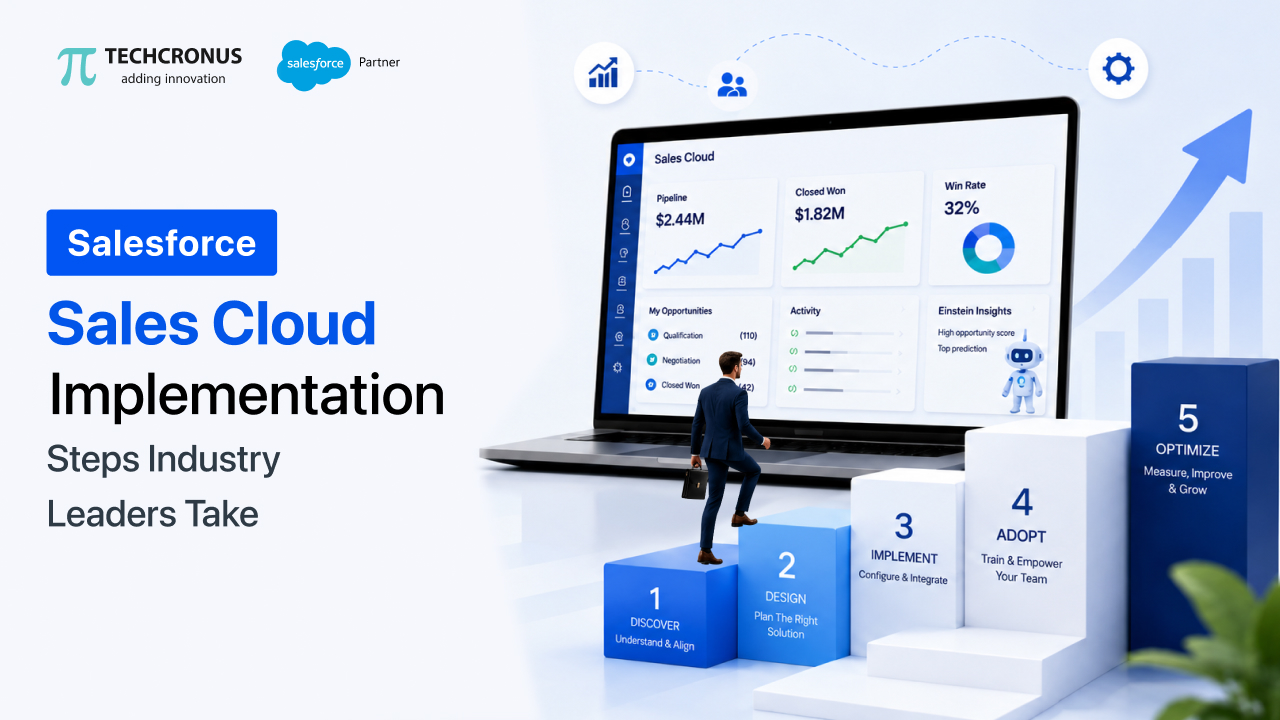
Table of Contents
The world’s highest-performing organizations understand one reality: Salesforce Sales Cloud implementation is about much more than deploying CRM software; it’s about creating a scalable sales engine that drives predictable revenue growth.
According to Salesforce’s 2026 State of Sales report, 94% of sales leaders using AI agents say they are essential for meeting business demands, while nine in ten sales teams already use or plan to adopt AI within the next two years. Organizations are investing in intelligent selling because modern buyers expect faster responses, personalized engagement, and data-driven interactions.
Every delayed follow-up, inaccurate forecast, and disconnected customer interaction silently reduces revenue. Businesses relying on outdated sales processes lose opportunities to competitors that leverage Salesforce Sales Cloud, AI automation, and real-time insights to close deals faster.
The question is no longer whether you need a CRM; it’s whether your Salesforce Sales Cloud implementation strategy is built to support long-term business growth.
The Hidden Revenue Leaks Most CEOs Never Measure
Revenue rarely disappears overnight. It leaks through hundreds of small operational inefficiencies every week. Sales representatives chase outdated leads. Managers spend hours building reports instead of coaching teams. Marketing and sales operate from different customer data. Forecasts become assumptions rather than business intelligence.
High-performing companies don’t eliminate these challenges by hiring more salespeople. They eliminate them by creating a connected revenue ecosystem where every lead, opportunity, quote, and customer interaction contributes to predictable growth. That shift separates market leaders from businesses constantly reacting to missed targets.
How to Increase Sales Team Productivity with Salesforce
High-performing organizations redesign their sales process before configuring technology. Salesforce Sales Cloud implementation becomes a business transformation initiative instead of another IT deployment.
- Centralize customer data across every sales interaction.
- Automate repetitive workflows and manual approvals.
- Prioritize high-intent leads using AI insights.
- Standardize sales stages for consistent forecasting.
- Enable real-time pipeline visibility for managers.
- Integrate business systems into one CRM.
- Coach representatives using conversation intelligence.
- Monitor performance through actionable sales dashboards.
- Reduce administrative tasks with intelligent automation.
- Continuously optimize workflows using performance analytics.
The result?
- More conversations.
- Better forecasts.
- Higher conversions.
- Faster decisions.
- Greater accountability.
As an industry leader, you must consider an excellent Salesforce CRM for sales teams.
Why Salesforce Sales Cloud Implementation Fails
An uncomfortable truth: Most CRM projects fail because businesses automate broken sales processes.
Research from IBM’s State of Salesforce 2025–2026: Only 33% of AI initiatives achieve expected ROI, and 72% never scale.
Because companies focus on software before business goals, poor data, limited sales involvement, weak executive support, and inadequate training reduce adoption; successful companies align CRM with business outcomes, assign executive sponsors, track KPIs, and continuously optimize after launch.
Salesforce Sales Cloud ROI: Growth Comes From Strategy, Not Software
According to IBM, organizations that combine strong governance, quality data, and enterprise-wide AI adoption report 60% greater operational efficiency, 57% better customer insights, and more than twice the pipeline expansion compared to their peers.
That should concern every CEO. Technology isn’t your biggest investment risk. Poor implementation is.
Businesses achieving the strongest Salesforce Sales Cloud ROI establish measurable success metrics before deployment. Through Salesforce Sales Cloud Agentforce AI for Sales 2026, Techcronus helps them align CRM with revenue objectives. We help you automate repetitive processes, integrate customer data, and continually optimize workflows using real sales performance.
Comparing Salesforce Sales Cloud vs HubSpot
| Feature | Salesforce Sales Cloud | HubSpot |
| Best For | Mid-market, enterprise and global organizations with complex sales operations. | Small businesses and startups needing quick deployment. |
| Scalability | Built to scale from SMBs to multinational enterprises without outgrowing the platform. | Suitable for growing businesses but can become limiting as complexity increases. |
| AI Capabilities | Agentforce, Einstein AI, predictive forecasting, next-best actions and enterprise-grade AI automation. | AI tools available but generally less extensive for complex enterprise workflows. |
| Customization | Extensive customization for industries, workflows, approvals, CPQ and enterprise processes. | Easier to configure but offers fewer deep enterprise customization options. |
| Reporting & Forecasting | Advanced dashboards, customizable reports, territory management and enterprise forecasting. | Strong reporting for SMBs but fewer enterprise-grade forecasting capabilities. |
| Integrations | 7,000+ AppExchange integrations with thousands of implementation partners worldwide. | Around 1,800+ marketplace integrations. |
| Implementation | Requires expert implementation but delivers long-term flexibility and governance. | Faster initial setup with fewer configuration requirements. |
| Global Enterprise Support | Trusted by 150,000+ businesses with a global ecosystem of consultants, Trailblazers and partners. | Strong SMB ecosystem with growing enterprise presence. |
| Customer Satisfaction | 99% of businesses switching from HubSpot reported satisfaction with Salesforce. | No equivalent independent switching metric cited. |
| Business Results | Customers switching from HubSpot reported 29% more revenue, 33% higher ROI and 31% more accurate AI. | Highlights ease of adoption and productivity improvements, based primarily on HubSpot’s own research. |
Salesforce Sales Cloud Implementation for Mid-Market USA: A Manufacturing Success Story
A California manufacturer generated strong demand but struggled with slow follow-ups, scattered data, and poor forecasts.
Techcronus redesigned its sales process before deploying Salesforce Sales Cloud. We automated lead qualification, integrated ERP data, and built real-time dashboards. The result? Faster decisions, better pipeline visibility, and a scalable CRM for sales that supported business growth across the US.
Real Estate Case Study: Salesforce CRM for Sales Teams UAE Dubai
A Dubai real estate enterprise struggled with disconnected sales, finance, legal, and inventory systems. Sales teams manually tracked leads, causing delayed follow-ups, inaccurate forecasts, and inconsistent customer experiences. Techcronus implemented a unified Salesforce CRM for sales teams. We automated lead management, bookings, approvals, ERP integration, and executive dashboards. Through our expert CRM for B2B Sales Teams Saudi Arabia GCC, their leadership gained real-time pipeline visibility. It improved booking accuracy, faster sales cycles, and scalable operations. Together, it helped in turning fragmented processes into predictable revenue growth.
Industrial Success Case Story: Salesforce Sales Cloud Implementation Partner Australia
A Sydney-based industrial equipment distributor struggled with scattered customer data, inconsistent quotations, and poor sales forecasting across multiple states. Opportunities were slipping through unnoticed, delaying revenue growth.
Techcronus redesigned its sales process, implemented Salesforce Sales Cloud, integrated ERP and customer data, and automated approvals. Leadership gained real-time pipeline visibility, faster quoting, and confident forecasting, enabling scalable expansion without increasing operational complexity
Salesforce Sales Cloud Pricing: Think Beyond License Costs
One of the biggest executive mistakes is evaluating Salesforce Sales Cloud pricing solely by subscription fees.
Total ownership includes:
- Discovery and consulting
- Data migration
- Integration
- User training
- Change management
- Governance
- Continuous optimization
The cheapest implementation frequently becomes the most expensive when adoption stalls or users return to spreadsheets. The better investment is selecting an implementation partner like Techcronus focused on measurable business ROIs rather than rapid deployment.
Why Techcronus Delivers Long-Term CRM Success
At Techcronus, we believe successful CRM transformation begins long before configuration.
We come armed for you with:
- Certified Salesforce partner delivering measurable business transformation globally.
- Business-first CRM strategies before technology implementation begins.
- Certified, experienced Salesforce Sales Cloud consultants maximize adoption, governance, and long-term ROI.
- End-to-end Salesforce implementation, integration, optimization, and support.
- Trusted across manufacturing, healthcare, retail, and finance industries.
- AI-powered Salesforce Sales Cloud implementation accelerates enterprise sales productivity.
- Global delivery expertise across the USA, UAE, Australia, and Europe.
- Proven methodology minimizes implementation risks and project delays.
- Scalable CRM architectures supporting future enterprise business growth.
- Continuous optimization ensures sustained CRM performance improvements.
Final Thoughts
Your competitors are already investing in AI, automation, and connected customer experiences. Standing still isn’t maintaining the status quo. It’s gradually surrendering market share. The question every executive should ask is how much revenue is being left on the table until you finally get into Salesforce Sales Cloud implementation? Connect today for a free Salesforce Sales Cloud Audit. See Exactly Where Your CRM is Costing Your Revenue.
Frequently Asked Questions
1. What is Salesforce Sales Cloud implementation?
Salesforce Sales Cloud implementation is the process of configuring and deploying Salesforce CRM to manage leads, opportunities, accounts, contacts, sales pipelines, forecasting, automation, and customer interactions. A successful implementation aligns the CRM with business goals and sales processes rather than simply installing software.
2. How does Salesforce Sales Cloud improve sales team productivity?
Salesforce Sales Cloud helps sales teams centralize customer information, automate repetitive tasks, prioritize leads, streamline approvals, improve pipeline visibility, and provide real-time sales insights. This allows representatives to spend more time selling and less time on administrative work.
3. How long does a Salesforce Sales Cloud implementation take?
Implementation timelines depend on business size, customization, data migration, integrations, and the number of users. A relatively simple implementation may take several weeks, while complex enterprise deployments can take several months.
4. Why do Salesforce Sales Cloud implementations fail?
Common reasons include unclear business objectives, poor data quality, inadequate user training, excessive customization, weak executive sponsorship, and failure to involve sales teams in the implementation process. Successful projects establish measurable KPIs and continuously optimize the CRM after launch.
5. How much does Salesforce Sales Cloud implementation cost?
Salesforce Sales Cloud implementation costs vary based on the number of users, Salesforce licenses, customization, integrations, data migration, training, and ongoing support. Businesses should evaluate the total cost of ownership, rather than looking only at Salesforce subscription pricing.