+1 (415) 234 7510
 +971 52 901 6677
 +91 8780928142
 WhatsApp
 Email

































Table of Contents
It is definitely a great challenge for real estate businesses to manage a portfolio that is growing in size.
Real Estate developers, Property management companies, and even investment firms face the same need: they have to coordinate financial records, construction budgets, tenant information, vendor payments, maintenance schedules, and even reporting to investors.
This is the kind of problem that can only get worse when the different processes are carried out in disparate systems or platforms, and then you have to look up information scattered all over the computer for a single transaction.
At this moment, a real estate ERP would help the business owner a lot.
Enterprise Resource Planning (ERP) software is a solution that integrates important areas of business in one place, thus providing a system for businesses to manage their company’s financial records, streamline their company processes, and increase profits while keeping an eye on business growth.
But it must be remembered that different companies have different business requirements. Some may be more interested in consolidated accounting whereas others may prefer to manage property, cost, or customized workflow functions, or some other business processes as their major functions.
In this piece of content, Techcronus Business Solutions shares some of the best ERP platforms for real estate portfolios and a few business factors that you need to consider when getting a new system.
Why Do Real Estate Businesses Need ERP Software?
Most real estate companies are involved in multiple properties, legal entities, projects, and different revenue streams.
Maintaining the information on one entity in separate spreadsheets or with different accounting apps could easily lead to mistakes and miscommunications.
A modern ERP real estate software system makes this kind of business flow a reality.
Main advantages of ERP include:
- Centralized Financial Management: A way to get a picture of income, expenditure, capital allocation, receivables, and payables of different properties.
- Budget tracking: It is possible to keep control of construction expenses, procurement, payment of contractors, and budget variances as well.
- Portfolio view: One can analyze different properties’ and business units’ financial results through different lenses.
- Workflow automation: It minimizes the time taken for approvals, payment of vendors, making purchase requests, repeating financial tasks, and so on.
- Enhanced reporting: Get the insight needed for management to assess cash flow, profitability, and the rate of return of investments.
- Scalable operations: Increase the number of properties, projects, users, and company divisions when the company grows.
A competent ERP system for property management should support existing business needs while still being flexible enough to adapt and grow with the business over time.
Top 5 ERP Platforms for Real Estate Businesses
Choosing the best platform depends on portfolio size, financial complexity, operational requirements, and available implementation resources. The following options offer different approaches to managing real estate operations.
1. Microsoft Dynamics 365 Business Central
Best for: Small and mid-sized real estate companies
Microsoft Dynamics 365 Business Central is built to integrate financial management, purchasing, sales, and inventory with operational reporting. Through its integration with other Microsoft applications, it’s a suitable choice for corporations already utilizing Excel, Teams, and Power BI.
If you are a property business growing in size then it could work for you like a tool to store your accounting data in one place, keep track of vendor transactions, and also reveal a better picture of expenses that are used for operating your business.
Essential functionality:
- General ledger and accounting reports
- Vendor and procurement management
- Budget planning and tracking as well as cash visibility
- Customizable workflows & Extensions
- Compatible with Microsoft Power BI and other business software
Why should you think about it?
Business Central provides a strong base for those businesses seeking a greater financial control system without immediately adopting the full-scale enterprise platform solution. You would get more features related to the real estate business only by using third-party extensions or integrations, which would depend upon the particular business model.
2. Oracle NetSuite
Best for: Growing portfolios requiring centralized financial management
Oracle NetSuite is a cloud-based ERP platform designed to connect financial management, reporting, and business operations. It can be particularly useful for real estate investment companies and developers managing multiple entities or expanding into new markets.
Its financial capabilities help businesses consolidate accounting information, monitor transactions, and improve reporting across organizational structures.
Key features:
- Multi-entity financial management and consolidation
- Financial dashboards and reporting
- Budgeting and forecasting capabilities
- Workflow automation
- Integration with specialized property management applications
Why consider it?
NetSuite can provide a centralized financial foundation for organizations that have outgrown basic accounting software. Businesses can use it to improve financial controls while connecting specialized property applications where additional operational functionality is required.
However, implementation costs, licensing, and customization requirements should be evaluated against the organization’s size and expected return on investment.
3. Sage Intacct
Best for: Finance-focused property businesses and developers
Sage Intacct specializes in cloud financial management and reporting. It can support organizations that need detailed visibility into performance across properties, departments, projects, and legal entities.
For development-focused companies, integration with construction-oriented solutions can extend financial management into project costing and contract-related workflows.
Key features:
- Multi-entity financial consolidation
- Detailed financial reporting
- Budgeting and forecasting
- Accounts payable and receivable management
- Project accounting through appropriate solutions and integrations
Why consider it?
Sage Intacct is worth evaluating when accurate financial reporting and cost visibility are major priorities. It can help finance teams understand where money is being spent and compare actual performance against budgets.
Businesses should confirm whether the required property management, leasing, and construction capabilities are available natively or need additional software.
4. Microsoft Dynamics 365 Finance & operation
Best for Large real estate enterprises with complex operations
Microsoft Dynamics 365 Finance & Operations supports sophisticated financial management across large organizations, including businesses operating in multiple countries, currencies, and legal entities.
It can be suitable for diversified real estate groups that need structured financial controls, procurement management, budgeting, and consolidated reporting.
Key features:
- Advanced financial management
- Multi-entity and multi-currency operations
- Procurement and vendor management
- Budgeting and financial planning
- Integration with Power BI, Azure, and the Microsoft ecosystem
Why consider it?
Large organizations often need consistent processes across subsidiaries, projects, and geographical locations. Dynamics 365 Finance can provide a scalable financial foundation, particularly when combined with other Microsoft business applications.
Its implementation typically requires careful planning, specialist expertise, and a clear understanding of the organization’s requirements.
5. Odoo ERP
Best for growing businesses seeking flexibility and customization
Odoo is an ERP software with a modular structure that can help businesses select and activate modules based on their working requirements in order to keep pace with their evolving operations.
Besides that, companies do not have to launch all the offered modules instantly; they can install only vital ones and grow their module list alongside their business requirements.
In a real estate business setup, Odoo might be able to integrate such functions as accounting, CRM, sales, purchasing, project management, document handling, and others that the business is involved in. The implementation of property management functions specifically could require configuration, custom coding, or even the installation of external programs and systems.
Key features:
- Integrated accounting and financial workflows
- CRM for managing property enquiries and prospects
- Project management and expense tracking
- Purchase orders and vendor management
- Customizable workflows and integrations
- Modular expansion as business requirements evolve
What are the reasons for choosing this platform?
Odoo could potentially become a right-fit choice for companies that are looking for a flexible platform, a system that won’t lock them into a huge enterprise package from the beginning. Property developers, for instance, could employ CRM to track potential buyers, accounting for finances, and project management tools to oversee development operations.
Via professional Odoo ERP development services, enterprises can determine how standard features and custom modules, together with the implementation, could meet their business processes. The solution will be appropriate to the degree of the requirement of the features and the complexity of the implementation.
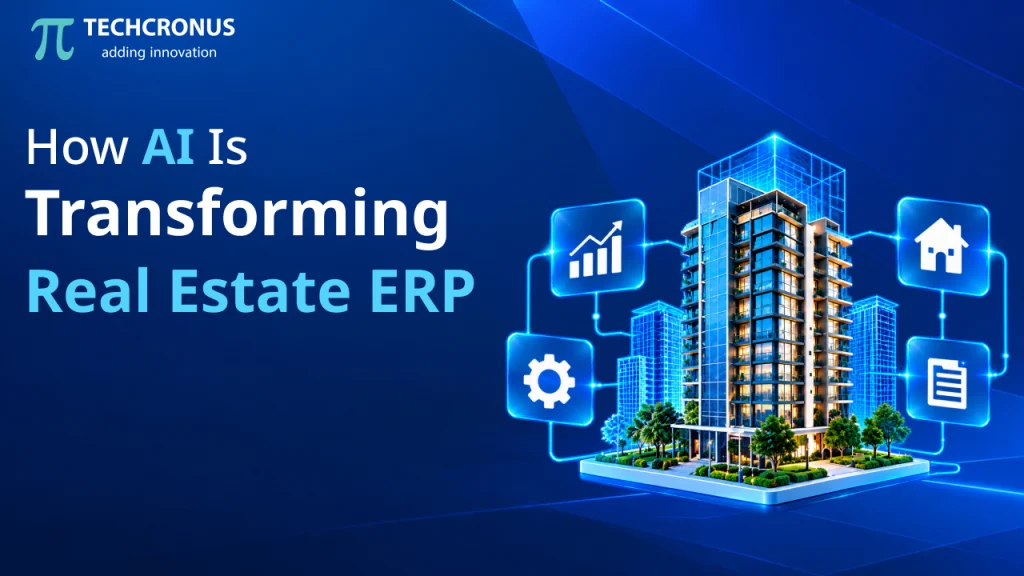
How AI Is Transforming Real Estate ERP
Artificial intelligence provides opportunities that allow real estate businesses to process data in a better way and also assess their performance. Although artificial intelligence is quite flexible and depends on a platform and implementation, some AI applications really suit the purpose of portfolio growth.
Document processing automation: Automatically extract data from invoices, contracts, and other financial documents to minimize manual data entry.
Forecasting cash with predictive analysis: Use past transactions and other available data to generate a cash flow forecast and budget plan.
Smart home reporting: Enable the teams to spot strange spending, identify the trends over time, and detect any potential discrepancies.
Using property and maintenance data: Artificial intelligence may be able to uncover patterns that suggest maintenance of buildings, equipment needs, or other maintenance. Maintenance and repair are part of the operations of a real estate business, but if you use AI, you might also be predicting when maintenance is going to be needed before it breaks down.
Assisting with workflow: Helping with day-to-day tasks like document classification, summary writing, and routing requests to reviewers.
When formulating an AI ERP software strategy, the primary focus should be on clearly identified business objectives – adopting AI solely because it is available is a major pitfall to avoid.
Take, for example, a property management firm that could set up invoice processing as its highest priority, whereas a developer might prefer to focus on project cost forecasting. Besides, an AI ERP software system can be utilized in a way that reinforces the human controls already in place without the need for a human hand in making major decisions.
In other words, AI ERP software can not be just a tool that supports financial processes but opens up the entire range of the company’s applications through data analytics, business process automation, and integrations with other systems. Organizations must ensure that they analyze the quality, ownership (privacy), and security aspects of data as well as the reliability of AI outputs in the production environment before making a decision to deploy these capabilities.
How to Choose the Right ERP for Your Real Estate Business
Choosing the Right ERP for Your Real Estate Business
A careful selection process can help you minimize software implementation risks and guarantee the chosen software aligns with your business strategy in the long run.
1st Step: You are supposed to do a mapping of existing workflows. For instance, explain how management and the different teams interact in terms of accounting, property sales, procurement, project costs, tenant data, and the whole reporting cycle.
2nd Step: Clearly set the requirements that are non-negotiable to you. Divide essential features from the ones that can be added afterwards.
3rd Step: Get all the different costs involved in running the system under one roof. You should consider the price of a license, the cost of the software being installed, and the cost of tailor-made development, integration, employee training, and regular maintenance, as well as an upgrade to the latest software versions.
4th Step: Think over the possibilities for system integration. Figure it out if the system will work together with your present ones of property management, CRM, banking, and data analysis.
5th Step: Make an appointment for the presentation. Order the vendors as well as consultants of their works that may require the installation of software to perform in the demo a variety of business situations, such as checking contractor invoices, for example, or preparing a financial report on the property level.
Step 6: Adoption and Growth Management. Draft a practical rollout strategy taking into account factors like data transfer, system testing, user education, and continuous technical assistance.
Ideally, we should pick a platform that helps with current workflow difficulties AND yet is flexible for expansion.
The objective is to select a platform that solves today’s operational challenges while providing room for future expansion.
Conclusion
Choosing a real estate ERP is an essential part of business growth for those handling growing property holdings, overseeing various projects, and managing increasingly complex financial operations.
Oracle NetSuite, Microsoft Dynamics 365 Business Central, Sage Intacct, Microsoft Dynamics 365 Finance, and Odoo ERP all offer their own unique sets of strong features and tools, which means that it’s really crucial to compare them to your particular business situation and requirements.
If you are after a good balance of flexibility and customisability, then you might find the Odoo solution helpful in being able to integrate accounting, CRM, purchasing, and project management processes. On the other hand, big corporate companies might look for a financial consolidation level of features. If you are mainly focusing on properties, the leasing, tenant management, and maintenance functions might be the ones to consider.
At Techcronus Business Solutions, we aim is actually to assist the real estate businesses with their technology decisions which will best fit their existing workflows, future growth, and major priorities. Through the correct ERP strategy, businesses can enhance the financial transparency, cut the manual work done, and set the grounds for a more scalable portfolio growth.
Looking to adopt a versatile ERP system that matches the unique needs of your real estate business?
Give Techcronus Business Solutions a call and talk about how the new system will change the business operations of your organisation, how you will integrate it with your existing systems, and also find the most suitable ERP solution for your business according to your goals.
FAQs
1. What is a real estate ERP system?
A real estate ERP system integrates essential business functions such as financial management, budgeting, procurement, project tracking, and reporting into one platform. It helps real estate developers, property management companies, and investment firms manage growing portfolios more efficiently.
2. What are the best ERP systems for real estate businesses in 2027?
Some of the leading ERP platforms to consider for real estate businesses in 2027 include Microsoft Dynamics 365 Business Central, Oracle NetSuite, Sage Intacct, Microsoft Dynamics 365 Finance, and Odoo ERP. The right choice depends on portfolio size, financial complexity, customization requirements, and operational needs.
3. How can ERP software benefit real estate companies?
ERP software helps real estate companies centralize financial data, track construction budgets, manage vendor payments, automate workflows, and improve reporting. It also provides better visibility into property-level expenses and business performance as portfolios expand.
4. Which ERP system is best for small and midsized real estate companies?
Microsoft Dynamics 365 Business Central can be a suitable option for small and midsized real estate companies that need integrated financial management, purchasing, budgeting, and reporting. Additional property-specific functionality may require third-party extensions or integrations.
5. Can ERP software manage multiple properties and legal entities?
Yes. ERP platforms with multi-entity financial management and consolidation capabilities can help businesses monitor transactions, consolidate financial records, and compare performance across properties, projects, and business units.