+91 8780928142
 +1 (415) 234 7510
 WhatsApp
 Email
Email

































Table of Contents
Many companies believe their ERP system is doing its job simply because transactions are recorded, and reports are generated. But behind the scenes, outdated ERP systems silently create operational bottlenecks that slow growth.
Industry estimates suggest that inefficient business processes and disconnected enterprise systems can reduce organizational productivity by as much as 20 to 30 percent. In competitive markets, that gap directly translates into lost revenue. Why does this happen? And how Techronus will be your game changer for the overall equipment effectiveness software market for global growth via AI.
The ERP Problem Most Businesses Still Ignore
- Finance teams spend days preparing reports that should take minutes.
- Sales teams work with customer data that never fully connects with operations.
- Marketing teams run campaigns without clear insight into inventory or supply chain realities.
These disconnects cost businesses far more than they realize.
ERP artificial intelligence is transforming passive record-keeping tools into intelligent decision engines. Businesses that fail to modernize risk falling behind competitors who operate with real-time intelligence.
The real shift in 2026 is implementing AI-powered ERP systems that connect CRM platforms. These all with marketing automation tools and operational data into one intelligent ecosystem.
Why Traditional ERP Systems Are Holding Companies Back
Most ERP systems in use today were designed years ago, when business operations were slower and data volumes were smaller.
Today, organizations deal with real-time digital transactions, omnichannel sales, global supply chains and rapidly changing customer expectations. Legacy ERP platforms struggle to keep pace with this complexity.
Common challenges and the following gaps often force employees to rely on spreadsheets and manual workarounds:
- Fragmented data across departments
- Slow financial reporting cycles
- Poor forecasting accuracy
- Lack of real-time operational visibility
- Limited integration with CRM and marketing tools
According to industry studies, employees spend nearly 30 percent of their time searching for or reconciling data across disconnected systems. This is exactly where ERP artificial intelligence platforms begin to deliver measurable advantages.
How AI Is Transforming ERP Systems
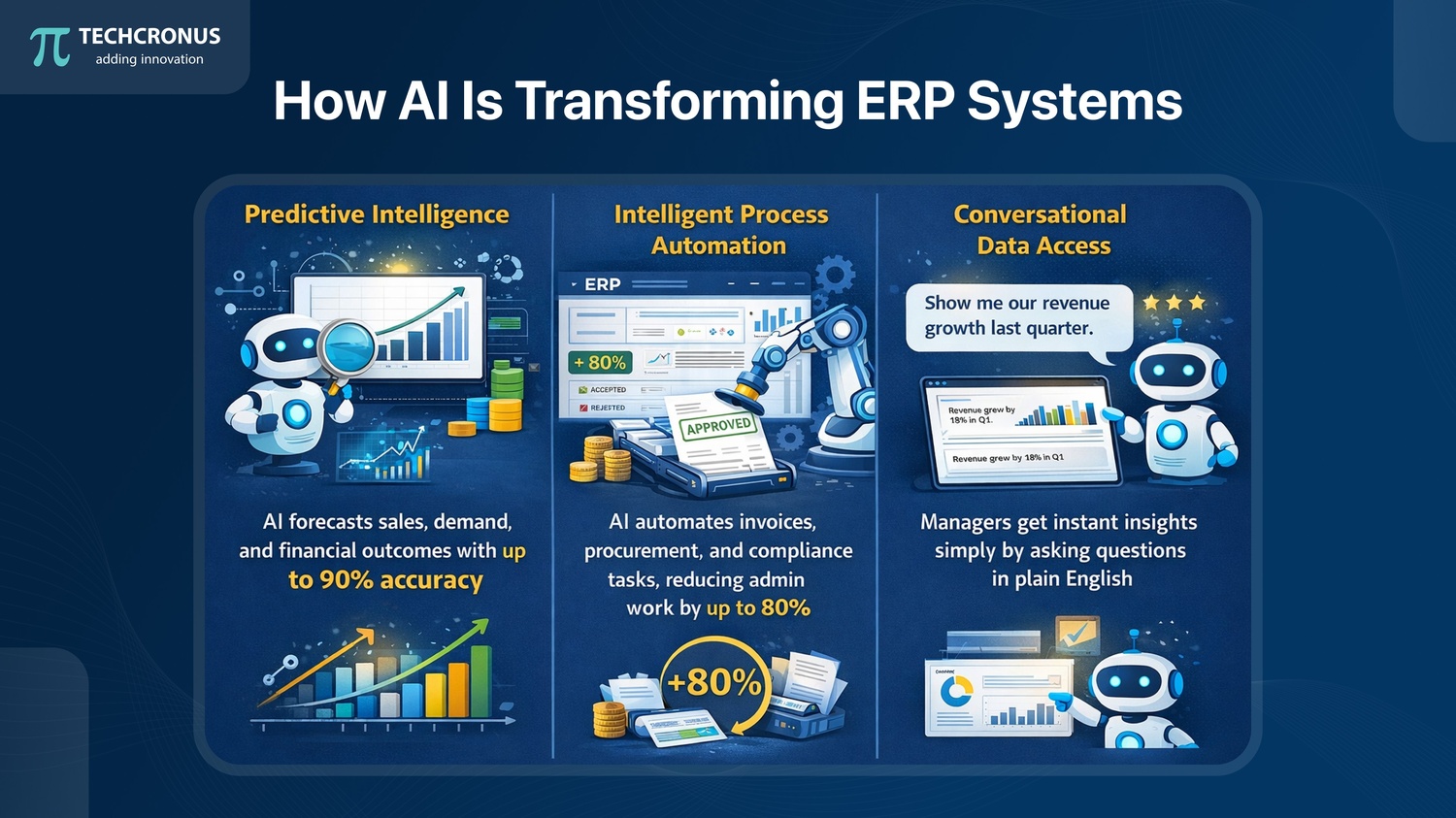
Artificial intelligence in ERP systems is changing how it functions. Instead of simply recording past transactions, modern ERP AI platforms now analyze patterns, detect risks, and guide business decisions.
Three major AI capabilities are driving this transformation via artificial intelligence for enterprise applications:
A) Predictive Intelligence
AI analyzes historical business data to identify trends and forecast outcomes.
Sales forecasting, demand planning, and financial projections become far more accurate when AI models process years of operational data. Studies indicate AI-enabled forecasting models can improve prediction accuracy by up to 90 percent.
For businesses managing complex supply chains or seasonal demand, this level of insight dramatically improves planning.
B) Intelligent Process Automation
Many ERP AI processes involve repetitive administrative work such as invoice approvals, procurement tracking, and compliance reporting.
AI-driven automation can reduce manual workload significantly. In some finance operations, automated invoice processing has reduced administrative effort by as much as 80 percent.
This allows teams to focus on strategic work rather than routine tasks.
C) Conversational Data Access
One of the most powerful improvements in modern artificial intelligence in ERP systems is natural language interaction.
Managers no longer need technical expertise to extract insights. Instead, they can simply ask the system questions and receive immediate data analysis.
This capability dramatically accelerates decision-making across departments.
The Missing Link: ERP, CRM, and Marketing Integration
ERP artificial intelligence systems = ERP connects seamlessly with CRM platforms and marketing automation systems.
Without artificial intelligence for enterprise applications integration, companies operate with incomplete information. Sales teams may close deals without knowing inventory levels. Marketing teams may generate leads that operations cannot fulfill quickly. Customer service teams may lack a complete view of customer transactions.
When AI ERP systems integrate with CRM and marketing automation platforms, businesses gain a single source of operational truth.
This unified data environment allows organizations to:
- Track the complete customer journey from lead to revenue
- Align marketing campaigns with real inventory availability
- Improve demand forecasting using customer behavior data
- Deliver faster and more personalized customer service
For companies aiming to scale operations efficiently, ERP integration is no longer optional. It is essential.
Why Businesses Are Moving Rapidly Toward AI-Driven ERP
The adoption of AI-powered ERP systems is accelerating worldwide.
The global market for AI in ERP systems was valued at approximately 5.8 billion dollars in 2025 and is projected to exceed 58 billion dollars by 2035. This growth reflects how aggressively companies are investing in intelligent enterprise systems.
Cloud deployment is also driving adoption. Over 80 percent of new ERP implementations now use cloud infrastructure, enabling faster integration and continuous system upgrades.
Finance departments are seeing particularly strong benefits. Analysts predict that AI-powered ERP systems could reduce financial closing cycles by up to 30 percent by 2028.
For growing businesses, these improvements directly translate into faster insights, better cash-flow management, and stronger operational control.
Why ERP Modernization Often Fails Without the Right Technology Partner
Despite the clear advantages, many artificial intelligence in AI ERP systems’ modernization projects fail to deliver expected results.
The reason is rarely the software itself. The real problem is poor integration planning of artificial intelligence for enterprise applications.
ERP artificial intelligence systems must connect with CRM platforms, marketing automation tools, e-commerce systems, analytics platforms, and internal databases. This is where specialized enterprise technology partners like Techcronus play a crucial role.
How Techcronus Helps Businesses Build Intelligent ERP Ecosystems
Techcronus focuses on helping organizations move beyond basic ERP deployments toward fully integrated digital ecosystems. The company works with businesses to connect ERP AI platforms with CRM systems, marketing automation software, and data intelligence tools. In short, we ace in the overall equipment effectiveness software market. This approach ensures that every department operates with the same real-time information.
Techcronus services typically focus on three core areas:
- ERP Integration and Customization – Aligning ERP platforms with operational workflows and enterprise data systems.
- CRM and Customer Data Integration – Connecting sales, service and operational insights to build a unified view of customers.
- Marketing Automation Integration – Linking marketing platforms with ERP and CRM systems to create smarter lead generation and customer engagement strategies.
All these together provide your business with an ideal operational environment. Better decision-making becomes significantly faster.
We will also solve your queries like:
- What are the leading ERP systems integrating advanced AI capabilities?
- Best AI-powered ERP platforms for small to medium businesses?
- And compare AI functionalities across leading ERP vendors
The Cost of Waiting
Many organizations postpone ERP artificial intelligence modernization because their current systems appear to function adequately. However, the hidden cost of outdated systems continues to grow.
Competitors who adopt AI-driven ERP platforms gain faster insights, more efficient operations and stronger customer relationships. Over time, this technological advantage compounds. Organizations that invest early in intelligent ERP ecosystems position themselves for faster growth and stronger operational resilience.
The Next Step Toward Intelligent Enterprise Operations
AI is transforming ERP systems from static operational tools into dynamic intelligence platforms. When businesses achieve this integration, the results are immediate:
- faster financial reporting
- stronger sales forecasting
- smarter marketing campaigns
- improved operational efficiency
Most importantly, leadership teams gain clear, real-time visibility into business performance.
For companies planning their ERP AI roadmap for 2026 and beyond, now is the right time. Time to truly be ready with AI in ERP systems, ready for the next phase of digital growth. Learn more about how Techcronus works with businesses to identify these gaps and design ERP ecosystems that support long-term scalability. Let’s take the lead TOGETHER, connect for a free consultation call.