+1 (415) 234 7510
 +971 52 901 6677
 +91 8780928142
 WhatsApp
 Email
Email
































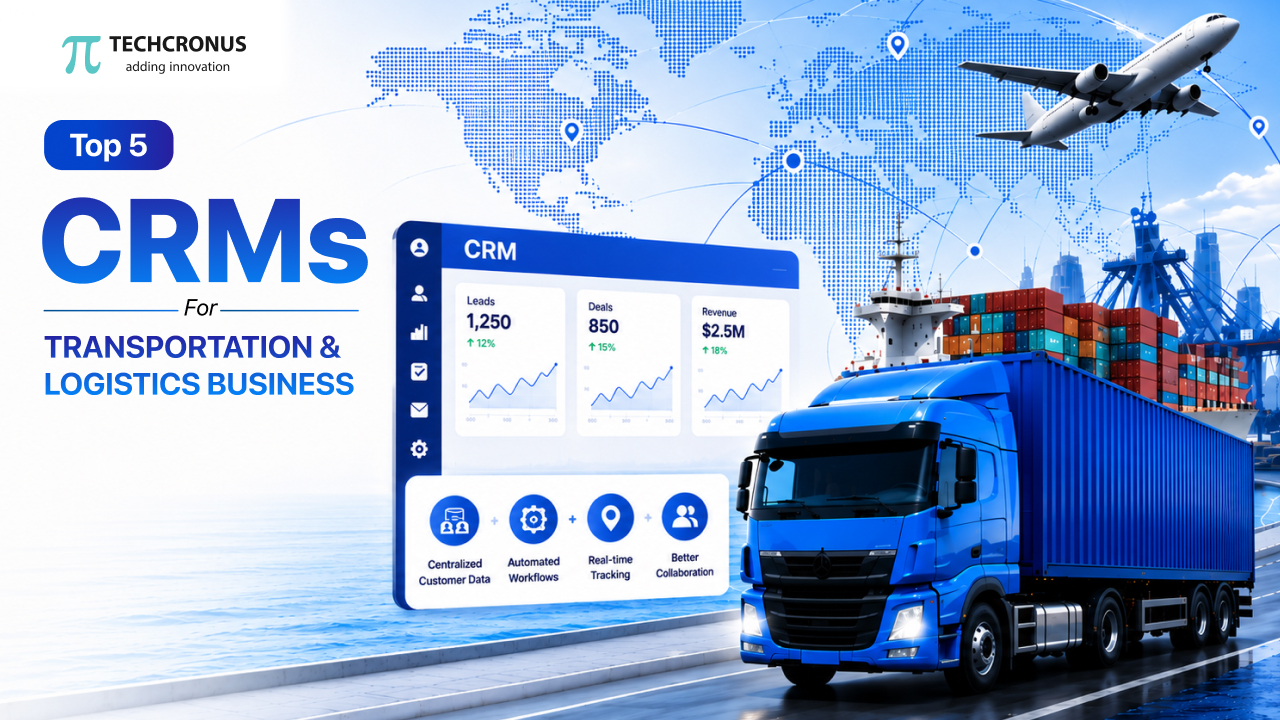
Table of Contents
Running a transportation or freight business relies heavily on logistics. It means juggling multiple shippers, carriers, drivers, and dispatch schedules. Not just that, you have to juggle them all at once. Without proper logistics management, leads slip through and errors happen that can even result in loss of revenue. With a reliable CRM transportation team, you can completely avoid all the hassle and focus on what actually grows your business.
A good logistics CRM keeps more than just contact details. It tracks the shipper-carrier relationship, automates follow-ups, and gives dispatch and sales teams a single source of reliable information. If you are running a small trucking business or a multi-branch freight forwarding business, the right transport CRM can have a direct effect on how fast you close deals and retain customers.
In this article, we’ll break down the top 5 platforms to consider, from global CRM leaders to specialized freight tools, so you can find the right CRM logistics fit for your business.
Why Do Transportation Companies Need a CRM?
Transportation and freight businesses do not work like a typical B2B outfit. They have many more things to juggle when it comes to logistics. A single deal can require the coordinated effort of multiple teams. You cannot rely on simple tools like spreadsheets, emails, and other generic applications and lists to ensure that all these teams are on the same page and that nothing gets lost in the cracks.
A dedicated CRM transport solves all these problems. It centralizes everything from contact details, quotes, load details, communication history, and follow-up tasks all in one place.
This ensures that:
- Your sales team can follow up on leads in a timely manner and not lose any because the information is buried somewhere.
- The dispatch team and the sales team both work from the same data. This eliminates the errors when data is duplicated by them.
- Management and decisions get real-time insight into the pipeline health, win rates, lane profitability, and other data points.
- Onboarding new personnel requires minimal effort. Since all this information is already in the centralized system, you don’t have to go hunting for it.
For transportation or even any company that relies heavily on logistics for a smooth operation, a CRM logistics setup is nonnegotiable. It also makes it much easier to stay on top of at-risk accounts since inactivity and missed follow-ups show up in the dashboard instead of going unnoticed.
Key Features to Look for in a Transportation & Logistics CRM
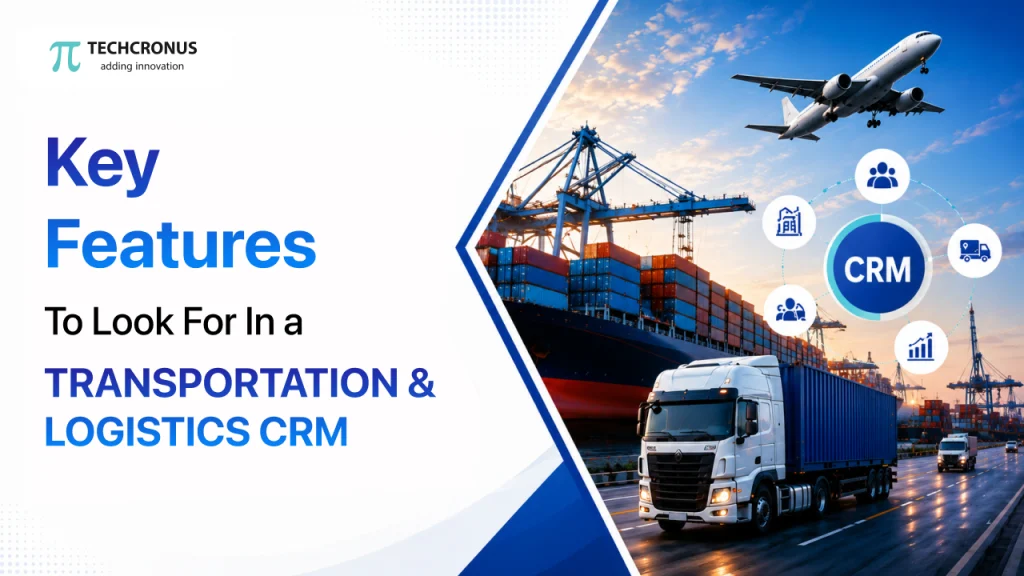
Not every CRM is built with freight and trucking workflows in mind. Before you onboard a platform, check it against the following criteria.
- Shipper and carrier management: Can the system track both parties involved in the shipment, the shipper and the carrier?
- Automation: Does it automate repetitive tasks like quote follow-ups, shipment status updates, and lead reassignment for inactive reps?
- Integrations: Will it connect with the business tools that you’re already using, like your accounting software and communication tools (email, WhatsApp, and SMS)?
- Mobile access: Can dispatchers and reps update records from the road, not just from a desktop?
- Reporting: Does it offer channel-level reporting and specific rep-level reporting, and not just generic sales dashboards?
- Implementation support: Can the CRM software be customised around your sales process, or does it require you to reinvent your process to fit into a rigid template?
Keeping these criteria in mind will make it much easier to compare the CRM options below.
1. Salesforce
Salesforce takes the top spot on this list. As one of the world’s leading CRM platforms, it is trusted by many Salesforce consulting firms to help transportation and logistics companies streamline operations, improve customer relationships, and drive business growth. Its flexibility makes it a strong fit for organizations of every size, from small businesses to large enterprises.
Why it works for transportation & logistics:
- Fully customizable objects and workflows to model shippers, carriers, lanes, and dispatch stages
- AI-powered insights (Einstein AI) for lead scoring and demand forecasting that find patterns and their causes and let you predict outcomes.
- Easily integrates into the business tools you’re already using, like TMS, ERP, and accounting tools via AppExchange.
- Real-time dashboards for tracking sales pipeline, inventory status, and customer satisfaction that show real-time data as it is modified.
Pros:
- It offers good scalability and grows with your business, like fleet size and branch count.
- It offers a large curated catalog of third-party apps.
- Strong reporting and forecasting tools powered by AI so you don’t rely only on charts and other traditional dashboard tools.
Cons:
- Comes at a much higher cost, especially with add-ons
- Requires a certified implementation partner to unlock its full potential in logistics workflows
Pricing: Starts around $25 to $300/user/month (billed annually), depending on edition.
2. Freshsales
Freshsales is a customer relationship management platform from Freshworks that helps businesses manage leads, contacts, deals, and sales activities in one place.
Key features:
- Captures, qualifies, assigns, and tracks leads throughout the sales process.
- Provides Kanban, table, and list views for managing sales activities.
- Allows teams to create deal pipelines and track opportunities across different stages.
- Automates workflows such as lead assignment, deal movement, follow-ups, and invoice reminders.
Pros:
- Easy-to-use interface with straightforward sales management features.
- Strong lead management and sales automation capabilities.
- Integrates well with other Freshworks business tools.
Cons:
- Limited logistics-specific features without customization or integrations.
- Advanced automation and features may require higher-tier plans.
Pricing: Starts at roughly $11/user/month, depending on the plan.
3. HubSpot
HubSpot brings sales, marketing, and service tools together in one interface. This makes it a solid choice for logistics companies that want something more than customer relationship management and logistics processes.
Key features:
- Offers contact management and automatic email tracking.
- Marketing automation for shipper/customer outreach.
- Simple, intuitive interface with a shallow learning curve.
Pros:
- A free tier is available for you to get started.
- Strong marketing automation that is unique.
Cons:
- Lacks logistics-specific features without custom development.
- Costs scale up quickly as contact volume grows.
Pricing: Roughly $15 to $3,600/user/month, depending on tier.
4. Pipedrive
Pipedrive is a sales-first CRM built around visual pipeline management, which suits smaller trucking and freight sales teams that want a simple, no-frills CRM trucking tool.
Key features:
- Drag-and-drop visual sales pipeline.
- Offers activity reminders to keep follow-ups on track.
- Comes with a mobile app for reps and dispatchers on the move.
Pros:
- Affordable and easy to set up.
- Great for teams focused purely on deal tracking.
Cons:
- Limited industry-specific customization for logistics. You have to fit into the template.
- Not built for complex, multi-stakeholder supply chain workflows.
Pricing: Roughly $14 to $129/user/month.
5. Zoho CRM
Zoho CRM rounds out the list as a flexible, budget-friendly option that fits well into a broader Supply Chain Management CRM stack, especially for companies already using Zoho Books, Inventory, or FSM.
Key features:
- Comes with AI-powered analytics (Zia) for lead and deal predictions and in -depth insights.
- Deep integration with Zoho Books, Inventory, and Creator for end-to-end operations.
- Highly customizable modules for shipper, carrier, and vendor records.
Pros:
- Affordable and scalable as the business grows.
- Works well as part of an integrated Zoho One ecosystem (CRM + Books + Inventory + FSM)
Cons:
- It can feel overwhelming initially due to the breadth of features
Pricing: Roughly $20 to $65/user/month.
Quick Comparison
| CRM | Best For | Starting Price | Logistics-Specific Fit |
| Salesforce | Large-scale operations needing deep customization | $25/user/month | High, with configuration |
| Freshsales | Small to mid-sized transportation and logistics companies looking for an affordable CRM with strong sales automation and lead management capabilities | $11/user/month | Moderate |
| HubSpot | Teams that prioritize marketing and lead nurturing over in-depth logistics management | Free trial available | Moderate |
| Pipedrive | Small trucking or freight sales teams | $14/user/month | Moderate |
| Zoho CRM | Budget-conscious companies wanting an all-in-one suite | $20/user/month | High, via Zoho One |
Final Thoughts
There’s no single “best” CRM for the logistics industry. What platform is right for you will depend on things like how big your fleet is, your budget, and how complicated your shipper and carrier workflows are. For more complex and larger operations, Salesforce and Zoho CRM offer more flexibility, while Pipedrive can be a good choice for leaner sales teams. After all, the right CRM is just the beginning. A good way to ensure you get your CRM set up correctly, get the buy-in from your team, and get real value from it within your logistics operations is to partner with an experienced implementation partner like Techcronus Business Solutions Pvt. Ltd.
Frequently Asked Questions
What is CRM in transportation and logistics?
A CRM transportation platform is software for managing customer relationships that is customized to track shippers, carriers, brokers, and other supply chain participants, instead of one generic “customer.” Manages leads, quotes, communication history, and follow-ups specific to freight and trucking sales cycles.
Do small trucking companies need a CRM?
Yes. A CRM trucking tool is a good idea even for a small fleet when leads and repeat shipper relationships start to become too many to track manually. Avoid missed follow-ups with a lightweight CRM like Pipedrive without the overhead of an enterprise platform.
Can I use a general CRM like Salesforce or HubSpot for logistics?
Yes, you can use a general CRM like Salesforce or HubSpot for logistics. But the typical CRM needs to be modified to include logistics-specific data such as lanes, load information, and carrier compliance. This is where working with an implementation partner such as Techcronus Business Solutions Pvt. Ltd. helps, as they configure the platform around your actual workflow and not a generic sales template.
What is the cost of a logistics CRM?
Price ranges from free starter plans (HubSpot) to $25 to $300+/user/month for enterprise solutions (Salesforce). Implementation and customization costs are usually separate and depend on the complexity of your supply chain management CRM requirements.