+1 (415) 234 7510
 +971 52 901 6677
 +91 8780928142
 WhatsApp
 Email
Email




































Table of Contents
Microsoft Dynamics for manufacturing helps manufacturing leaders deliver higher productivity, lower costs, better compliance, and faster innovation without compromising quality. Yet, many process manufacturers still rely on disconnected systems, creating production delays, inventory inaccuracies, quality risks, and poor decision-making.
As the CEO of Techcronus, I’ve worked with manufacturers across multiple industries and geographies. The biggest challenge isn’t adopting new technology; it’s implementing an ERP that truly understands process manufacturing. Disconnected workflows reduce factory productivity significantly.
That’s where MS Dynamics manufacturing becomes a strategic business advantage.
What Is Dynamics 365 For Process Manufacturing?
Dynamics 365 for process manufacturing is Microsoft’s cloud ERP capability within Dynamics 365 Supply Chain Management that helps manufacturers manage formula-based production, batch processing, quality control, inventory, production planning, and compliance finance from a unified platform. It is purpose-built for industries such as food, chemicals, pharmaceuticals, paints, cosmetics, and nutraceuticals where production depends on recipes rather than discrete components.
Microsoft ERP for Manufacturing Industry: Why a Different Approach is Required
Process manufacturing is fundamentally different from discrete manufacturing. Instead of assembling individual components, manufacturers work with:
- Recipes and formulas
- Batch production
- Yield optimization
- Potency management
- Shelf-life control
- Co-products
- By-products
- Regulatory compliance
- Batch traceability
Microsoft Learn explains that process manufacturing is specifically designed for formula-based and batch-oriented production environments rather than traditional bills of materials used in discrete manufacturing.
Consider a beverage manufacturer modifying a single ingredient percentage. That one change can affect:
- Raw material availability
- Batch yield
- Production costs
- Product consistency
- Inventory valuation
- Regulatory compliance
- Customer satisfaction
Traditional ERP systems often require multiple manual updates across departments. Microsoft Dynamics manufacturing eliminates these operational silos. It means connecting formula management, production control, inventory, procurement, and finance quality into a single manufacturing platform built for continuous and semi-continuous production.
Common Challenges Process Manufacturers Face
Before implementing ERP, most manufacturers experience at least one of these operational bottlenecks:
- Recipe and formula inconsistencies
- Poor batch traceability
- Production scheduling conflicts
- Manual quality inspections
- Inventory inaccuracies
- Regulatory compliance risks
- Rising production costs
- Slow decision-making caused by disconnected systems
These challenges often reduce production efficiency while increasing operational risk. Microsoft recommends connecting production, inventory, planning, procurement, quality, and finance AI into a unified manufacturing platform to eliminate data silos.
Industries That Gain The Greatest Competitive Advantage
Dynamics 365 process capabilities are ideal for organizations operating in:
- Food processing
- Beverage manufacturing
- Pharmaceuticals
- Chemicals
- Paints and coatings
- Fertilizers
- Cosmetics
- Personal care
- Industrial lubricants
- Nutraceuticals
Although every sector has unique compliance requirements, successful manufacturers share one common goal:
Complete operational visibility across the production lifecycle.
Essential Features Every Process Manufacturer Should Configure
Buying ERP software is straightforward. Configuring it correctly creates a long-term competitive advantage.
Formula Management
Recipes define production quality. Errors in formulas create waste, inconsistent products, and compliance risks.
Microsoft Dynamics 365 manufacturing enables organizations to manage multiple approved formula versions, percentage-based ingredients, scalable batch quantities, ingredient substitutions, co-products, and by-products from a centralized system.
For example, a pharmaceutical manufacturer producing multiple batch sizes can automatically scale approved formulas while maintaining product consistency and regulatory compliance.
Batch Production Control
Efficient batch planning directly impacts profitability. Poor planning commonly results in:
- Material shortages
- Excess inventory
- Production delays
- Increased waste
- Higher operating costs
Microsoft Dynamics 365 for manufacturing enables planners to create and manage batch orders while maintaining complete traceability throughout the manufacturing lifecycle. Microsoft also supports unified production control, capacity planning, and production status management to improve operational efficiency.
Advantage: Complete Batch Traceability Improves Customer Trust
Co-Products And By-Products
Many ERP implementations underestimate this capability.
Consider edible oil manufacturing. Besides the primary product, valuable secondary outputs are generated. Without proper cost allocation, profitability reporting becomes inaccurate. Dynamics 365 enables structured management of co-products and by-products, improving production costing and financial visibility.
Inventory Visibility Drives Better Decisions
Inventory challenges rarely begin inside the warehouse. They usually originate from inaccurate production planning.
Microsoft identifies real-time inventory visibility as one of the core advantages of modern manufacturing ERP because manufacturers can monitor raw materials, work-in-progress, and finished goods continuously across operations.
Dynamics 365 manufacturing ERP empowers production planners with live inventory data instead of relying on spreadsheets or delayed reports.
For example, if a food manufacturer detects declining stock of a critical ingredient, procurement teams can replenish inventory before production schedules are disrupted. The result is fewer shortages, lower carrying costs, and stronger supply chain resilience.
Advantage: Better Inventory Decisions Reduce Working Capital
Production Scheduling Without Guesswork
Production schedules constantly change because of equipment availability, labor constraints, supplier delays shifting customer demand.
Traditional planning methods struggle to adapt quickly.
Microsoft recommends integrating production scheduling with inventory, machine capacity, demand forecasts planning optimization to reduce bottlenecks and improve resource utilization.
Microsoft Dynamics 365 manufacturing solution synchronizes these business variables, enabling manufacturers to improve delivery performance while reducing operational interruptions.
Quality Management Must Be Embedded From Day One
Quality cannot be treated as a final inspection activity.
It must be integrated throughout production.
Microsoft supports quality management through automated inspections, production monitoring, compliance controls, and manufacturing execution capabilities.
An effective implementation should configure:
- Batch inspection plans
- Quality checkpoints
- Hold-and-release workflows
- Automated alerts
- Compliance documentation
- Product genealogy
These controls reduce recalls, strengthen compliance, and build long-term customer trust.
AI Is Transforming Modern Manufacturing
Manufacturers no longer compete only on production cost.
They compete on intelligence.
Microsoft continues investing in AI-powered planning, forecasting, predictive insights, and operational optimization across Dynamics 365 manufacturing applications, helping organizations improve productivity and decision-making.
Organizations implementing AI-enabled manufacturing today are building faster, smarter, more resilient operations prepared for tomorrow’s competitive landscape.
Is Dynamics 365 Right For Every Process Manufacturer?
Not always.
The best results come when your business has complex production workflows, multiple manufacturing locations, stringent quality requirements, regulatory compliance obligations or growing supply chain complexity.
If your teams still depend on spreadsheets for production planning, inventory reconciliation, batch traceability, or quality documentation, your ERP is probably limiting business growth rather than enabling it.
This is where Microsoft Dynamics 365 process manufacturing becomes a strategic investment instead of simply another software implementation.
Manufacturing Readiness Checklist Before Implementation
Before starting any ERP project, ask these questions:
- Are formulas and recipes standardized?
- Is master data validated?
- Are production workflows documented?
- Have quality checkpoints been defined?
- Are warehouse locations optimized?
- Are costing methods finalized?
- Have user roles been mapped?
- Are regulatory reporting requirements documented?
Organizations completing these steps of Dynamics 365 support services typically experience smoother implementations, lower project risks, and faster user adoption. That’s because configuration reflects real operational requirements rather than assumptions.
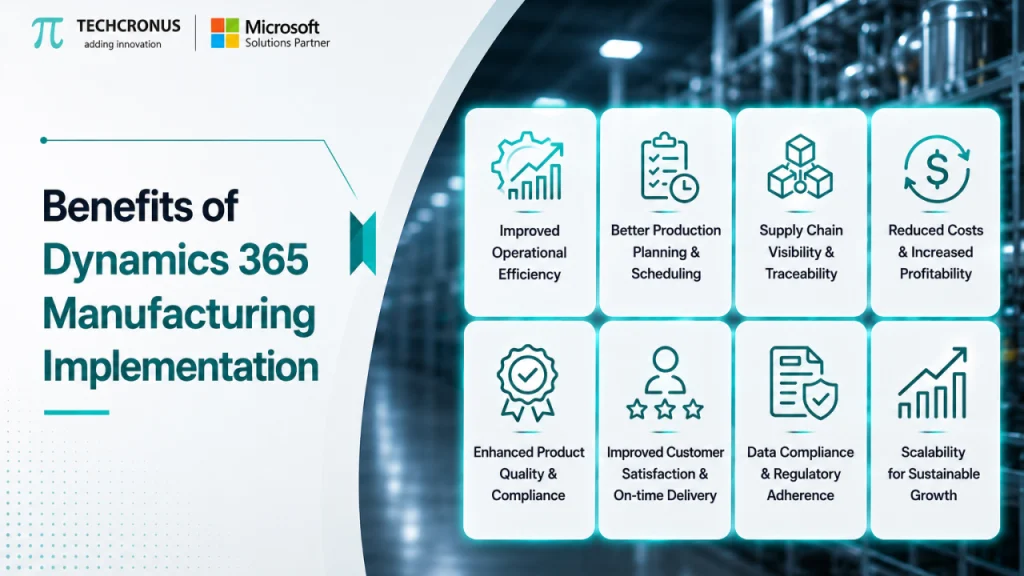
Benefits of Dynamics 365 Manufacturing Implementation
The biggest competitive advantage is having one trusted source of operational data across procurement, production, warehousing, quality, finance customer service.
- Faster production planning
- Lower inventory carrying costs
- Better batch traceability
- Reduced material wastage
- Improved production scheduling
- Higher inventory accuracy
- Faster financial closing
- Stronger regulatory compliance
- Better executive reporting
- Improved customer satisfaction
Regional Considerations For Global Manufacturers: Techcronus Advantage
Companies expanding internationally require localization alongside standardized operations.
- Our arm of Microsoft Dynamics 365 Manufacturing USA helps manufacturers integrate production, finance, warehouse management, and compliance within a unified business platform. As a Microsoft Dynamics 365 partner in Texas, we are supporting scalable operations across multiple facilities.
- Organizations operating in Europe often prioritize sustainability, traceability, and regulatory compliance. Microsoft Dynamics 365 Manufacturing UK supports these objectives through integrated supply chain, inventory, and manufacturing capabilities.
- Manufacturers investing across the Middle East increasingly seek digital factories with resilient supply chains. Microsoft Dynamics 365 Manufacturing UAE enables businesses to modernize production. And MS Dynamics 365 customer engagement is always improving visibility across procurement, operations finance. Businesses beginning Dynamics 365 Manufacturing implementation UAE projects should prioritize localization, tax compliance, multilingual processes and future scalability from day one.
- Growing industrial organizations also benefit from cloud-first manufacturing modernization. Microsoft Dynamics 365 Manufacturing Australia supports distributed operations with connected planning and operational intelligence.
Microsoft Dynamics for Manufacturing Companies: Why Choose Techcronus
- Certified Microsoft Dynamics specialists with manufacturing expertise. We are Microsoft Dynamics partners.
- Global delivery across the USA, UK, UAE, and Australia.
- We are the best Dynamics 365 Consultancy that gives you an industry-first discovery before every ERP implementation.
- End-to-end implementation, migration, customization, ongoing support.
- AI-powered Dynamics solutions for operational excellence.
- Proven methodology minimizes implementation risks significantly.
- Flexible engagement delivering measurable business ROI.
So what are you waiting for? Schedule a free assessment call with us, and we will help you hire Microsoft CRM developers that best suit your ROI needs across the globe.
FAQs
What is the difference between discrete and process manufacturing in Dynamics 365?
Process manufacturing uses formulas, recipes, batch production, co-products, and by-products, potency management, while discrete manufacturing relies on bills of materials and individual units. Microsoft provides dedicated process manufacturing capabilities for batch-based industries.
How long does a Dynamics 365 manufacturing implementation take?
Project timelines vary depending on manufacturing complexity, data quality, integrations, customization, regulatory requirements and user readiness. Microsoft recommends phased implementation, including planning, configuration, testing, migration, training, and controlled go-live.
Which industries benefit most from Dynamics 365 Process Manufacturing?
Food processing, pharmaceuticals, chemicals, paints, cosmetics, nutraceuticals, fertilizers, specialty chemicals beverage manufacturers benefit the most. That’s because they require formula management, batch traceability, and compliance quality control.