+1 (415) 234 7510
 +971 52 901 6677
 +91 8780928142
 WhatsApp
 Email
Email































Table of Contents
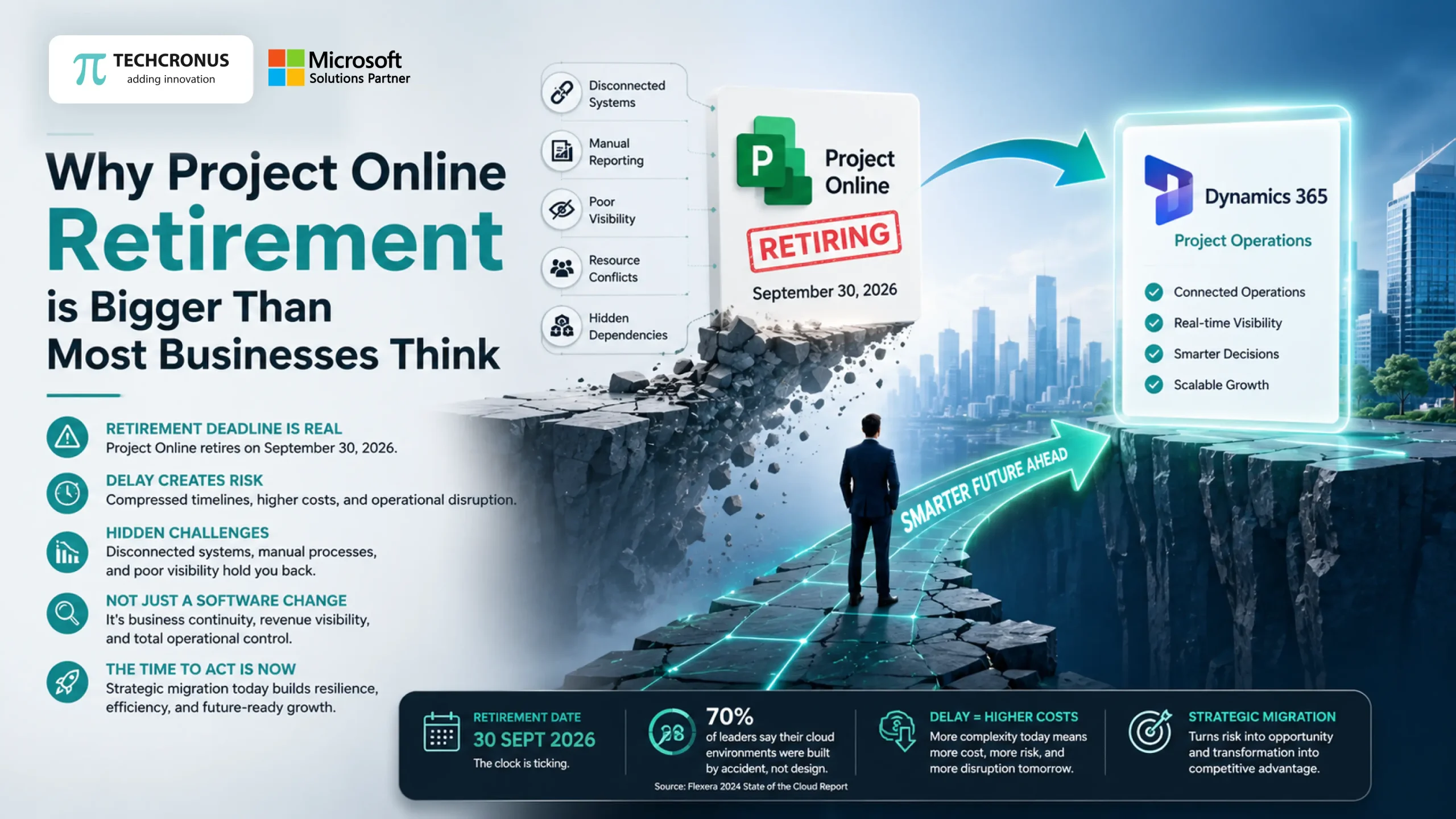
Microsoft has already announced that the new project’s online-only sales ended in October 2025 and official retirement is scheduled for September 30, 2026. For your organization, this means that delaying planning will result in compressed migration timelines.
Your projects are not retiring, your software is.
And for many enterprise leaders across the US, UK, Middle East, Dubai, and Australia, that changes everything.
When Microsoft announced retirement timelines, many organizations treated it as another IT upgrade. That assumption is expensive. Because this is not simply a software replacement. It is business continuity, revenue visibility and total operational control.
Companies delaying Microsoft project online Migration Services are already discovering something uncomfortable: project systems that once worked are becoming barriers to scale.
As founders and digital transformation leaders working with enterprise organizations, we repeatedly see the same pattern. Businesses that plan migration strategically create a competitive advantage. Businesses that wait create operational risk.
Why Business Leaders Are Not Treating This Like A Normal Software Upgrade
Over the past decade, enterprise project environments have evolved from standalone planning tools into operational ecosystems connecting delivery, finance, customers, resources, reporting, and forecasting.
As Microsoft Business Partners, we at Techcronus, have seen organizations across multiple industries discover that migration challenges rarely originate from software.
They originate from disconnected business processes. That is why organizations evaluating Microsoft project online Migration Services increasingly look beyond technical migration and prioritize transformation outcomes.
For leadership teams exploring project online retirement migration, the objective is not merely protecting existing workflows. The objective is to build future operational scalability.
Project Online Retirement: Business Risks Organizations Can’t Ignore
- The retirement deadline is rapidly approaching for organizations
- Legacy workflows face future disruption
- Delayed migrations increase implementation complexity
- Historical project data requires planning
- Resource management visibility may suffer
- Unsupported processes create operational risks
- Manual workarounds reduce productivity significantly
- User adoption challenges grow later
- Integration dependencies require assessment now
- Competitors are already modernizing project operations
The Enterprise Problem Nobody Talks About
Project management software rarely fails dramatically. It fails slowly. Leadership notices:
- Delivery delays increasing
- Forecasting becoming unreliable
- Teams building shadow spreadsheets
- Multiple disconnected systems are emerging
- Resource conflicts are becoming common
- Reporting cycles are becoming slower
These are business growth problems.
Research also shows enterprise modernization challenges are not isolated to project systems. A recent CEO survey found that 70% of leaders admitted their cloud environments were built “by accident rather than design.” And this creates fragmented operational environments that become increasingly difficult to scale.
Organizations increasingly searching for project online replacement solutions are no longer asking: “Which project tool should we buy?”
They ask: “How do we scale operations without creating more complexity?”
What Enterprise Buyers Usually Get Wrong During Migration Planning
Enterprise teams frequently focus heavily on technology selection while underestimating operational dependencies.
- Typical migration mistakes include:
- Migrating bad workflows
- Ignoring reporting dependencies
- Underestimating change management
- Treating migration as only an IT project
- Selecting tools before defining business outcomes
Organizations searching for project online replacement solutions often discover that software comparison alone does not solve operational complexity. Businesses evaluating a project online replacement for enterprises achieve stronger outcomes when migration decisions begin with business objectives rather than product features.
Why Enterprises Are Moving Toward Microsoft Planner & Dynamics 365
Primary Option: Enterprises Are Choosing Microsoft Planner
Modern project teams need more than task management. They need intelligent work management that scales across departments, locations, and business functions.
- AI-powered project planning capabilities
- Unified Microsoft ecosystem integration
- Real-time team collaboration visibility
- Faster project status reporting
- Simplified cross-functional task management
- Future-ready Microsoft-supported platform
- Reduced project administration overhead
Secondary Option: Why Enterprises Are Investing In Dynamics 365
Organizations are increasingly replacing disconnected systems with a unified business platform that combines customer, operational, financial, and service data into a single source of truth.
- Connected customer relationship management
- Automated sales process acceleration
- Real-time business performance insights
- Intelligent workflow automation capabilities
- Scalable enterprise growth foundation
- Advanced Microsoft Copilot integration
- Centralized operational decision-making platform
Sales pipelines, financial systems, resource planning, customer relationships, forecasting, reporting, and even AI-powered automation– all need either of the above now. This is why enterprise buyers are evaluating an online replacement for enterprises
The Question Every CIO is Asking: How to Migrate from Project Online
Migration means protecting operational continuity.
Enterprise migrations usually require:
- Existing project assessment
- Dependency mapping
- Workflow evaluation
- Reporting architecture review
- Integration planning
- User adoption strategy
Organizations attempting migrations without structure frequently experience delays, duplicated systems, budget overruns, and failed adoption. That’s why selecting an experienced project online migration partner like Techcronus matters significantly more than selecting the software itself.
What A Successful Migration Timeline Actually Looks Like
Businesses researching how to migrate from a project online often underestimate timeline complexity.
Most enterprise programs typically include:
Phase 1 — Discovery and dependency mapping
Phase 2 — Architecture planning
Phase 3 — Testing and validation
Phase 4 — Deployment
Phase 5 — User adoption
Phase 6 — Optimization
Organizations working with an experienced project online migration partner typically reduce rework because dependencies are identified earlier rather than during deployment.
Why Planner Alone is Not Always Enough
Many businesses initially consider the project online to planner migration. For smaller teams, Planner can provide excellent collaboration capabilities.
But enterprise environments often require: Multi-region resource planning, portfolio visibility, financial reporting, customer-linked delivery, governance controls and capacity management.
The Financial Reality: Understanding Project Online Migration Cost
Many organizations ask: “What is the migration budget?” That is rarely the correct question.
Better questions include:
- What does delayed migration cost?
- How much is operational disruption cost?
- What do you lose amid duplicated infrastructure costs?
Migration expenses typically include:
- Discovery
- Architecture planning
- Data transformation
- Testing
- Training
- Change management
- Post-launch optimization
Organizations delaying decisions frequently increase total project online migration cost because complexity grows over time. Waiting usually does not reduce spending, rather it compounds it.
What Impacts Enterprise Migration Budgets Most
Businesses delaying decisions often increase overall project online migration cost because dependencies become harder to untangle over time. The largest contributors affecting project online migration cost usually include:
- Number of active projects
- Custom workflows
- Integrations
- Reporting complexity
- Resource structures
- Security requirements
- Geographic operations
A Leadership Guide: Project Online Retirement Checklist of 10 Most Important Aspects
A complete project online retirement checklist prevents businesses from solving only today’s problem while creating tomorrow’s bottlenecks.
- Current project inventory
- Existing customizations
- Integration dependencies
- Reporting architecture
- Security requirements
- Resource structures
- Financial connections
- Governance needs
- User adoption planning
- Future scalability requirements
Why Many Organizations Skip Direct Replacement Approaches
Leadership teams building a project online retirement checklist frequently discover that simply replacing software rarely solves existing operational gaps. Businesses evaluating the project online to Planner Migration often find themselves asking larger questions around forecasting, delivery visibility, financial reporting, and scalability. This is one reason organizations increasingly evaluate connected business platforms rather than direct replacements.
Why Dynamics Migration Is Accelerating Globally
Across the US, UK, GCC countries, Dubai, and Australia, businesses are accelerating cloud modernization programs because operational visibility increasingly influences competitiveness.
Global organizations face additional complexity:
- Multi-country teams
- Regional compliance requirements
- Different currencies
- Distributed resources
- Complex reporting requirements
This is why conversations increasingly focus on Project online to Dynamics migration rather than direct software replacement. Because global operations require integrated ecosystems.
Why Choosing The Right Migration Partner Changes Everything
Without certain capabilities, migration becomes expensive experimentation. With them, migration becomes growth infrastructure. Technology alone rarely causes migration failure. Execution does. A successful project online migration partner like Techcronus always provides:
- Business consulting
- Architecture expertise
- Change management
- Enterprise integration experience
- Adoption frameworks
- Long-term optimization strategies
Why Techcronus Believes That Waiting Creates Larger Problems for Your Business
Businesses investing early in Microsoft Project Online Migration Services create more room for strategic decision-making rather than reactive decision-making. Organizations are starting to grow quickly:
- More flexibility
- Better budgeting control
- Lower operational disruption
- Stronger adoption
If your team is evaluating project online replacement solutions or searching for a trusted project online migration partner, one reality remains constant:
Retirement deadlines create urgency. But helping you with transformation creates an advantage. And we provide you with complete Dynamics 365 Project Operations Services.
Techcronus helps organizations design migration strategies that align project operations with business outcomes rather than simply replacing technology. Schedule A Free Call Today.