+91 8780928142
 +1 (415) 234 7510
 WhatsApp
 Email
Email

































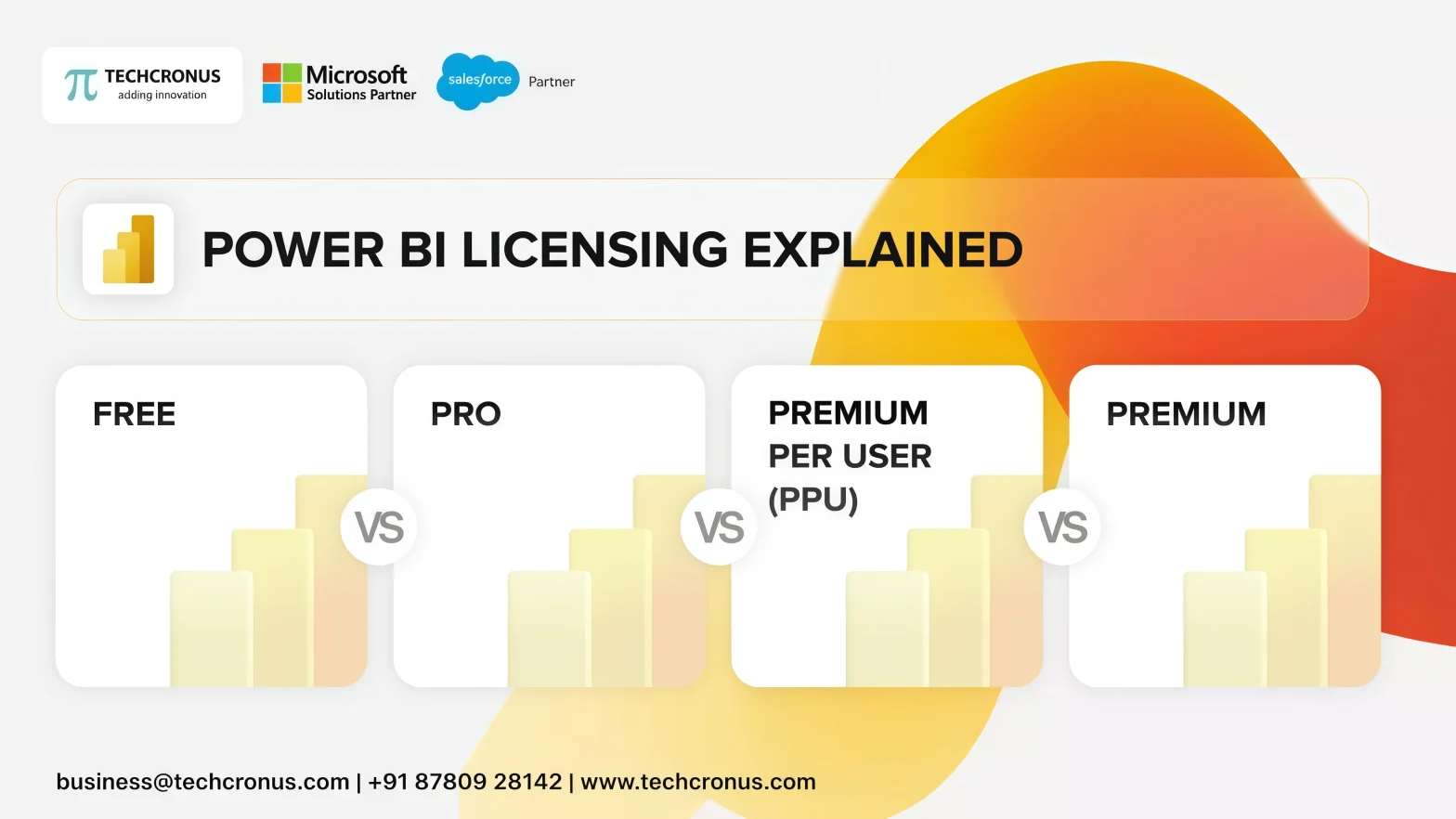
Table of Contents
Power BI has moved from being a simple reporting tool to a core decision-making engine for global businesses. In 2026, organizations are no longer asking if they need Power BI. Rather, they are asking which license actually makes financial and operational sense. Understanding Power BI pricing and licensing is now critical before committing budgets, teams and long-term analytics strategy. Why? We are now sharing some self-explanatory stats on why your business needs Power Bi
Key Power BI Adoption Statistics as of January 2026
- Microsoft Power BI holds roughly 30–36% global BI market share. Techcronus is a leading Microsoft Partner
- Microsoft was named a BI Leader in the 2025 Gartner Magic Quadrant again. And
- 97% of Fortune 500 companies use Power BI today.
- Power BI powers 30+ million active monthly users worldwide.
- Over 78% of enterprises use at least one BI platform.
- BI adoption delivers an average 127% ROI in three years.
- AI-driven analytics tools represent 40% of BI investment in 2025.
So, today we are here to break down real-world differences. We will show case what’s different between Free, Pro and Premium options, with a clear business lens.
Understanding the Real cost of Power BI
Microsoft keeps Power BI pricing intentionally modular. This allows startups, SMBs and enterprises to scale differently. But then, it also creates confusion. The actual cost of Power BI depends on three variables: number of users, data size and collaboration needs.
As of January 2026, Power BI licensing still falls into three practical buckets: Free, Pro and Premium (including Premium Per User). Each serves a very different business intent.
Power BI Free – Best for Learning, Not for Business
Power BI Free remains a zero-cost option. It allows individual users to connect to data sources, build dashboards and explore insights locally.
However, Free stops being useful the moment collaboration begins. Reports cannot be shared securely, scheduled refreshes are limited and governance controls are absent. This makes Free suitable only for personal learning or proof-of-concept work.
When comparing Power BI pro vs Power BI Free: Free is not designed for revenue-impacting analytics.
Power BI Pro – The Collaboration Baseline
Power BI Pro is where real business usage begins. As of January 2026, the cost of Power BI Pro remains approximately USD 10 per user per month in the US and UK, with region-adjusted pricing across the Middle East.
Pro enables:
- Secure report sharing
- Team collaboration
- Scheduled data refresh
- App publishing within organizations
For most SMBs, Pro becomes the default choice. When evaluating Power BI pro vs Power BI Free, Pro clearly wins for any organization beyond a single analyst.
Still, Pro has limitations. Large datasets, AI workloads and enterprise-grade performance can strain Pro-only environments.
Premium Per User (PPU) – Advanced Power for Businesses Without Capacity Costs
Premium Per User (PPU) was introduced for organizations needing advanced features without investing in full Premium capacity. The Power BI pro versus premium per user (PPU) discussion is common among growing tech-driven firms. In practical terms, Power BI pro vs premium per user (PPU) comes down to feature depth versus budget flexibility. PPU costs more per user, but removes many Pro constraints. PPU includes:
- Larger dataset limits
- Advanced AI features
- Enhanced performance
- Enterprise modeling tools
Power BI Premium Capacity – Built to Scale Global Businesses
Power BI Premium is not priced per user. It is priced per capacity. As of January 2026, Power BI Premium costs still begin around USD 4,995 per month for entry-level capacity. You can scale upward based on performance requirements. The Power BI Premium cost makes sense only when hundreds or thousands of users consume reports. This is where Power BI premium vs pro becomes a strategic decision, not a licensing one.
Premium is designed for:
- Large enterprises
- External report distribution
- Massive data models
- High-concurrency environments
Choosing Between Pro, PPU and Premium
Many organizations struggle with Power BI premium vs Power BI Pro because they compare prices instead of outcomes. Pro is user-centric. Premium is platform-centric.
Similarly, Power BI premium vs pro discussions often miss hybrid strategies. Many Techcronus clients use a mix of Pro for general users, PPU for power analysts and Premium for external reporting.
Understanding Power BI premium vs Power BI Pro requires mapping analytics usage to business value, not just headcount.
Common Power BI Licensing Mistakes Businesses Make
Many organizations overpay for Power BI because licensing decisions are made in isolation. Buying Premium without usage analysis often results in underutilized capacity. On the other hand, relying only on Pro can cause performance bottlenecks as data volumes grow.
Another common issue is assigning advanced licenses to casual report viewers. This silently increases the overall cost of Power BI without improving outcomes. Businesses operating across regions also ignore data residency and governance needs, which later forces expensive restructuring.
A well-designed license mix always performs better than a single-license approach.
Global Considerations in the USA, UK and the Middle East
Power BI pricing is consistent globally but applied differently based on compliance, data residency, and cloud regions. Organizations operating across the US, UK and Middle East must factor in governance, performance latency and regional licensing compliance.
This is where working with experienced Power BI consulting firms becomes critical. Licensing mistakes scale fast…and so do costs.
Power BI License Use Cases by Business Size
- Power BI Free is typically used by analysts validating datasets or building prototypes before deployment. It is not suitable for production reporting.
- Power BI Pro works best for internal teams sharing dashboards across sales, finance and operations. This is where most SMB analytics journeys begin.
- Premium Per User fits advanced analytics teams running complex models, AI insights, or large datasets without a full enterprise rollout.
- Power BI Premium is ideal for enterprises distributing reports to thousands of internal or external users while maintaining performance and governance.
Matching licenses to actual use cases reduces waste and improves adoption.
Why Strategy Matters More Than Licensing
Power BI licenses alone do not deliver insights. Architecture, data modeling, security design and performance tuning determine success.
Organizations often overspend on licenses while underinvesting in strategy. Engaging Microsoft Power Platform consulting experts ensures that Power BI integrates properly with Power Apps, Power Automate and enterprise systems.
When Businesses Should Involve Power BI Experts like Techcronus
Power BI becomes complex. That too, when multiple data sources, security roles, and regions are involved. Performance issues, slow refresh cycles and inconsistent metrics are early warning signs of poor design.
Organizations expanding across geographies often struggle. They face issues with governance, access control and cost optimization. At this stage, working with experienced Power BI consulting firms helps avoid issues, especially compliance risks.
Expert-led implementations ensure Power BI scales alongside business growth. Techcronus, like expert firms help it integrate with broader ecosystems and support long-term analytics maturity.
Power BI and Platform Compatibility
Despite demand, Power BI Desktop is still not natively available for macOS. Businesses using Apple ecosystems have to rely on virtualization or cloud access strategies. This makes planning for Power BI for Mac users essential during rollout.
Ignoring platform realities leads to adoption friction….especially in leadership teams.
Final Verdict
The smartest organizations do not ask which license is cheapest. They ask which setup drives faster decisions with lower long-term risk. That is where Techcronus steps in to help businesses align licensing, architecture and outcomes without waste. Connect today to learn more, earn better ROI.