+1 (415) 234 7510
 +971 52 901 6677
 +91 8780928142
 WhatsApp
 Email
Email


































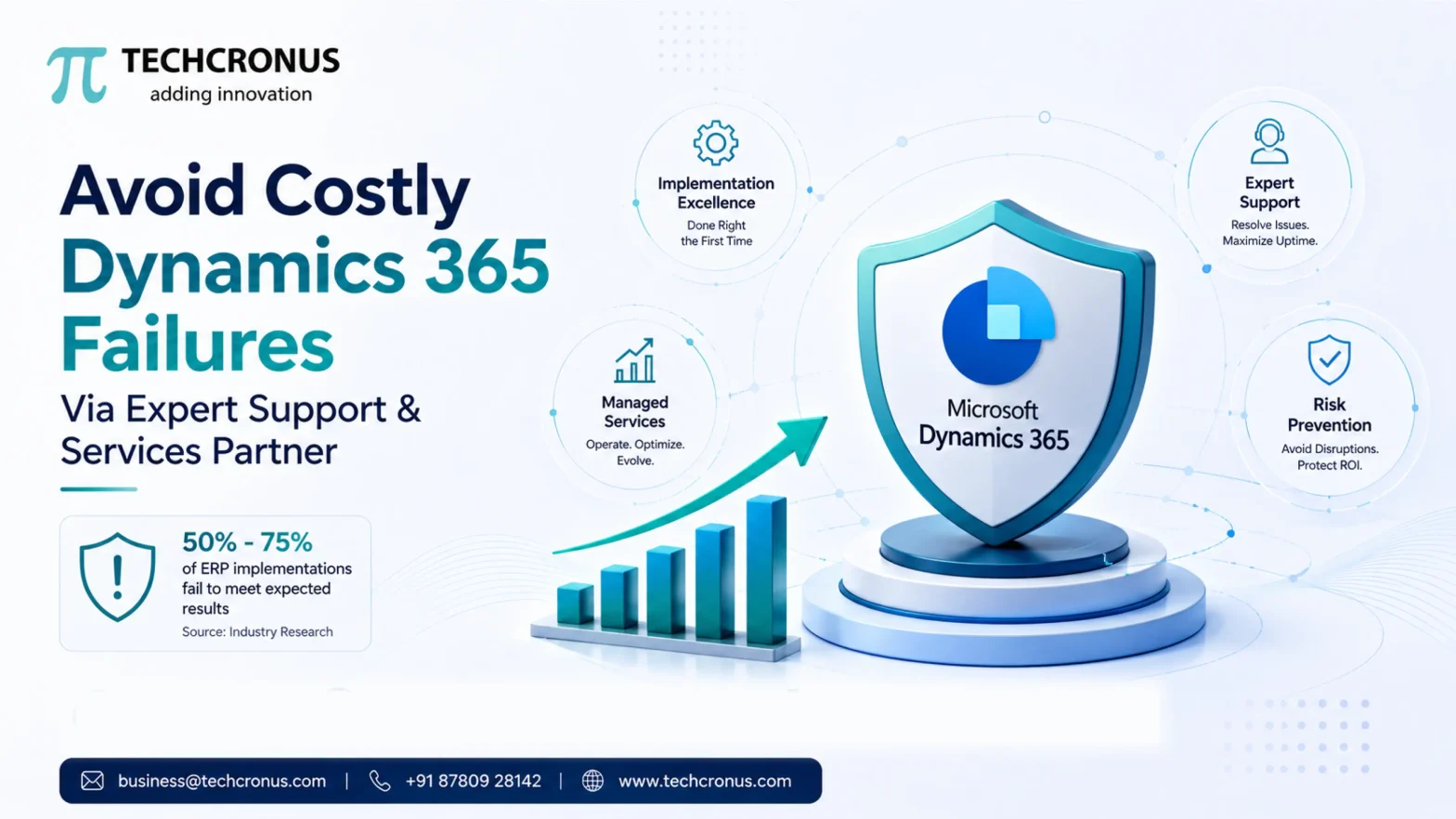
Table of Contents
Across enterprise transformation programs in the US, UK, UAE, Saudi Arabia, and Australia, one pattern is consistently repeating: companies invest in Microsoft Dynamics 365 but fail to realize that successful adoption requires more than deployment. To stop Dynamics 365 failures, organizations must focus on post-implementation support, governance, user adoption, and continuous optimization.
Industry research shows 50%–75% of ERP implementations fail to meet expected results due to scope, integration, and adoption issues. And in almost every case we have seen at Techcronus, the gap is not technology — it is lifecycle ownership.
Today, I will share exactly why enterprises now prioritize a Dynamics 365 managed services partner instead of treating implementation as a one-time IT project.
Dynamics 365 Failure Starts After You Go-live
Most organizations increasingly engage a Dynamics 365 implementation support partner like Techcronus to stabilize systems beyond deployment. Why, because only after they go LIVE does the real risk begin.
The most common failure triggers include:
- Poor data migration quality
- Weak integration architecture
- Lack of a user adoption strategy
- Over-customization of standard workflows
- No structured post-go-live governance
What ERP Failure Actually Costs Enterprises
ERP failure is not a technical inconvenience — it is a financial drain.
Across enterprise benchmarks:
- 70%+ of ERP projects exceed budgets
- 65% miss delivery timelines
- Most incur 20–40% cost overruns due to rework
But the hidden cost is more severe:
- Delayed financial reporting cycles
- Poor forecasting accuracy
- Broken sales pipelines
- Inventory inefficiencies
- Executive decision latency
We recently supported a UK distribution enterprise where the monthly financial close took 14 days due to inconsistent Dynamics data structures. After the structured Dynamics 365 consulting company’s intervention, it was reduced to under 4 days.
Why Implementation Alone is NOT Enough
At Techcronus, we often inherit systems that were “successfully implemented” but are operationally failing within 90 days. That’s because most organizations treat Dynamics 365 as a deployment exercise. But enterprise reality is different.
A successful rollout requires continuous governance across:
- Security roles and compliance
- Release wave updates from Microsoft
- Integration lifecycle management
- Data model evolution
- Business process alignment over time
Without governance, even a perfectly built system decays within 6–18 months. This is why enterprises move toward a Dynamics 365 managed services partner, not just implementation vendors.
Hidden Failure Layer Most Vendors Don’t Talk About
Dynamics 365 consulting companies with lifecycle expertise outperform project-only vendors. Because with Techcronus, you will cut down, three silent risks that still remain:
- Data debt accumulation – Poor master data hygiene compounds over time, breaking reporting accuracy.
- Integration fragility – Each new SaaS tool increases dependency risk across the ecosystem.
- Customization lock-in – Over-customized systems become expensive to upgrade and slow to scale.
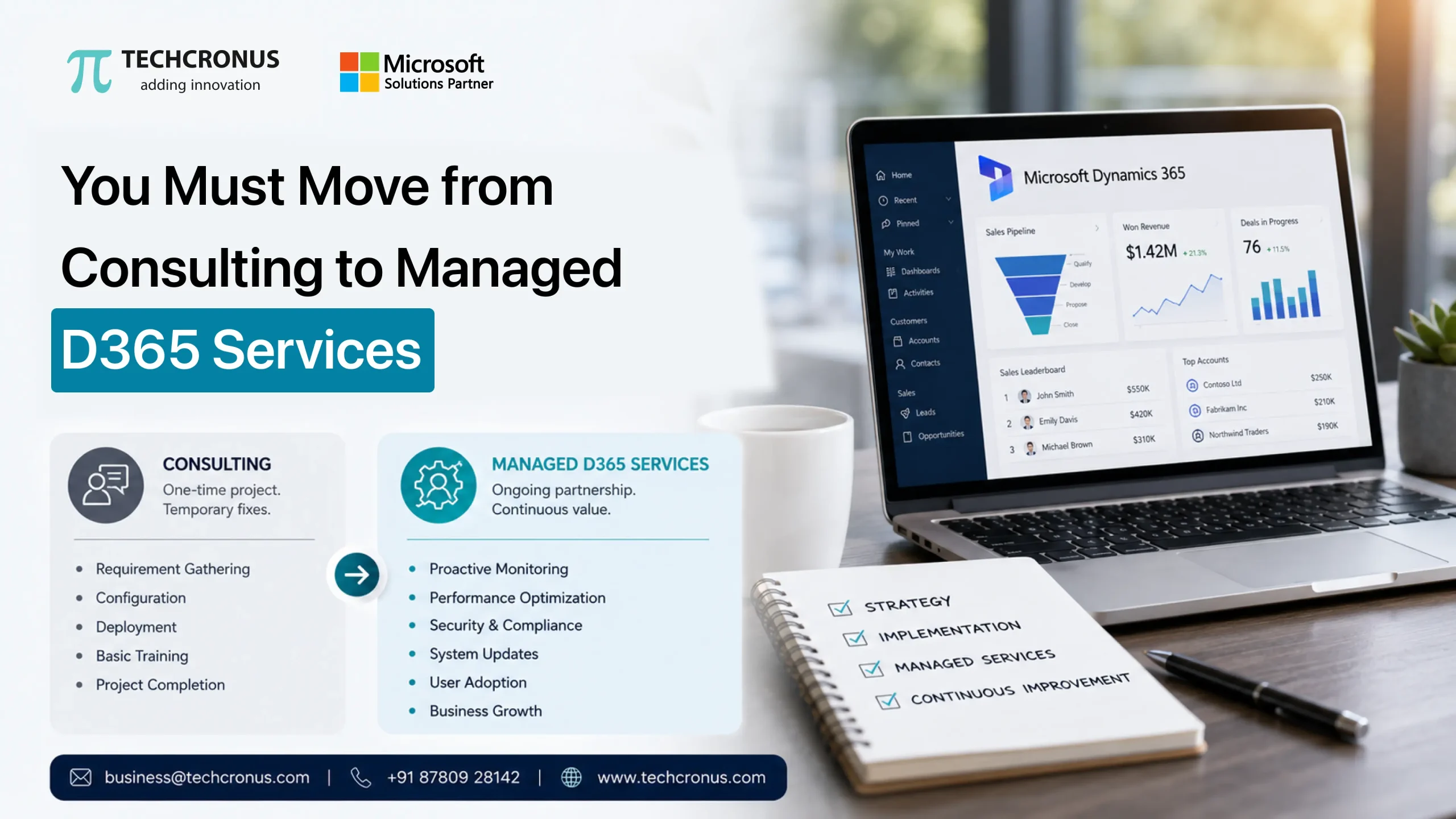 You Must Move from Consulting to Managed D365 Services
Traditional Microsoft Dynamics consulting services focus on delivery milestones:
- Requirement gathering
- Configuration
- Deployment
- Basic training
Microsoft Dynamics consulting models need to extend into lifecycle ownership rather than one-time delivery. Without this shift, organizations accumulate technical debt disguised as “working systems.” Because enterprise reality demands ongoing engineering. Modern Dynamics environments evolve constantly due to:
- Microsoft Copilot AI updates
- Power Platform expansion
- Regulatory compliance changes
- Multi-cloud integrations
Managed Services Protect the Real Enterprise Value
A Dynamics 365 managed services provider in the USA model ensures continuous system health instead of reactive firefighting. Key capabilities include:
- Continuous monitoring of ERP/CRM performance
- Integration failure prevention across enterprise systems
- Security patching and compliance updates
- Cost optimization across Azure and licensing layers
- End-user adoption reinforcement
For example, a logistics enterprise we supported in Texas was losing shipment visibility due to repeated integration failures between warehouse systems and Dynamics 365. After a structured managed services engagement, operational uptime improved from 91% to 99.6% within one quarter.
Techcronus Solves Regional Complexity in Global Rollouts
Dynamics 365 is not a universal template — it behaves differently by region. These regional differences are exactly why generic implementation vendors fail at scale. And we ensure we cut off such things across key locations globally. A few examples are here….
United States
Enterprises require deep integration capability across finance, CRM, and multi-entity reporting. Many specifically seek Dynamics 365 consultants in the US to manage complexity in distributed operations.
- Texas & Virginia (US enterprise hubs)
Large manufacturing and supply chain operations frequently engage
- Microsoft Dynamics implementation partners in Texas
- Dynamics implementation partners in Virginia, like Techcronus, for industry-specific ERP design.
United Kingdom
Compliance-heavy industries demand structured governance. That’s why Dynamics 365 managed services partner UK models are essential for audit readiness and GDPR alignment.
United Arab Emirates
VAT structures, bilingual workflows, and multi-subsidiary reporting require certified expertise. Many enterprises rely on certified Dynamics 365 consultants in the UAE for implementation accuracy.
Why Microsoft Ecosystem Success Depends on Partner Experience
Enterprises increasingly prefer a structured Microsoft Dynamics partner rather than fragmented vendor ecosystems. Microsoft Dynamics 365 is powerful, but complexity scales quickly with:
- Power BI integration layers
- Azure data flows
- Third-party SaaS systems
- Custom APIs across business units
This is whyThe difference is means accountability across the full lifecycle.
How Techcronus Operates Differently
At Techcronus, we don’t position Dynamics 365 as a deployment project. We operate it as a living enterprise system. This hybrid model is why clients engage us as a long-term Dynamics 365 managed services partner instead of switching vendors after go-live.
That means combining:
- Implementation architecture
- Continuous optimization
- Managed services governance
- Industry-specific process design
We also serve as a Dynamics 365 implementation support partner for organizations recovering from failed or partially stable deployments.
ROI Model of Dynamics 365 (Beyond Software Value)
Microsoft reports strong long-term ROI from Dynamics 365 ERP deployments.
But that ROI is only realized when supported by a strong Microsoft Dynamics consulting services ecosystem.Enterprise ROI actually comes from 5 layers:
- 1. Operational efficiency – Automation reduces manual reconciliation effort
- 2. Decision velocity – Real-time dashboards reduce lag in leadership decisions
- 3. Revenue visibility – Sales forecasting accuracy improves pipeline conversion
- 4. Compliance reduction cost – Audit readiness reduces legal and financial risk overhead
- 5. Scalability efficiency – New markets can be added without re-architecture
What High-Performing Enterprises Do Differently
Top-performing organizations design success upfront. For this, they take the following head on…
- Define business process ownership before implementation
- Invest heavily in data readiness (not just migration)
- Align leadership KPIs with system design
- Use phased rollout instead of big-bang deployment
- Maintain continuous partner involvement post go-live
Dynamics 365 consulting services outperform traditional ERP rollouts. In fact, organizations that invest in structured consulting before deployment are significantly more likely to achieve stable ROI within 12–24 months.
The Shift Top-Level Global Leaders Are Making Fast
Enterprise leaders are now focused aggressively on:
- Who ensures it keeps performing at scale?
- How to prevent post-go-live breakdowns?
- Ways to align it with the evolving business strategy?
That is why demand for Dynamics 365 consulting as well as Microsoft Dynamics consulting services and lifecycle-based ownership models is accelerating globally. Even mid-market companies now evaluate vendors based on post-implementation sustainability rather than deployment speed.
In competitive regions like the US, UK, UAE, and Australia, that delay translates directly into lost market advantage. Choosing the right Dynamics 365 managed services partner is NOW…an enterprise survival decision. Schedule a free call to understand how we can help you scale with Dynamics 365 implementation support & services partner.