+1 (415) 234 7510
 +971 52 901 6677
 +91 8780928142
 WhatsApp
 Email
Email
































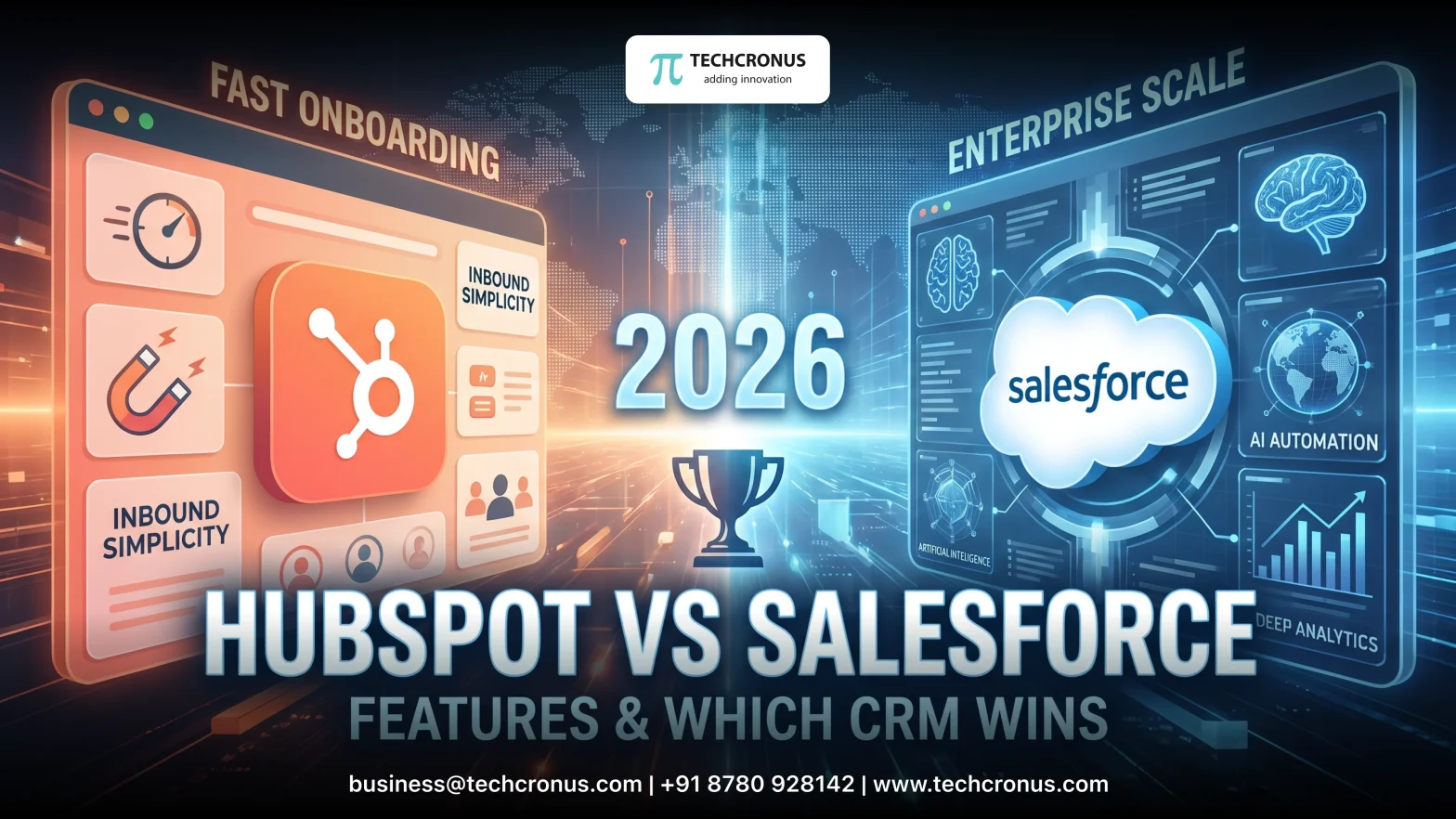
Table of Contents
As the founder of Techcronus, I speak with business owners, CTOs, sales heads, and enterprise leaders across the US, UK, Australia, Dubai, and the Middle East almost every day. The pattern is identical everywhere.
Revenue targets are increasing. Customer acquisition costs are rising. Sales teams are under pressure. Yet most companies are still operating with partitioned systems, disconnected customer data, and an age-old style of reporting.
That is exactly why the debate around HubSpot vs Salesforce has become one of the most important business technology decisions of 2026.
According to Gartner, CRM remains the largest software market globally. On the other hand, Salesforce continues to lead the worldwide CRM market share for enterprise adoption. Statista also projects global CRM software revenue to cross $98 billion in 2026 as AI-driven automation transforms customer engagement.
Why This CRM Decision Will Define Revenue Growth in 2026 And Beyond
At Techcronus, we help businesses avoid following failures through strategic CRM implementation, migration, AI automation, integration and optimization services.
For companies expanding internationally, choosing the wrong CRM can create:
- Slower deal closures
- Poor lead visibility
- Inefficient marketing spend
- Weak forecasting accuracy
- Customer churn
- Sales pipeline leakage
- Team productivity loss
Difference Between The Two CRM Giants
The first question most decision makers ask is the difference between HubSpot and Salesforce.
On the surface, both platforms manage customer relationships, automate sales activities, and centralize customer data. But operationally, they are built for different levels of business complexity.
Many companies researching what Hubspot vs Salesforce is assume both systems deliver identical capabilities. That assumption becomes expensive later.
HubSpot focuses heavily on simplicity, faster onboarding, intuitive dashboards, and inbound marketing alignment.
Salesforce focuses on enterprise scalability, customization depth, workflow complexity, AI intelligence, and large-scale operational control.
Another common question we hear is whether HubSpot is like Salesforce when companies prepare for rapid international expansion.
The answer depends entirely on:
- Team size
- Sales complexity
- Compliance requirements
- Reporting expectations
- Integration ecosystem
- Global expansion plans
- AI adoption goals
Businesses with simple sales workflows often adopt HubSpot faster. Enterprises managing multiple departments, territories, approval systems, and partner networks usually lean toward Salesforce.
HubSpot CRM vs Salesforce CRM: Which Performs Better?
The comparison between Hubspot CRM vs Salesforce CRM becomes critical when leadership teams focus on scalability.
HubSpot CRM Strengths
HubSpot performs exceptionally well for:
- Growing startups
- Mid-sized businesses
- Inbound marketing teams
- Fast onboarding environments
- Simpler sales pipelines
- Lower technical dependency
- Its interface is cleaner, so training time is lower
- Adoption rates are usually faster.
For companies building lean revenue operations, HubSpot often creates faster execution.
Salesforce CRM Strengths
Salesforce dominates in:
- Enterprise automation
- Multi-country operations
- AI-powered forecasting
- Deep workflow customization
- Advanced analytics
- Large sales organizations
- Compliance-heavy industries
This is why large enterprises across the US, UK, Dubai, and Australia continue investing heavily in Salesforce ecosystems.
At Techcronus, we frequently implement Salesforce for businesses managing complex B2B customer journeys. The second comparison around Hubspot vs Salesforce CRM usually appears when businesses outgrow entry-level CRM systems and require deeper operational intelligence. That transition stage is where many companies lose momentum because their CRM no longer supports scale.
Marketing Automation Battle: Salesforce Marketing Cloud vs. HubSpot
Marketing leaders constantly compare Salesforce Marketing Cloud vs. HubSpot when planning customer acquisition strategies. Both platforms offer automation. But their execution models differ significantly.
| Feature Area | HubSpot | Salesforce Marketing Cloud |
| Ease of Use | User-friendly dashboard with faster onboarding for sales and marketing teams | Enterprise-grade interface designed for large operational environments |
| Best Fit | Startups, SMBs, and growing businesses | Mid-size to enterprise organizations with complex workflows |
| Campaign Automation | Simple workflow automation and lead nurturing | Advanced AI-powered omnichannel automation |
| Personalization | Basic to mid-level personalization capabilities | Real-time enterprise personalization with predictive AI |
| Email Marketing | Easy drag-and-drop campaign builder | Highly customizable enterprise email orchestration |
| Customer Journey Mapping | Simplified automation journeys | Deep multi-touch customer journey orchestration |
| Analytics & Reporting | Easy-to-read dashboards and reports | Advanced enterprise analytics with predictive forecasting |
| Integration Ecosystem | Faster integration with common business apps | Extensive enterprise integrations and API flexibility |
| AI Capabilities | AI-assisted content and workflow recommendations | Einstein AI-driven predictive insights and automation |
| Scalability | Ideal for growing businesses with lean teams | Designed for global multi-region scalability |
| Technical Dependency | Lower setup complexity and minimal technical expertise needed | Requires experienced implementation and CRM consultants |
| Cost Structure | More affordable for growing companies | Higher investment with enterprise-grade capabilities |
| Deployment Speed | Faster implementation and team adoption | Longer implementation due to customization depth |
| Sales & Marketing Alignment | Strong inbound marketing alignment | Advanced enterprise-wide customer engagement management |
| Global Enterprise Readiness | Better for fast-growing companies entering digital sales | Stronger for enterprises handling global customer operations |
This comparison matters massively in competitive global markets. Consumers in the Middle East, the UK, and Australia increasingly expect personalized digital experiences. Businesses failing to deliver that personalization lose conversions quickly.
The second discussion around HubSpot vs Salesforce Marketing Cloud often happens when businesses scale internationally and require stronger automation maturity.
At Techcronus, we help organizations build advanced CRM and marketing ecosystems that align sales, support, and customer engagement into one connected growth engine.
Pricing Reality: What Most Businesses Get Wrong
One of the biggest mistakes companies make is evaluating CRM software only through licensing costs.
Questions around Salesforce vs. HubSpot pricing dominate early discussions. But software cost alone means nothing. The real investment includes:
- CRM implementation
- Data migration
- Workflow automation
- API integrations
- Team onboarding
- AI enablement
- Reporting configuration
- Ongoing optimization
A cheaper platform that limits scalability becomes expensive later. Similarly, an enterprise CRM without proper adoption becomes a wasted investment.
The second comparison around Hubspot vs Salesforce pricing usually emerges after companies realize operational inefficiencies are costing more than software subscriptions. That is why Techcronus approaches CRM consulting from a revenue perspective.
Can Salesforce and HubSpot Work Together?
Many growing organizations now use Salesforce and HubSpot together to balance enterprise sales management with flexible inbound marketing. At Techcronus, we specialize in integrating platforms into unified digital ecosystems instead of isolated software silos. That integration-first mindset helps global businesses operate faster and smarter.
This hybrid strategy helps businesses:
- Improve lead visibility
- Align sales and marketing teams
- Centralize reporting
- Strengthen nurturing workflows
- Increase customer retention
- Accelerate pipeline conversion
Hubspot Versus Salesforce: Which CRM Actually Wins?
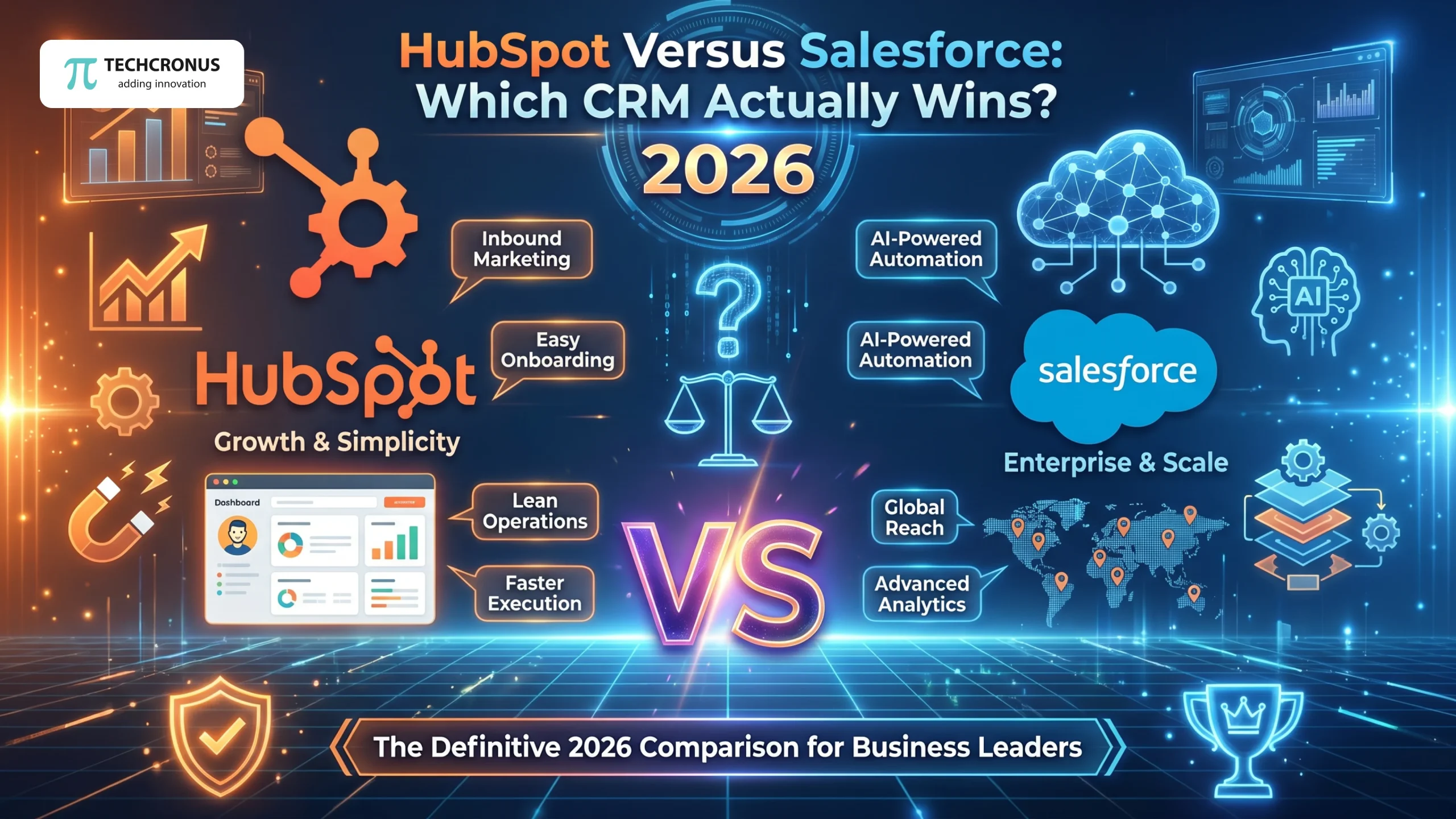
The winner depends on your growth stage. The debate around HubSpot versus Salesforce should never be reduced to feature lists alone.
HubSpot can deliver strong results if your business prioritizes:
- Faster onboarding
- Simpler execution
- Lean sales operations
- Inbound marketing
- Lower technical dependency
Salesforce usually becomes the stronger long-term investment if your organization requires:
- Enterprise scalability
- AI-driven automation
- Multi-region workflows
- Complex reporting
- Deep integrations
- Advanced forecasting
Is HubSpot similar to Salesforce?
Yes, both platforms solve CRM challenges. But they solve them differently.
HubSpot prioritizes usability.
Salesforce prioritizes enterprise flexibility.
The second question around – is Hubspot similar to Salesforce – usually appears when businesses begin evaluating AI forecasting, global customer engagement, and advanced sales intelligence. That is where implementation expertise becomes more important than software selection itself.
Why Businesses Choose Techcronus for CRM Transformation
Among the top global Salesforce consulting firms, at Techcronus, we deploy CRM tools to engineer revenue ecosystems. Whether you need a Salesforce consultant Dubai or any other region, our teams help businesses across the US, UK, Dubai, Australia, and the Middle East with:
- CRM consulting
- Salesforce implementation
- Hubspot implementation
- AI workflow automation
- CRM migration
- Third-party integrations
- Marketing automation
- Sales pipeline optimization
- Business intelligence dashboards
- Ongoing CRM support
We focus aggressively on revenue acceleration. Because in 2026, companies that fail to modernize customer engagement systems will lose market share faster than ever before.
The businesses winning globally are already using AI-powered CRM ecosystems to:
- Predict buying behavior
- Improve conversion rates
- Automate lead nurturing
- Personalize engagement
- Reduce operational costs
- Increase sales velocity
The CRM decision you make today will directly influence your revenue growth for the next decade. And that decision deserves a strategic technology partner that understands both business growth and enterprise execution. Connect for a Free Consultation Call, and we will help you scale your business like no other.