+1 (415) 234 7510
 +971 52 901 6677
 +91 8780928142
 WhatsApp
 Email
Email


































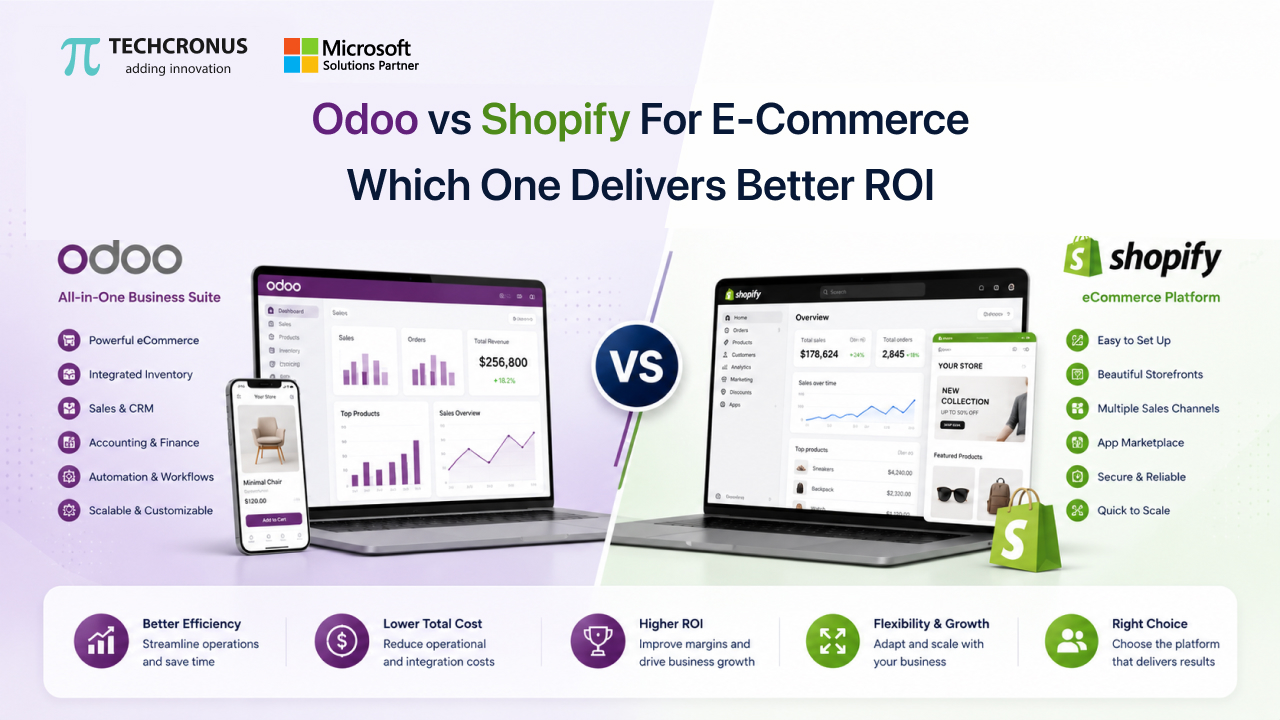
Table of Contents
In today’s eCommerce market, choosing the wrong platform can quietly destroy margins. It can also create operational bottlenecks. Results in slow growth long before leadership teams recognize the problem.
The debate around Odoo vs Shopify is now about revenue growth, operational efficiency, scalability, customer experience, inventory visibility, and long-term return on investment.
Business leaders across the US, UK, Australia, UAE, Saudi Arabia, Qatar, Bahrain and Oman are facing the same challenge: how to scale online sales without creating disconnected systems that become expensive to maintain.
- According to Shopify, merchants generated over $292 billion in GMV during 2024 through the Shopify ecosystem.
- Meanwhile, Odoo reports more than 12 million users globally and over 50,000 online websites running on its platform.
These numbers prove that both platforms are capable. Now the real question is which platform delivers sustainable growth for your business model? Let’s solve this puzzle today.
Key Challenges Growing eCommerce Businesses Face
United States
Many American retailers struggle with fragmented technology stacks.
Their online store, CRM, accounting software, inventory systems, marketing tools, and customer support platforms operate separately. This often creates data silos and operational delays.
United Kingdom
UK businesses face increasing compliance requirements. There are VAT complexities and inventory management challenges. There is always immense pressure to improve customer experiences without increasing overhead.
Australia
Australian companies often manage distributed operations across large geographical regions. Inventory visibility, warehouse synchronization, and fulfilment efficiency become significant growth barriers.
UAE and Dubai
Businesses in Dubai and the wider GCC region are experiencing rapid digital commerce growth. Many retailers need multilingual storefronts, multi-currency support, B2B portals, and centralized operational control.
So, all the above challenges directly influence the result of any Odoo vs Shopify eCommerce comparison.
Why Growing Businesses Eventually Outgrow Shopify
Many businesses start successfully with Shopify Development Services. However, growth introduces operational complexity.
As product catalogues expand, warehouses multiply, and B2B sales emerge. Then, financial reporting requirements increase. And businesses often find themselves managing multiple applications instead of one integrated ecosystem.
Common growth-stage challenges include:
- Rising monthly app subscription costs
- Limited ERP capabilities
- Duplicate data across systems
- Inventory synchronization delays
- Complex reporting requirements
- Increasing integration maintenance
Now, here Odoo becomes attractive. Instead of connecting multiple third-party systems, businesses can operate eCommerce, CRM, inventory, accounting, purchasing, customer service, and reporting within a single platform
Odoo vs Shopify: ROI Factors Business Leaders Should Evaluate
Most platform comparisons focus on features. Executives focus on profitability.
When evaluating platform ROI, leadership teams should actually assess:
| Business Area | Shopify Approach | Odoo Approach |
| CRM | Separate apps | Native module |
| Inventory | Additional tools | Native module |
| Accounting | Third-party integration | Native module |
| Procurement | External systems | Native module |
| Manufacturing | Limited support | Native module |
| Reporting | Multiple data sources | Unified database |
For businesses planning aggressive expansion, reducing software fragmentation can significantly improve operational efficiency and long-term ROI.
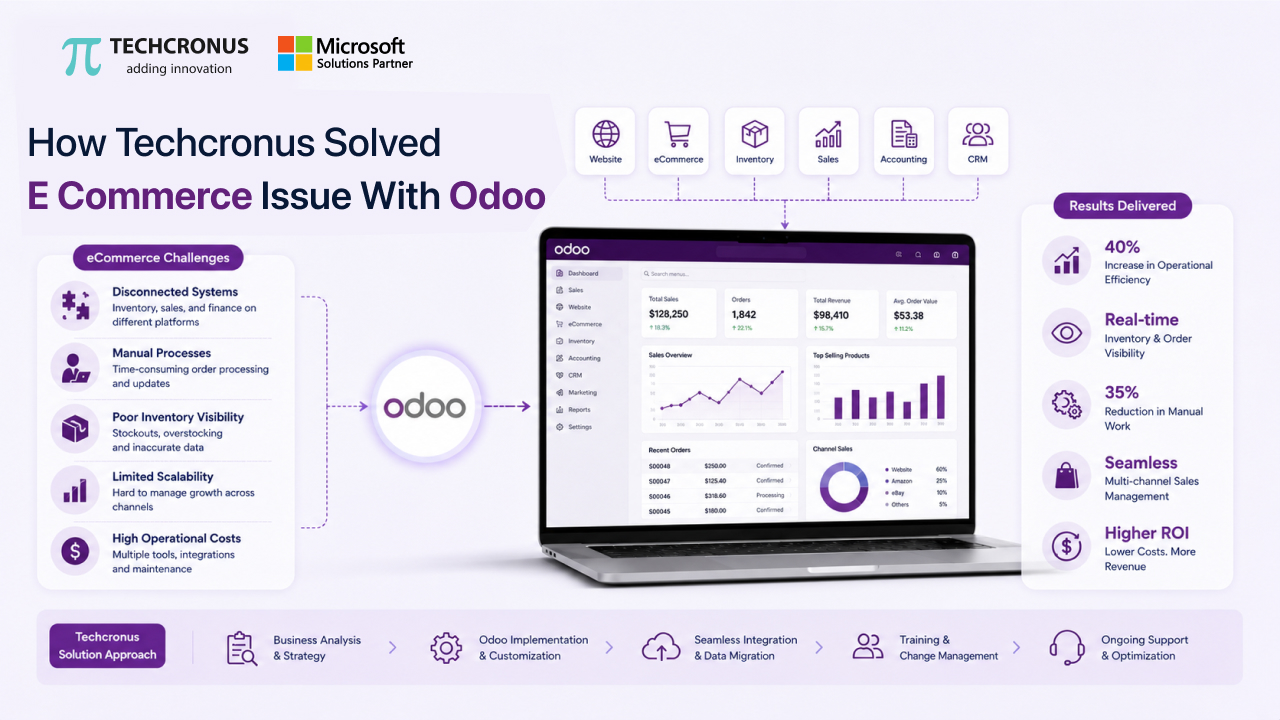
Techcronus Solution Framework for Your Business
At Techcronus, we help businesses evaluate platform decisions based on business effects rather than software popularity.
Our approach includes:
-
Business Discovery
Understanding revenue goals, operational workflows, customer journeys, and growth targets.
-
Software Architecture Assessment
Evaluating whether a business requires a storefront platform, a full ERP ecosystem, or a hybrid approach.
-
Odoo Implementation Strategy
Designing integrated ecosystems covering:
- eCommerce
- CRM
- Inventory
- Accounting
- Procurement
- Manufacturing
- Customer Service
- Continuous Optimization
Improving performance, automation, analytics, and customer experience after launch.
How Techcronus Solved eCommerce Issues with Odoo
US Retail Distributor
Odoo vs Shopify for US eCommerce businesses increasingly means prioritizing operational integration.
A growing distributor struggled with inventory discrepancies across three warehouses. Following an Odoo implementation, inventory, sales, purchasing, and fulfillment were unified within a single platform. This reduced manual reconciliation and improved operational visibility.
UK Wholesale Business
A wholesale supplier faced challenges managing tiered pricing, VAT reporting, and B2B customer portals. By consolidating processes into Odoo, the company streamlined customer management and reduced administrative overhead.
This scenario highlights key differences in Odoo vs Shopify UK eCommerce evaluations.
Australian Multi-Location Retailer
An Australian retailer operating nationwide required centralized inventory management and synchronized warehouse operations. Odoo’s integrated architecture helped eliminate inventory blind spots and improve fulfilment performance across locations.
Dubai Omnichannel Brand
A rapidly growing retailer needed multilingual commerce, B2B sales capabilities and centralized business management. The implementation supported regional growth objectives while reducing reliance on multiple disconnected applications.
This reflects a common consideration in Odoo vs Shopify for Dubai online store projects.
Benefits of Choosing Odoo for Long-Term Growth
When businesses reach operational maturity, Odoo often provides advantages that extend beyond online selling.
Key benefits include:
- Unified business platform
- Native CRM functionality
- Integrated accounting
- Advanced inventory management
- Multi-warehouse support
- Manufacturing capabilities
- Procurement automation
- Strong customization flexibility
Organizations evaluating Shopify vs Odoo scalability for enterprise requirements frequently prioritize these capabilities when planning long-term expansion.
Technology and Implementation Insights
Technology alone does not create ROI; its business alignment does. A successful implementation requires more than software deployment.
Businesses should evaluate:
- Data migration complexity
- Change management requirements
- User adoption planning
- Process redesign opportunities
- Integration architecture
- Reporting requirements
Signs Your Business Is Ready for Odoo
Your organization should consider Odoo if:
- You operate multiple warehouses
- Selling happens through B2B and B2C channels
- More than five disconnected business applications
- Require real-time operational reporting
- Manage international operations
- Need CRM, accounting, inventory, and eCommerce under one platform
Executive Summary – Odoo vs Shopify at a Glance
Decision-makers often want answers before details.
| Business Priority | Shopify | Odoo |
| Fast Store Launch | Strong | Moderate |
| ERP Integration | Limited | Excellent |
| Inventory Management | Basic to Moderate | Advanced |
| Multi-Warehouse Operations | Add-ons Required | Native |
| Manufacturing Businesses | Weak | Strong |
| B2B Commerce | Shopify Plus | Native |
| Custom Workflows | Limited | Highly Flexible |
| Long-Term ROI | Moderate | High |
Future Trends Shaping eCommerce
The future of commerce extends far beyond online storefronts or ODOO ERP for small businesses
Businesses increasingly require:
- AI-powered operations
- Predictive inventory planning
- Real-time analytics
- Unified customer data
- Omnichannel experiences
- Automated workflows
Those doing Odoo vs Shopify eCommerce comparison results are increasingly prioritizing platform ecosystems rather than standalone eCommerce functionality.
According to IBM research, organizations using AI-driven business processes continue to increase operational efficiency and decision-making speed.
Why Techcronus for Odoo Implementation & Services
Selecting between Odoo and Shopify options is ultimately a strategic business decision.
Techcronus has helped organizations worldwide modernize business operations through ERP, eCommerce, cloud, AI, analytics, and enterprise application services. Our teams work with clients across retail, manufacturing, distribution, healthcare, logistics, education, finance, and professional services.
What differentiates Techcronus from Other Software Partners:
- Proven global delivery capability as the among the top ODOO ERP CUSTOMIZATION COMPANY
- Deep Odoo expertise in Odoo customization services
- Business-first implementation approach during Odoo implementation services
- Strong focus on ROI while implementing Odoo development services
- Scalable enterprise architecture
- Long-term technology partnership mindset
E-commerce is Scaling, Where Are You?
The answer to Odoo vs Shopify depends on your growth objectives.
Are you still assessing:
- Odoo vs Shopify for US eCommerce businesses?
- Odoo vs Shopify UK eCommerce?
- Odoo vs Shopify for Dubai online store initiatives?
We will share which platform helps your entire business scale profitably. We will also help you implement, customize, and optimize the right Odoo strategy for measurable business ROI and long-term competitive advantage. Schedule a free call today.
Frequently Asked Questions (FAQs)
1. Which is better for growing businesses: Odoo or Shopify?
The answer depends on your business goals. Shopify is ideal for businesses that want to launch an online store quickly with minimal setup. Odoo is better suited for growing businesses that need an integrated ERP solution combining eCommerce, CRM, inventory, accounting, purchasing, manufacturing, and customer service on a single platform.
2. What are the main differences between Odoo and Shopify?
The biggest difference is their scope. Shopify is primarily an eCommerce platform, while Odoo is a comprehensive business management suite. Odoo offers built-in ERP modules for finance, inventory, CRM, HR, manufacturing, and procurement, whereas Shopify often requires third-party apps for similar functionality.
3. Is Odoo a better choice than Shopify for enterprise businesses?
For organizations with complex operations, multiple warehouses, B2B sales, or international expansion, Odoo is often the better choice. Its integrated ERP capabilities help reduce software fragmentation and improve operational efficiency compared to managing multiple Shopify apps and integrations.
4. When should a business migrate from Shopify to Odoo?
Businesses should consider migrating when they experience challenges such as increasing app subscription costs, disconnected systems, inventory synchronization issues, complex reporting requirements, or the need for integrated accounting, CRM, and inventory management.
5. Can Odoo handle both B2B and B2C eCommerce?
Yes. Odoo supports both B2B and B2C eCommerce through a single platform. It includes features like customer-specific pricing, quotation management, customer portals, multi-currency support, multilingual websites, and integrated CRM, making it suitable for businesses serving multiple customer segments.
6. Is Odoo suitable for businesses with multiple warehouses?
Absolutely. Odoo offers advanced inventory management with native multi-warehouse support, stock transfers, barcode scanning, replenishment rules, and real-time inventory visibility, making it ideal for businesses managing complex supply chains.