+1 (415) 234 7510
 +971 52 901 6677
 +91 8780928142
 WhatsApp
 Email
Email
































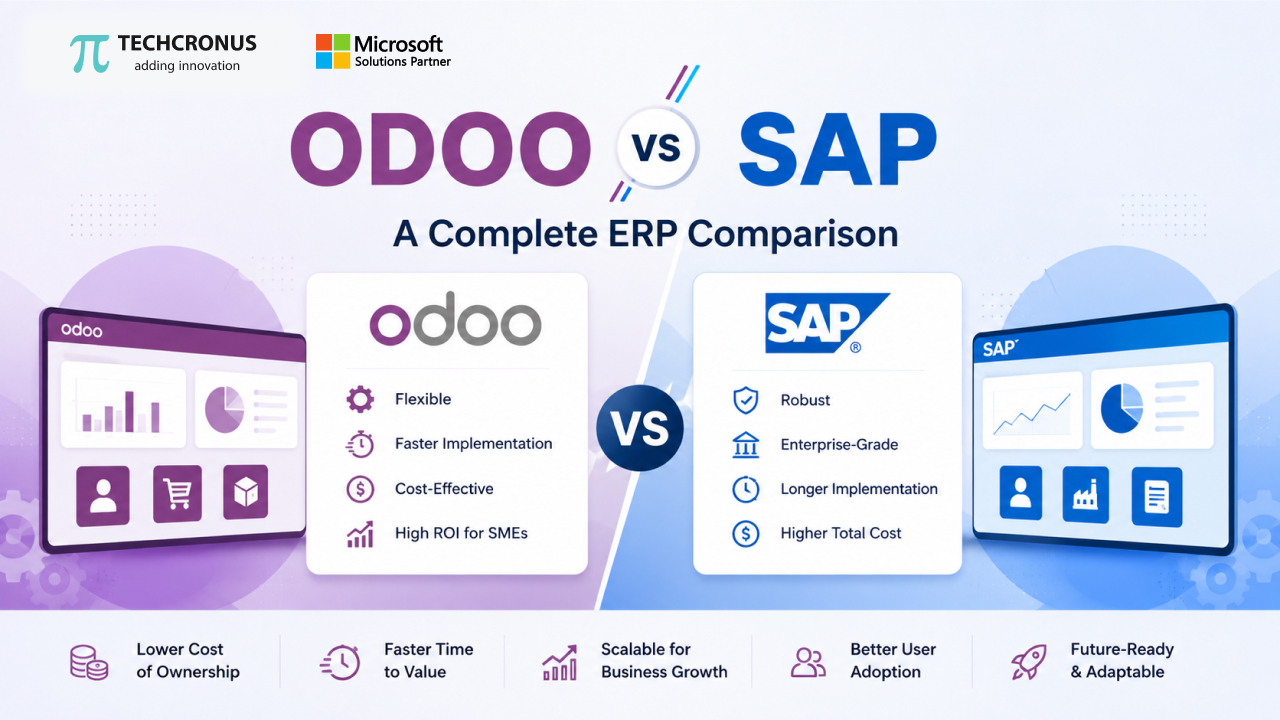
Table of Contents
As the founder of a technology consulting company working with organizations across the United States, the United Kingdom, Australia, the UAE, Saudi Arabia, Qatar, and Oman, I’ve noticed a major shift in how business leaders approach the Odoo vs SAP ERP decision when evaluating ERP investments.
Five years ago, ERP selection was often driven by brand recognition. Today, CFOs, CEOs, Operations Directors, and Digital Transformation Leaders are asking a different question:
“How quickly can this ERP start generating measurable business value?”
So, the conversation around Odoo vs SAP has become one of the most important ERP discussions for growing businesses.
The ERP market itself is evolving rapidly. Odoo reported €619 million in revenue for 2025 while maintaining strong annual growth. This reflects increasing global adoption among SMEs and mid-sized organizations seeking flexible and cost-efficient ERP solutions.
The reality is simple: An ERP system should become your most profitable business asset.
Why Mid-Sized Businesses Are Re-Evaluating ERP Strategy
Many businesses reach a point where disconnected systems begin slowing growth. Sales operates on one platform, finance uses another, and sadly, the inventory sits somewhere else. Management relies on spreadsheets to connect everything.
The result?
- Delayed reporting.
- Manual errors.
- Poor visibility.
- Lost revenue opportunities.
Here, ERP enters the picture. However, many companies evaluating SAP vs Odoo discover that software licensing is not their biggest concern. Rather, what’s concerning is implementation cost, deployment time, adoption speed, and ultimately the ROI.
These together determine whether an ERP project becomes a growth accelerator or an expensive operational burden.
The Hidden Cost Most ERP Buyers Miss
Industry comparisons consistently show that implementation services frequently exceed software licensing costs over the first few years of ownership. This is exactly why implementation strategy matters more than vendor marketing. The true ERP implementation cost mid-sized business leaders must evaluate includes:
- Business process mapping
- Data migration
- User training
- System integrations
- Custom workflows
- Reporting configuration
- Change management
- Ongoing support
Odoo vs SAP ERP Implementation Cost: What the Numbers Reveal
Let’s discuss what executives actually care about: the budget.
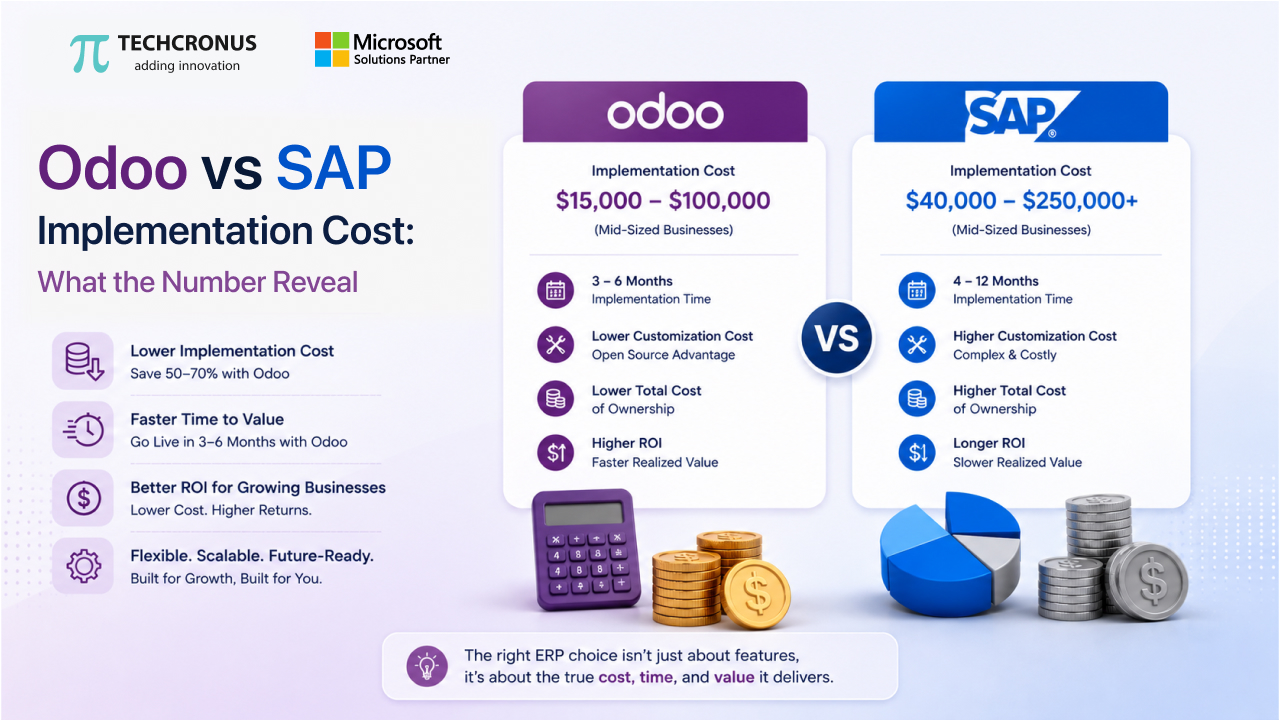
Research from multiple ERP implementation studies shows that mid-sized Odoo deployments commonly range between $15,000 and $100,000, depending on complexity. While SAP Business One implementations often range from $40,000 to $250,000 or more.
This makes Odoo vs SAP implementation cost one of the strongest decision drivers for growing organizations.
Suppose a Dubai-based wholesale distributor had 120 employees. The company required:
- CRM
- Inventory
- Procurement
- Accounting
- Warehouse Management
- Customer Portal
The SAP proposal estimated a nine-month deployment. The Odoo roadmap estimated sixteen weeks. The business chose Odoo. The savings generated from implementation were redirected into regional expansion and customer acquisition. Quite common across GCC markets.
Speed Matters More Than Most Companies Realize
- Independent ERP comparisons show Odoo implementations commonly take three to six months.
- SAP Business One projects frequently require four to twelve months, depending on project scope.
Many ERP buyers underestimate the financial impact of implementation timelines. Every month spent waiting for ERP deployment delays:
- Productivity gains
- Process automation
- Cost reductions
- Data visibility
- Revenue optimization
When discussing SAP vs Odoo, implementation speed should never be treated as a secondary consideration. Faster deployment means faster returns, in turn meaning stronger business growth.
The Real ROI Calculation Business Leaders Should Use
Many ERP vendors talk about features. Very few discuss ROI properly. An ERP investment should be measured by operational improvements.
These include:
- Reduced manual processing
- Lower labor costs
- Faster order fulfillment
- Better inventory accuracy
- Improved cash flow visibility
- Enhanced customer experience
This is why many organizations build an Odoo ERP ROI calculator framework before selecting an ERP platform.
A UK manufacturing company reduced manual reporting workloads by 70% after centralizing production, procurement, inventory, and finance operations through Odoo. Techcronus helped the management gain real-time visibility. Decision-making accelerated and profitability improved.
The ROI came from the correct operational transformation of the software.
SAP Business One vs Odoo Cost Over Five Years
Initial implementation cost only tells part of the story. Long-term ownership matters even more.
Several ERP comparison studies indicate that Odoo can deliver approximately 50–70% lower total cost of ownership compared with SAP Business One. That’s particularly for mid-sized organizations requiring flexibility and customization.
This makes SAP Business One vs Odoo a cost discussion far more than licensing. It becomes a discussion about:
- Upgrade costs
- Maintenance expenses
- Consulting dependency
- Customization flexibility
- Future scalability
Is Odoo the Best SAP Alternative for Mid-Sized Business Growth?
For many organizations, yes. SAP remains a powerful platform for highly complex multinational entERPrises with extensive compliance requirements.
However, many growing organizations are actively seeking a SAP alternative for mid-sized business operations because they need agility rather than complexity.
An Australian industrial equipment supplier faced this exact challenge. Their leadership team wanted automation and visibility, but did not require entERPrise-level complexity. After evaluating both platforms, Techcronus aligned Odoo more closely with their growth objectives, implementation budget, and deployment timeline. The result was faster adoption and stronger user engagement.
Why Companies Decide to Replace SAP with Odoo
One trend we are seeing globally is organizations choosing to replace SAP with Odoo after years of struggling with complexity and escalating operational costs.
Their reasons often include:
- Lower ownership costs
- Greater flexibility
- Easier customization
- Faster implementation
- Better user adoption
Importantly, businesses rarely switch because SAP lacks capability.
They switch because their operational requirements no longer justify the associated cost and complexity.
What to Know Before You Migrate from SAP to Odoo
The objective should never be replicating old inefficiencies inside a new platform. Your focus has to be on creating a smarter operating model. The objective should be an experienced Odoo ERP implementation company like Techcronus that can significantly reduce migration risk while accelerating business outcomes.
So, if your organization plans to migrate from SAP to Odoo, preparation is critical. Successful migration projects typically focus on:
- Data quality assessment
- Process optimization
- Integration planning
- User training
- Change management
How Techcronus Determines Success as the Right Odoo Partner
Technology alone does not guarantee ERP success; its perfect execution does. Whether you are evaluating entERPrise transformation or implementing Odoo ERP for small business growth initiatives, our approach is built around ROI, efficiency, and scalability.
At Techcronus, we help organizations…
- Unlock measurable ERP value through strategic consulting, implementation expertise, and long-term optimization.
- Our team delivers Odoo implementation services customised to industry-specific business processes.
- We provide advanced Odoo customization services that align workflows with operational goals instead of forcing businesses into rigid software structures.
- Our specialized Odoo development services support complex integrations, automation initiatives, and scalable ERP architectures.
- As an experienced Odoo ERP customization company, we focus on business outcomes, not just software deployment.
The Final Call For Faster ROI
If your organization is a global entERPrise with highly complex multinational requirements, SAP may still be the right choice.
However, for most mid-sized businesses seeking faster deployment, lower ownership costs, stronger flexibility, and quicker returns, Odoo increasingly delivers a better business case.
The time to act is now. Every quarter spent delaying ERP modernization is another quarter your competitors can use to become faster, leaner, and more efficient. Schedule a free consultation call to discuss your ERP roadmap. We will share how we can help accelerate your digital transformation journey.
Frequently Asked Questions (FAQs)
1. Which is better for mid-sized businesses: Odoo or SAP?
The right ERP depends on your business requirements. SAP is well-suited for large enterprises with complex global operations and extensive compliance needs. Odoo is often the preferred choice for small and mid-sized businesses because it offers greater flexibility, faster implementation, lower costs, and an integrated suite of applications for CRM, accounting, inventory, manufacturing, and eCommerce.
2. What are the main differences between Odoo and SAP?
The key difference is their approach. SAP focuses on enterprise-grade ERP solutions for large organizations, while Odoo provides a modular ERP platform that businesses can scale as they grow. Odoo is generally easier to customize, quicker to deploy, and more cost-effective for growing businesses.
3. Is Odoo cheaper than SAP?
Yes. In most cases, Odoo implementation costs and total cost of ownership are significantly lower than SAP, especially for small and mid-sized businesses. Costs vary based on project scope, customizations, integrations, and the number of users, but Odoo is widely recognized as a more budget-friendly ERP solution.
4. How long does it take to implement Odoo compared to SAP?
Implementation timelines depend on business complexity, but Odoo projects are typically completed within 3–6 months, whereas SAP Business One implementations often take 4–12 months or longer. A faster deployment enables businesses to realize ROI sooner.
5. Can I migrate from SAP to Odoo?
Yes. Businesses can successfully migrate from SAP to Odoo with proper planning and an experienced implementation partner. A typical migration includes data migration, process optimization, system integration, user training, testing, and change management to ensure a smooth transition.
6. Why are businesses replacing SAP with Odoo?
Many organizations choose to replace SAP with Odoo to reduce implementation costs, lower ongoing maintenance expenses, simplify customization, improve user adoption, and gain greater flexibility. Odoo’s modular architecture also makes it easier to scale as business needs evolve.