+1 (415) 234 7510
 +971 52 901 6677
 +91 8780928142
 WhatsApp
 Email
Email
































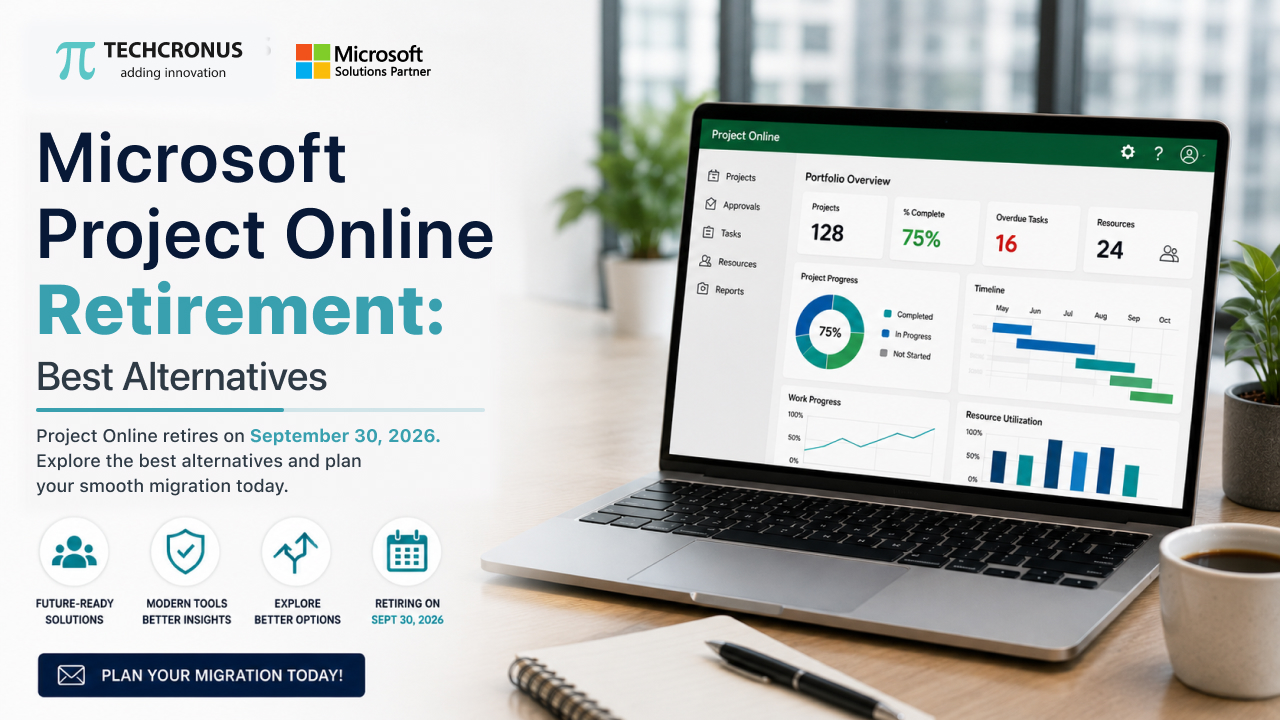
Table of Contents
If your PMO, IT leadership team, or transformation office is still running Microsoft Project Online, the clock is ticking.
Microsoft has officially announced that Project Online will retire on September 30, 2026. Organizations relying on legacy project portfolio management environments now face a strategic decision: migrate proactively or risk business disruption, reporting gaps, integration failures, and escalating operational costs.
Over the past decade, Techcronus consultants have assessed a variety of enterprise PMO environments across the globe. These ranged from 50 to over 2,000 active projects across manufacturing, engineering, IT, financial services, healthcare, and public-sector organizations … and beyond.
So, today I will help you compare the Best Microsoft Project Online alternatives, evaluate migration costs, and timeline. I will also explain how enterprises can successfully transition with the right implementation strategy.
Why Enterprises Are Replacing Project Online Now
Many organizations initially planned to wait until late 2026. That assumption is becoming increasingly risky.
Microsoft has confirmed the retirement of Project Online while directing future innovation toward Microsoft Planner, the Power Platform, and AI-powered work management experiences. Existing environments remain supported until September 2026, but long-term investments are clearly shifting elsewhere.
For enterprise PMOs, the concern extends beyond licensing.
Critical dependencies often include:
- Portfolio governance frameworks
- Resource capacity planning
- Financial forecasting models
- Power BI reporting integrations
- ERP connectivity
- Approval workflows
- Custom PWA configurations
According to PMI’s Pulse of the Profession research, organizations with mature project management practices waste significantly less investment than organizations with low project management maturity.
According to Gartner, worldwide spending on enterprise software continues to rise as organizations accelerate digital transformation initiatives.
This is precisely why Microsoft Project Online alternatives for enterprises have become a board-level discussion across the US, UK, Australia, UAE, Oman, and Saudi Arabia.
What Enterprises Actually Need in 2026
Modern enterprise PMOs require portfolio visibility, workflow automation, ERP and CRM integrations, and enterprise-grade security. Organizations using Microsoft Dynamics for Small Business often prioritize scalable project management solutions that align with future growth plans.
When evaluating alternatives to Microsoft Project Online, many organizations focus only on scheduling features.
That is a mistake.
Modern enterprise PMOs require:
- Portfolio visibility
- Resource optimization
- Financial governance
- AI-assisted planning
- Executive dashboards
- Multi-project dependency management
- Workflow automation
- ERP and CRM integrations
- Enterprise-grade security
A global engineering client with operations across the Middle East approached Techcronus. They did so after discovering that more than 600 active projects depended on custom workflows built over seven years. Their challenge was not replacing Gantt charts. It was preserving governance while modernizing delivery processes. That distinction determines migration success.
Leading Microsoft Project Online Alternatives
A) Smartsheet
Smartsheet remains a popular option for enterprises seeking strong reporting, collaboration and scalable workflows.
Ideal for:
- Large distributed teams
- Process-heavy organizations
- Executive reporting requirements
Monday.com Enterprise
Monday delivers strong usability and rapid adoption.
Best for:
- Fast-growing organizations
- Operational project management
- Cross-functional teams
B) Microsoft Planner Premium + Power Platform
For organizations deeply invested in Microsoft 365, Planner Premium represents Microsoft’s preferred future direction. Companies working with a trusted Microsoft Dynamics 365 Partner in the United States can streamline implementation, integration, and adoption across the Microsoft ecosystem.
Best for:
- Microsoft-centric organizations
- Medium-complexity PMOs
- Digital workplace transformation initiatives
C) Jira Align + Atlassian Ecosystem
Increasingly adopted by technology companies managing Agile portfolios at scale.
Ideal for:
- Software development organizations
- Agile transformation programs
- Enterprise DevOps environments
Techcronus Recommendation Framework
| Organization Type | Recommended Platform |
| Existing Microsoft-heavy Enterprise PMO | D-365 |
| Microsoft 365-first Organizations | Microsoft Planner |
| Reporting-intensive Enterprises | Smartsheet |
| Fast-growing Cross-functional Businesses | D-365 |
| Agile & Software-led Enterprises | Jira Align |
Existing Microsoft-heavy Enterprise PMOs often benefit from working with an experienced Microsoft Dynamics 365 Partner in Texas to ensure seamless integration between project management, ERP, and CRM systems.
Project Online Replacement Cost Comparison
A realistic Project Online replacement cost comparison must include more than subscription fees. Many enterprises underestimate hidden costs, such as:
- Data migration
- Workflow rebuilding
- User training
- Integration redesign
- Reporting modernization
- Change management
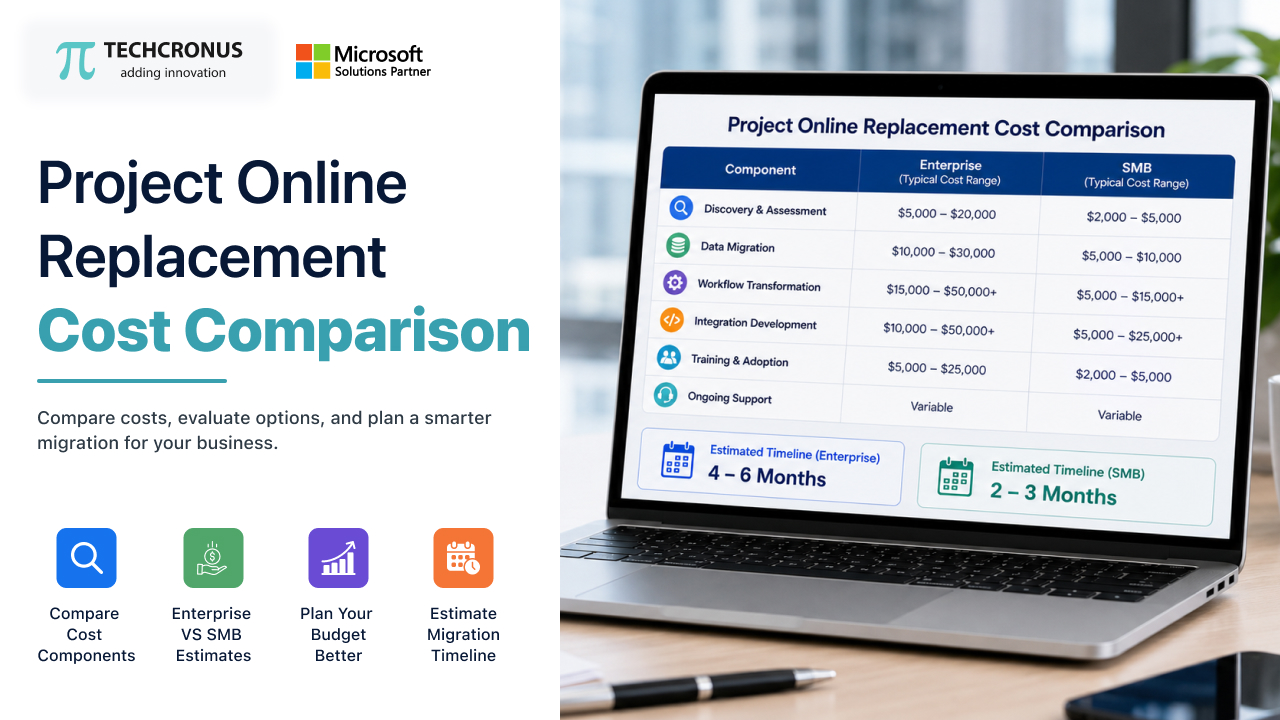
Typical enterprise migration investments include:
| Component | Typical Cost Range |
| Discovery & Assessment | $5,000–$20,000 |
| Data Migration | $10,000–$30,000 |
| Workflow Transformation | $15,000–$50,000+ |
| Integration Development | $10,000–$50,000+ |
| Training & Adoption | $5,000–$25,000 |
| Ongoing Support | Variable |
The estimated timeline is about 4 – 6 months for a successful enterprise migration.
Typical SMB migration investments include:
| Component | Typical Cost Range |
| Discovery & Assessment | $2,000–$5,000 |
| Data Migration | $5,000–$10,000 |
| Workflow Transformation | $5,000–$15,000+ |
| Integration Development | $5,000–$25,000+ |
| Training & Adoption | $2,000–$5,000 |
| Ongoing Support | Variable |
The estimated timeline is about 2 – 3 months for a successful SMB migration.
A UK-based infrastructure client initially budgeted only for licensing. After an assessment by Techcronus, they found that legacy approval workflows and reporting dependencies accounted for nearly 60% of the total migration effort.
The lesson: software costs are rarely the largest expense.
Comparing Project Online vs Competitors
Portfolio Governance – Many lightweight tools lack advanced portfolio management capabilities.
Resource Planning – Enterprise resource forecasting remains a critical differentiator.
Financial Controls – Budget visibility and project financial governance are often overlooked.
Integration Readiness – CRM, ERP, HRMS, and BI connectivity significantly influence long-term success.
AI Enablement – Future-ready platforms increasingly incorporate AI-powered forecasting, recommendations, and automation.
The Reality of Enterprise Project Management Software Migration
Successful enterprise project management software migration requires structured execution. At Techcronus, migration engagements typically include:
Phase 1: Assessment
Current-state analysis of projects, workflows, integrations, reports and governance structures.
Phase 2: Architecture Design
Future-state platform selection and operating model design.
Phase 3: Data Migration
Historical project data, resources, schedules, and metadata transfer.
Phase 4: Process Modernization
Workflow optimization rather than simple replication.
Phase 5: Adoption
Training, governance frameworks, and executive onboarding.
A Middle East construction group reduced project reporting time by 72%. This happened due to modernizing processes during migration instead of merely recreating legacy configurations.
Business Benefits Enterprises Typically Achieve
Following a successful enterprise project management software migration, organizations commonly achieve:
- Faster portfolio reporting
- Improved resource utilization
- Reduced manual administration
- Better executive visibility
- Higher project delivery consistency
- Improved governance compliance
A manufacturing client reduced executive reporting preparation from three days to less than four hours after modernization. Professional project management software implementation services help organizations:
- Reduce migration risk
- Accelerate adoption
- Preserve reporting continuity
- Minimize downtime
- Improve governance
- Maximize ROI
Selecting the Right Project Online Migration Partner
Selecting a trusted project online migration partner is often the most important decision in the entire transformation journey.
The right partner, like Techcronus, provides:
- Migration assessments
- Architecture consulting
- Platform expertise
- Data migration services
- Integration capabilities
- Change management support
- Post-go-live optimization
Beyond migration expertise, organizations should choose a partner with deep experience in Microsoft Dynamics CRM, Microsoft 365, and enterprise application modernization to maximize long-term value.
Why Enterprises Choose Techcronus
Techcronus has supported organizations navigating complex Microsoft ecosystem transformations while ensuring business continuity and measurable outcomes.
As a trusted Microsoft Dynamics 365 Partner in the United States, Techcronus helps organizations modernize their project management ecosystems while maintaining governance, reporting continuity, and operational efficiency.
With us, you gain…
- Certified Microsoft ecosystem specialists
- Enterprise PMO transformation expertise
- End-to-end migration execution
- Data migration and validation
- Integration development capabilities
- Change management support
- Post-go-live optimization services
Who has trusted us…
- A Sydney-based infrastructure company needed portfolio visibility across 1,200 projects.
- A London financial services firm required a governance-heavy migration with audit compliance requirements.
- A Riyadh transformation office prioritized executive reporting and resource forecasting.
RUSH!! The Window For Proactive Migration Is Closing
Microsoft has already established the retirement timeline. The question is no longer whether organizations should evaluate the best Microsoft Project Online alternatives. But the rush is now towards how quickly your business can identify the right platform, define a migration roadmap, and execute transformation without business disruption.
Organizations delaying migration frequently encounter:
- Resource shortages from migration partners
- Compressed testing windows
- Budget approval bottlenecks
- Executive reporting disruptions
- User adoption challenges
- Increased transformation costs
A UAE-based engineering organization approached Techcronus only six months before the retirement deadlines. Limited planning time increased migration costs by approximately 35% compared to earlier phased migration scenarios.
For enterprises seeking strategic EPM consulting and migration services, implementation expertise, and long-term modernization success, the migration journey should begin now. Schedule a Free Consulting Call Today.