+1 (415) 234 7510
 +971 52 901 6677
 +91 8780928142
 WhatsApp
 Email
Email
































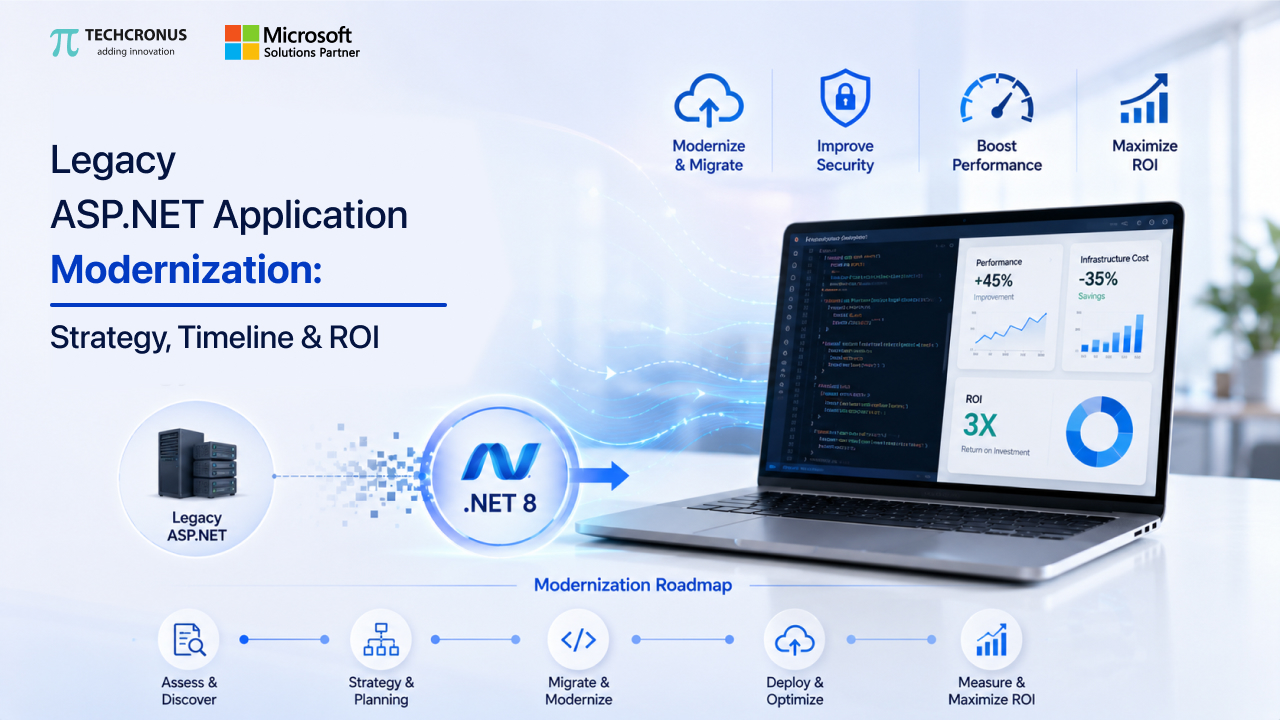
Table of Contents
Outdated ASP.NET architecture kills business growth and destroys enterprise competitiveness today. Competitors run lightweight cloud-native platforms that deploy new features within hours. Meanwhile, legacy systems drain valuable engineering resources and cause frequent application outages. Many organizations hire offshore .NET developers to modernize legacy applications, while ASP.NET migration services help eliminate technical debt, improve performance, and protect enterprise revenue streams.
As the co-founder of Techcronus, I advise global executives facing massive technical debt. You cannot scale enterprise operations on outdated monolithic application frameworks.
Let us examine real data driving digital transformation across global markets. Modernization reduces enterprise server disk usage by up to 77 percent. It also boosts engineering team productivity by more than 31 percent.
Furthermore, legacy software maintenance consumes up to 80 percent of IT budgets.
You must migrate legacy .NET applications before outdated code freezes innovation. Here is our executive strategy, realistic timeline, and enterprise execution roadmap.
What Kills Competitiveness in the USA Today
American enterprises face relentless market disruption from cloud-first agile startups. Delaying platform modernization directly destroys market share and operational profit margins.
The True Cost of Legacy Technical Debt
Old application architecture slows down development velocity across engineering departments significantly. Developers waste thousands of hours fixing fragile monolithic codebases every year. .NET modernization services replace rigid code with flexible, scalable cloud modules. Without strategic intervention, legacy technical debt eventually halts software feature releases entirely. Smart business leaders invest in reliable .NET Migration Services right now.
Severe Security Risks and Compliance Roadmap Failures
Outdated frameworks lack native support for modern enterprise security encryption protocols. Cybercriminals actively exploit unpatched vulnerabilities in legacy infrastructure every single day. One major data breach triggers catastrophic financial penalties and lost customer trust. Executing an enterprise .NET upgrade secures your platform against evolving cyber threats.
Strategic Execution Models for Enterprise Transformation
Choosing the correct modernization pathway dictates long-term software performance and ROI. Leaders must balance immediate operational needs against long-term architectural stability.
Lift-and-Shift Rehosting Versus Deep Architectural Reengineering
Rehosting simply moves existing monolithic software directly onto cloud virtual machines. This rapid approach reduces local hardware costs but preserves bad architecture. Conversely, deep reengineering transforms monoliths into cloud-native microservices for true scalability. Our engineering team specializes in comprehensive ASP.NET migration services worldwide. We analyze your specific business goals before recommending an execution model.
The Incremental Strangler Fig Migration Pattern
Never attempt a high-risk system rewrite in a single deployment phase. We implement the proven incremental Strangler Fig migration pattern for enterprises. This strategy gradually replaces old modules with modern cloud microservices safely. Your core daily business operations continue running without any disruptive downtime. This iterative approach allows continuous user validation and steady performance gains.
Techcronus Case Studies and Results
Let us examine how market leaders achieve measurable business transformations. Practical execution requires deep industry knowledge and technical precision.
Healthcare System Modernization Across the USA
A leading American healthcare network struggled with crashing patient management portals. Peak daily traffic caused severe delays in accessing critical medical records. They hired our team to execute a .NET Framework to .NET 8 migration. We decoupled their legacy database and built secure, HIPAA-compliant cloud microservices. The client achieved a 45 percent faster portal response time instantly. Patient appointment booking efficiency increased by 30 percent within three months.
Global Financial Services Platform Upgrade
An international fintech institution processed high volumes of daily financial transactions. Their rigid core platform blocked rapid global expansion into new regions. They partnered with Techcronus for specialized .NET application modernization consulting. We helped them migrate ASP.NET to .NET 8 across multi-cloud environments. Infrastructure hosting costs dropped by 35 percent within ninety days of deployment. System throughput increased threefold without adding expensive new hardware infrastructure.
Technical Risks and Implementation Roadmap
Managing technical risk requires structured engineering governance and proactive planning. Every milestone must validate system integrity before retiring legacy software components.
Preventing Data Loss and Achieving Zero Downtime
Data loss during platform migration ruins customer trust and brand reputation. Our developers implement continuous dual-write database synchronization protocols during transition cycles. Automated testing suites verify data accuracy across legacy and modern environments continuously. This strict methodology ensures zero downtime for your critical business operations.
Realistic Enterprise Timelines and Milestone Tracking
- Comprehensive application transformation typically spans three to nine months in duration.
- Architecture discovery and dependency mapping require roughly four weeks to complete.
- Core module refactoring and API development consume eight to sixteen weeks.
- Final cloud deployment, optimization, and security audits finalize the transformation roadmap.
- Clear sprint tracking keeps executive stakeholders aligned with delivery dates.
Enterprise Budget Considerations and Cost Management
Strategic modernization requires transparent financial planning and clear business ROI projections. Executive leadership must justify capital investments with clear long-term returns.
Optimizing Capital Allocation and Measuring ROI
Upgrading legacy platforms requires dedicated capital for expert software engineering talent. However, cloud-native architecture reduces ongoing server maintenance overhead drastically over time. Automated CI/CD deployment pipelines drastically cut manual regression testing expenses. Enterprises typically realize full financial payback within twelve months of go-live.
Eliminating Wasteful Licensing and Infrastructure Overhead
Legacy proprietary servers force enterprises into expensive, long-term vendor licensing agreements.
- Moving to modern open-source framework architectures eliminates vendor lock-in completely.
- Cloud infrastructure scales compute power dynamically based on actual user traffic.
- You stop paying for idle server capacity and maximize profit margins.
Change Management Insights for Digital Transformation Leaders
Technology transformations fail when internal teams resist adopting new workflows. Leadership must guide engineering departments through cultural change with empathy.
Aligning Engineering Teams With Strategic ROI Results
Internal developers often feel anxious when moving away from familiar platforms.
Executive leaders must clearly explain how modernization drives company market growth. Our experts provide hands-on .NET consulting services to upskill internal teams. Structured mentorship builds developer confidence and accelerates new platform adoption significantly.
Overcoming Internal Cultural Resistance to Modernization
Change frequently creates friction between product owners and legacy engineering teams.
Transparent communication dismantles organizational silos and reduces fear of new technologies. Include internal developers in weekly sprint reviews and architecture design sessions. Celebrate incremental deployment milestones to maintain high momentum and team morale.
Critical Market Statistics Before You Scale
Industry data proves that delaying modernization puts enterprise survival at risk. Around 80 percent of enterprises actively adopt advanced AI models today. However, outdated codebases block successful AI integration across 70 percent of enterprises.
Modernizing legacy applications also lays the foundation for industry-specific AI solutions, including Conversational AI for Manufacturing, where intelligent assistants can support production teams, automate routine inquiries, and improve operational efficiency.
You must streamline foundational software before deploying enterprise AI capabilities. We deliver expert .NET Migration Services to prepare your digital ecosystem.
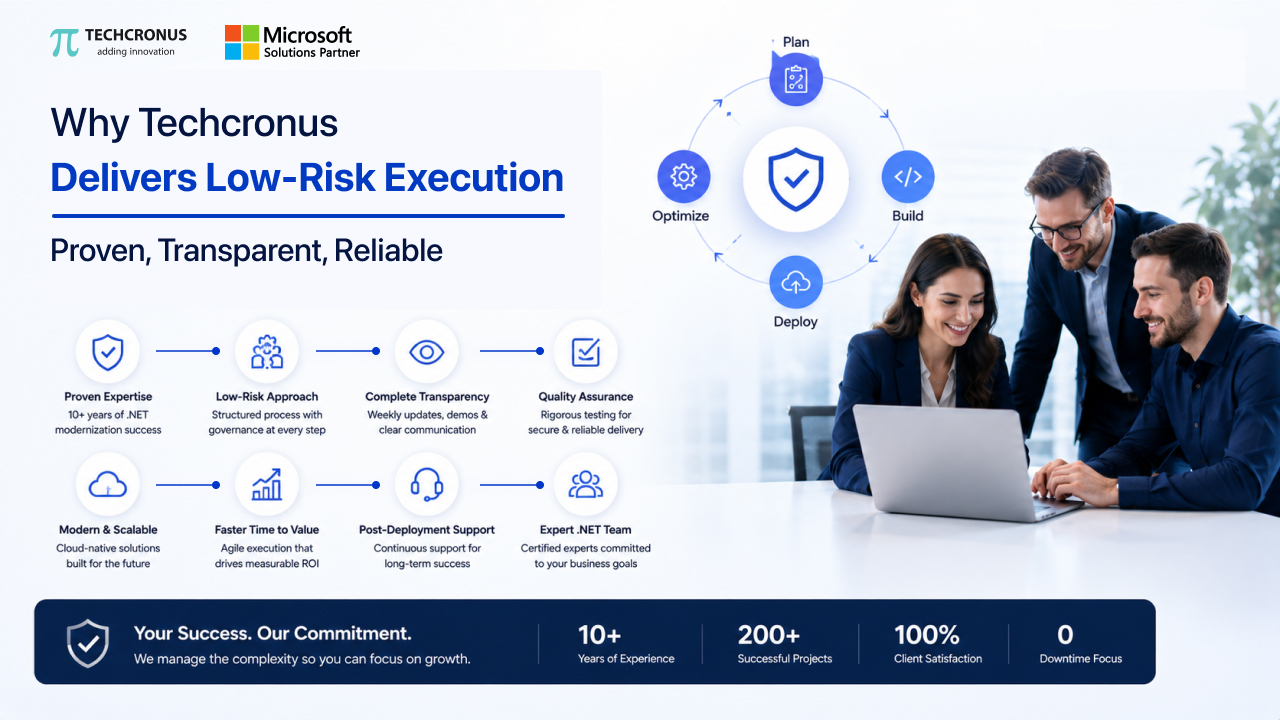
Having an experienced engineering partner guarantees project delivery on schedule.
- Techcronus brings over a decade of enterprise software engineering excellence worldwide.
- We deliver reliable .NET Migration Services backed by strict governance frameworks.
- As a premier dot net development company in the USA, we understand enterprise software scale.
- Our engineers safeguard your business logic while refactoring core software architecture.
- We maintain complete transparency with weekly executive progress reports and demos.
- Enterprises hire .NET migration experts from Techcronus to ensure zero operational disruption.
Modernize Before Competitors Do
Legacy software modernization is an urgent strategic mandate for executive leadership. Delaying system upgrades destroys market competitiveness and increases operational security risks. Techcronus stands ready to execute your enterprise modernization roadmap with precision. Stop losing market share to agile competitors running modern cloud platforms. Partner with our seasoned engineering team to outpace global market competition. CALL US to get a FREE .NET Modernization Assessment from Techcronus
Frequently Asked Questions (FAQs)
1. What are .NET Migration Services?
.NET Migration Services help organizations modernize legacy .NET applications by migrating them to the latest .NET platform, such as .NET 8, improving performance, security, scalability, and cloud readiness. Migration can also include application re-architecture, cloud migration, API modernization, and database optimization.
2. Why should businesses migrate from .NET Framework to .NET 8?
Migrating from .NET Framework to .NET 8 provides several business benefits, including:
- Improved application performance
- Enhanced security and long-term Microsoft support
- Better cloud-native capabilities
- Cross-platform compatibility
- Lower infrastructure costs
- Faster application development and deployment
- Easier integration with Azure, Docker, Kubernetes, and AI services
3. How long does a .NET application migration take?
The timeline depends on the application’s size, complexity, custom integrations, and business requirements. Small applications may take a few weeks, while large enterprise modernization projects can take 3 to 9 months. A detailed assessment helps define an accurate migration roadmap.
4. What are the common challenges during a .NET migration?
Organizations often encounter challenges such as:
- Legacy code dependencies
- Third-party library compatibility
- Database migration
- Custom integrations
- Downtime risks
- Performance optimization
- User adoption
- Security and compliance requirements
Working with an experienced .NET migration partner helps minimize these risks.
5. What is the difference between rehosting and rearchitecting a .NET application?
Rehosting moves an existing application to the cloud with minimal code changes, offering faster migration but limited modernization benefits.
Rearchitecting redesigns the application using modern cloud-native architectures such as microservices, APIs, and containers, resulting in better scalability, performance, and long-term flexibility.
6. Can legacy ASP.NET applications be migrated to .NET 8?
Yes. Most legacy ASP.NET applications can be migrated to .NET 8. The migration approach depends on the application’s architecture, dependencies, third-party components, and business goals. Some applications require code refactoring, while others may need partial or complete modernization.
7. What are the benefits of modernizing legacy .NET applications?
Modernizing legacy .NET applications helps organizations:
- Reduce technical debt
- Improve application performance
- Strengthen cybersecurity
- Lower infrastructure and maintenance costs
- Accelerate software releases
- Support AI and cloud technologies
- Improve scalability and business continuity
- Enhance user experience