+1 (415) 234 7510
 +971 52 901 6677
 +91 8780928142
 WhatsApp
 Email
Email
































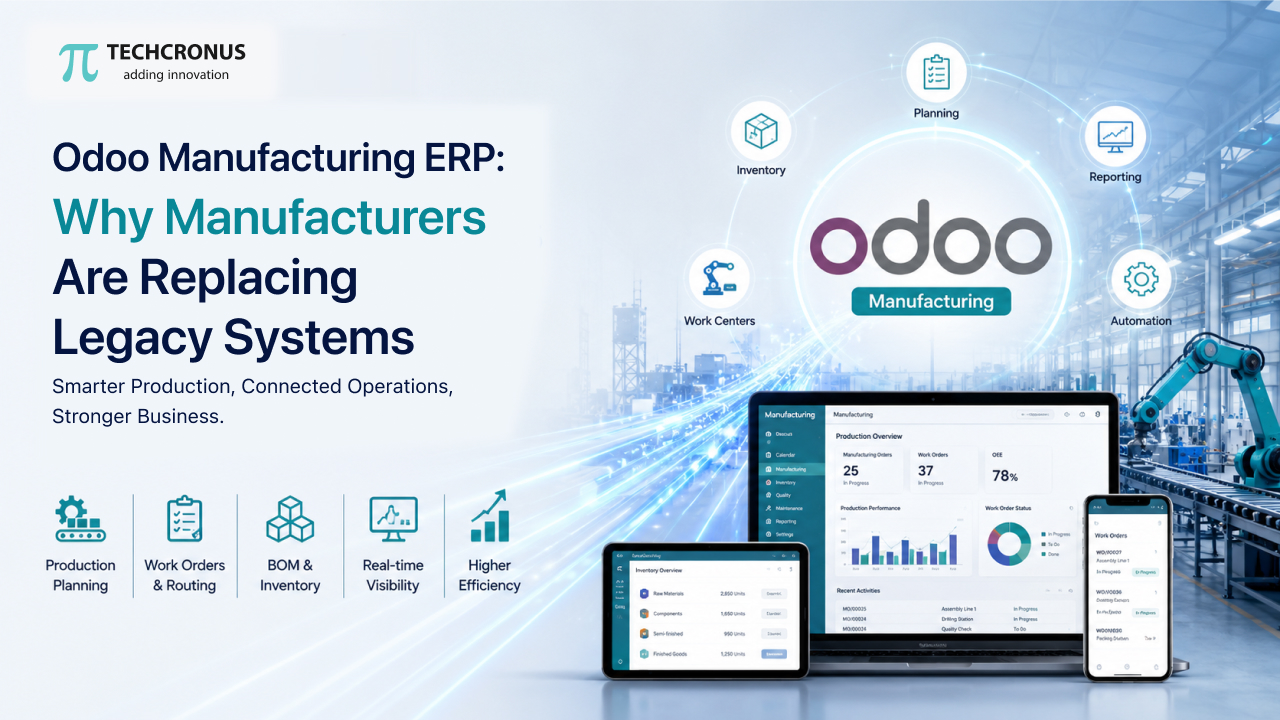
Table of Contents
Odoo Manufacturing ERP gives manufacturers a connected foundation for production planning and operations. A production schedule is only as reliable as the information behind it. Legacy systems often leave production, inventory, and planning disconnected. That slows decisions and increases operational risk. Odoo Manufacturing can bring these processes into one connected platform. But implementation matters as much as the software.
In the USA alone, 94% of North American manufacturers plan ERP investments, but only 50% fully leverage their current ERP systems.
This is why more manufacturing businesses are reassessing their ERP strategy. Odoo manufacturing gives companies a connected way. On a single platform, you can manage production orders, bills of materials, work centres, operations, inventory, and planning.
Let’s now discuss how it benefits your business.
Why Legacy ERP Is Becoming A Production Problem
Legacy systems are not automatically bad. Many have supported manufacturers for years. The problem appears when the system can no longer keep pace with the business.
I will share an example of a very big Steel Company in Abu Dhabi. They had most business processes running through a legacy ERP. But the production planning was handled separately using Excel spreadsheets. Its planners had to continuously adjust schedules for changing customer requirements, long raw-material transit times, and shifting sales demand. This made planning and execution harder to scale.
The company later introduced a more integrated digital environment with Odoo ERP. The company reports a fivefold increase in production-planning efficiency, daily processing of more than 1,800 orders, and nearly 40% faster order processing.
The lesson is clear: An integrated Odoo ERP for manufacturing can help bring these operational processes together.
What Production Teams Actually Need From a Modern ERP
The following is a fundamentally different operating model from managing production through disconnected files.
| Production question | What the ERP should show |
| What must we produce? | Confirmed demand and production priorities |
| Can we produce it on time? | Available capacity and production schedules |
| Do we have materials? | Current stock and material requirements |
| What happens next? | Connected operations and work orders |
| Is production delayed? | Real-time status and exception visibility |
Why the Business Case Is Different in the USA, Australia and GCC
The need for manufacturing ERP may be global. The business case is local. The right ERP case depends on the operational problem first. The technology comes second.
USA: Complexity makes integration critical
A US mid-market manufacturer was managing production, inventory, quality, and finance across five disconnected legacy systems. Manual reconciliation consumed more than 40 hours every week. The problem was not simply outdated software. Production planners could not see reliable information across departments.
What this means: For companies considering Odoo ERP for manufacturing companies in the USA, the priority is often connecting systems, improving visibility, and reducing manual reconciliation.
Australia: Distance makes planning accuracy essential
An Australian contract manufacturer experienced growth while relying on MYOB and extensive spreadsheets. Its expanding operations and export activity made real-time inventory visibility and batch tracking increasingly important.
What this means: For an Odoo production planning project for an Australian manufacturer, material visibility and inventory accuracy can directly affect production continuity.
GCC: Scale makes production control essential
A large Abu Dhabi iron manufacturer operates in a highly complex production environment. After modernising production planning and execution, it reported a fivefold efficiency increase, more than 2000 daily orders processed, and a 50% reduction in order-processing time.
What this means: For an Odoo manufacturing partner UAE project, scalability, production visibility and execution control may become the strongest business drivers.
What The Odoo Manufacturing Module Actually Does
It is valuable when each of your business functions reflects the real production process.
Depending on the business, the configuration may include:
- Bills of materials.
- Manufacturing orders.
- Work orders.
- Work centres.
- Routing sequences.
- Work-order dependencies.
- Multi-level product structures.
- Production planning.
- Subcontracting.
- Quality workflows.
- Maintenance processes.
- Shop-floor execution.
- Production reporting.
For buyers researching Odoo manufacturing module features, work orders, and BOM routing, the important point is how these elements connect. And that is where the Odoo Manufacturing Module comes into action.
Odoo Manufacturing vs Epicor for SME: The Right Comparison
A growing food manufacturer needs bills of materials, work orders, routing and shop-floor planning. It finds Odoo manufacturing a practical fit because its manufacturing tools connect production planning with inventory, quality and maintenance.
A complex industrial manufacturer handling make-to-order, engineer-to-order or configure-to-order production may need deeper specialist capabilities. Epicor Kinetic specifically supports these manufacturing models alongside advanced production and lean manufacturing tools.
Odoo manufacturing vs Epicor for SME – Always compare production complexity, required integrations, planning depth and implementation capacity. The right choice is the system that matches the operation today without creating unnecessary complexity tomorrow. Businesses evaluating manufacturing ERP solutions can also compare features, pricing, and verified user reviews on Techimply before making a final decision. This helps organizations choose the ERP platform that best fits their production requirements.
What An Actual Odoo Manufacturing ERP Implementation Looks Like
An Odoo manufacturing implementation is not simply installing software and importing data. It usually moves through clear business stages. Consider a mid-sized manufacturing company replacing spreadsheets and disconnected systems with Odoo.
| Implementation Step | What Actually Happens | Simple Example |
| 1. Discovery | The team studies current workflows. | Planners use spreadsheets for schedules. |
| 2. Process Design | The future workflow is defined. | Material availability connects with production planning. |
| 3. Data Preparation | Product and manufacturing data gets cleaned. | Incorrect BOMs and duplicate item codes are corrected. |
| 4. Configuration | Odoo is configured around approved processes. | Operations link to work centres and production orders. |
| 5. Integration | Required systems connect with Odoo. | Accounting and inventory data flow together. |
| 6. Testing | Real production scenarios are tested. | Planners test material shortages and delayed orders. |
| 7. Go-Live | Users begin operating the new system. | Production teams create and track orders in Odoo. |
| 8. Optimisation | The system improves after real usage. | Reports reveal recurring planning bottlenecks. |
How Much Does Odoo Manufacturing Implementation Cost?
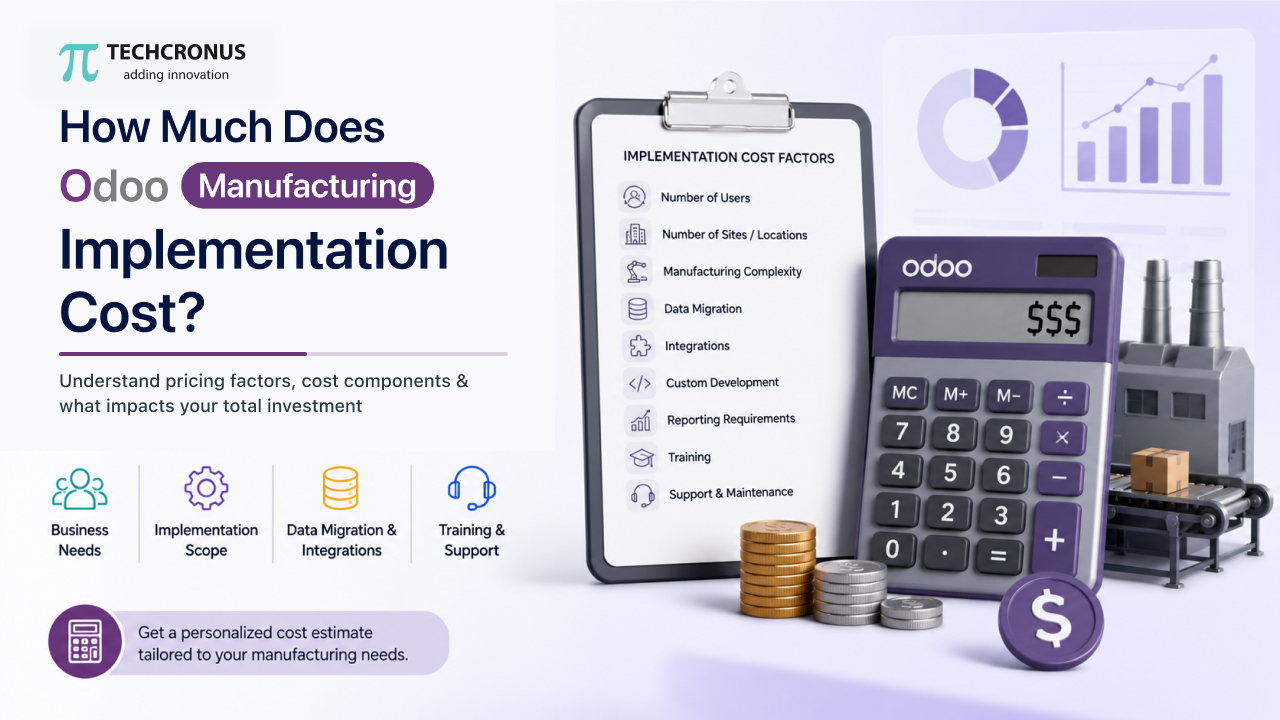
The answer depends entirely on scope. The cost can change based on:
- Number of users.
- Number of sites.
- Manufacturing complexity.
- Data migration.
- Integrations.
- Custom development.
- Reporting.
- Training.
- Support requirements.
A small single-site manufacturer and a multi-location operation don’t have the same implementation estimates.
Therefore, how much an Odoo manufacturing implementation costs should be answered after discovery, not before it. Need a realistic number for your factory? Ask Techcronus for a scope-based Odoo manufacturing assessment. We help you decode it all before you commit to a budget.
Why Choose Techcronus for Odoo Manufacturing Implementation?
Techcronus maintains offices in the USA, Australia, and UAE, giving manufacturers a relevant regional presence.
- 12+ years of software development and implementation experience.
- 80+ software engineers and technical staff across projects.
- 800+ software solutions designed, developed, and deployed globally.
- 500+ customers served across multiple industries and markets.
- Clients served across more than fifteen countries worldwide.
- Manufacturing expertise spanning ERP, analytics, software, and support.
- Odoo implementation includes discovery, architecture, migration, integration, deployment, and support.
- Regional offices operate across the USA, Australia, and the UAE.
- One team supports customization, integrations, upgrades, and migration.
- Techcronus reports certified consultants supporting business transformation projects.
- Its process emphasizes discovery before system architecture and implementation.
- Manufacturing solutions address operational technology and process requirements.
Ready to Move Beyond Legacy Production Planning?
The right manufacturing ERP decision begins with understanding the operation. Need a practical implementation plan? Talk to Techcronus about your manufacturing workflows, current ERP limitations, and next steps