+1 (415) 234 7510
 +971 52 901 6677
 +91 8780928142
 WhatsApp
 Email
Email
































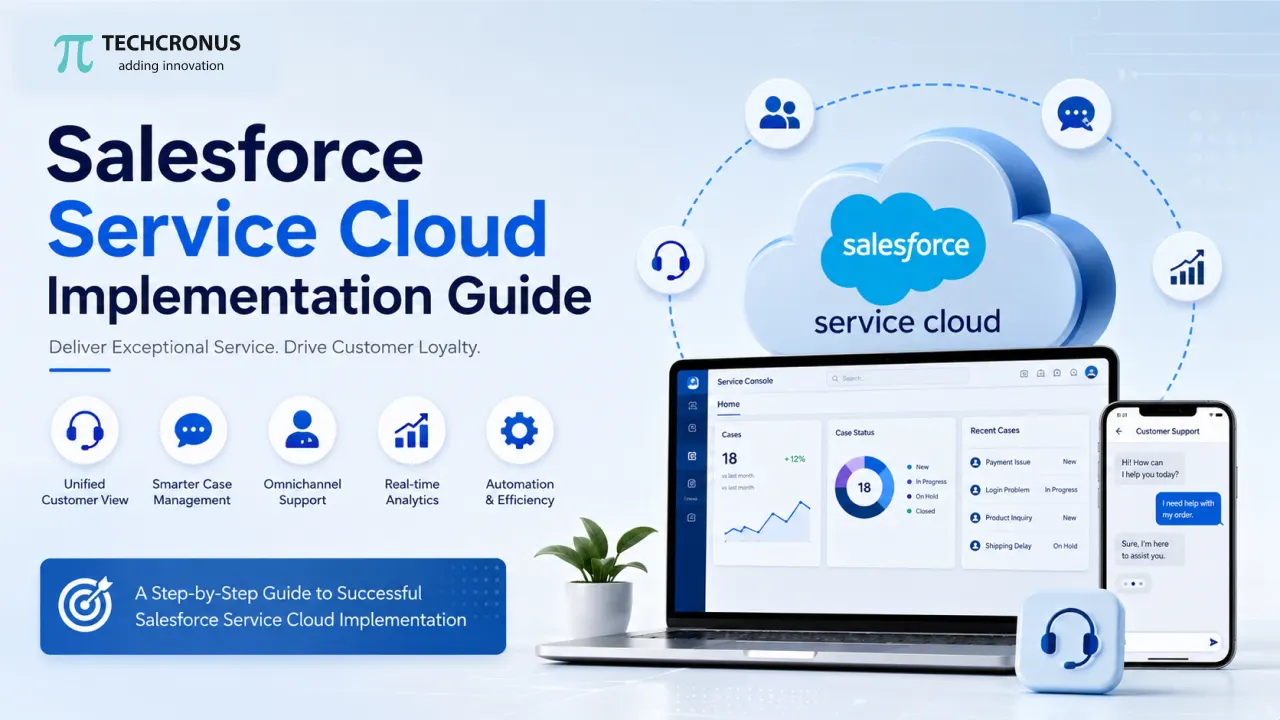
Table of Contents
A Salesforce Service Cloud implementation often begins with a simple goal: improve customer support. Yet, I’ve sat across the table from operations leaders in Sydney, Dubai, London, and New York, and I keep hearing the same sentence in different accents: “Our support numbers look fine, so why are renewals slipping?”
Here’s the uncomfortable truth I tell every one of them. A broken customer support CRM doesn’t announce itself. It doesn’t send an alert when a customer gives up. It just lets them leave, quietly, while your dashboard still shows green.
Research backs this up in a way that should worry every CEO reading this.
According to Zendesk’s 2026 CX Trends data, 56% of unhappy customers never complain at all — they simply switch to a competitor.
Another study also reported the same pattern for years: silent churn, not loud complaints, is what actually erodes revenue.
Regular findings suggest that a third of loyal customers will abandon a brand they love after just one bad experience.
Now you see why “no complaints” is the most dangerous metric in your business. Let’s learn more
The Real Cost of a Fragmented Support Stack
When support agents are toggling between five tabs to answer one ticket, the customer feels it before your metrics do. Salesforce’s own research shows 73% of customers say a great experience with one company raises their expectations for every other company they deal with, including yours.
Meanwhile, 72% of customers call being transferred between agents a textbook example of bad service, and American Express found that a single dissatisfied customer will tell 15 or more people about it. In markets as reputation-driven as Australia, the UAE, the UK and the USA, that word-of-mouth damage compounds fast.
This is exactly why more mid-market and enterprise leaders are moving toward a unified Salesforce Service Cloud implementation instead of duct-taping together spreadsheets, shared inboxes and disconnected help-desk tools. When you have Salesforce customer service software for enterprises, you get all case history, purchase data, and prior conversations live on one record. This helps in agents stop apologizing for the system and start actually solving problems.
What Salesforce Service Cloud Pricing Really Looks Like in 2026 & Beyond
I will be direct, because most vendors won’t be. Salesforce Service Cloud pricing starts at $25 per user per month on Starter Suite, scaling to $100 on Pro Suite, $165 on Enterprise and $330 on Unlimited, with the Einstein 1 Service bundle at $500 for AI-heavy operations.
But the sticker price is never the real number; add-ons like Digital Engagement, Voice and Field Service typically add another $50 to $200 per seat, and that’s before implementation.
This is the exact reason CEOs ask us how to reduce customer support costs with Salesforce Service Cloud rather than simply “how much does it cost.” The answer isn’t picking the cheapest edition; it’s licensing the right edition to the right agent group instead of overpaying Unlimited-tier pricing for a tier-one team that never touches those features. Experienced Salesforce consulting firms help businesses align licensing with actual usage, ensuring every team has the features they need without paying for capabilities they never use. Done correctly, businesses right-size their spend by 15–30% without losing a single capability their agents actually use.
Salesforce Service Cloud vs Zendesk: Which Is Better in 2026?
Every second discovery call I run eventually gets to this question, so let’s settle it. The honest answer is: it depends on where your customer data already lives. Zendesk wins on speed of deployment and simpler pricing. Salesforce Service Cloud wins when your support team needs to see the same record as sales, marketing, and billing — no context-switching, no “let me transfer you,” no repeating yourself three times. For businesses already running Salesforce Sales Cloud, Service Cloud isn’t a competing platform; it’s the missing half of the customer story.
What This Costs a Mid-Market Business
Enterprise quotes scare people, so let’s talk mid-market. The typical Salesforce Service Cloud implementation cost for mid-market businesses with teams of 20 to 75 agents runs on Enterprise or Pro Suite editions, with implementation, data migration, and agent training scoped to the actual complexity of your case workflows, not a generic template. This is where a Salesforce Service Cloud implementation partner USA businesses trust becomes non-negotiable because a rushed, template-based build is exactly what leaves gaps that customers fall through six months later.
Techcronus Salesforce Implementation is Specific to Your Region, Not a Generic One
The implementation should be shaped around your reality:
USA: As the Best Salesforce Service Cloud partner in North America, we connect service with complex enterprise systems. This includes sales operations, analytics, and scalable customer workflows.
UK: We build a governed service environment that supports data privacy, process control, reporting, and long-term operational efficiency. As a Salesforce Service Cloud consulting company, UK businesses return to project after project; we don’t hand off a build and disappear — we stay through adoption. Across the UK, our Salesforce Service Cloud implementation UK engagements focus on GDPR-aligned data handling and omnichannel case routing for regulated industries.
Australia: We design Salesforce customer service software Australia needs. It helps processes around local business requirements, privacy considerations, regional operations and scalable digital channels.
UAE: We support fast-growing, multi-market businesses with connected workflows, integrations, automation and customer experiences that can scale across the region. As a recognized Salesforce Service Cloud partner in the UAE, we know regional compliance and customer expectations. We’ve implemented Salesforce Service Cloud for UAE customer support teams managing multilingual case volume across retail, logistics and finance. The response-time expectations are unforgiving, and Arabic-English handoffs can’t create delays.
Quick Answers, CEO to CEO
Does it actually lower support costs? Yes, mainly through deflection and routing efficiency, not headcount cuts.
Worth it for a mid-market team? Usually, provided the edition and add-ons match real usage rather than a bundled sales pitch.
How fast can rollout happen across regions? Timelines vary with compliance needs, but a phased rollout typically beats a single big-bang launch.
Why Techcronus is the Best Salesforce Service Cloud Implementation Partner
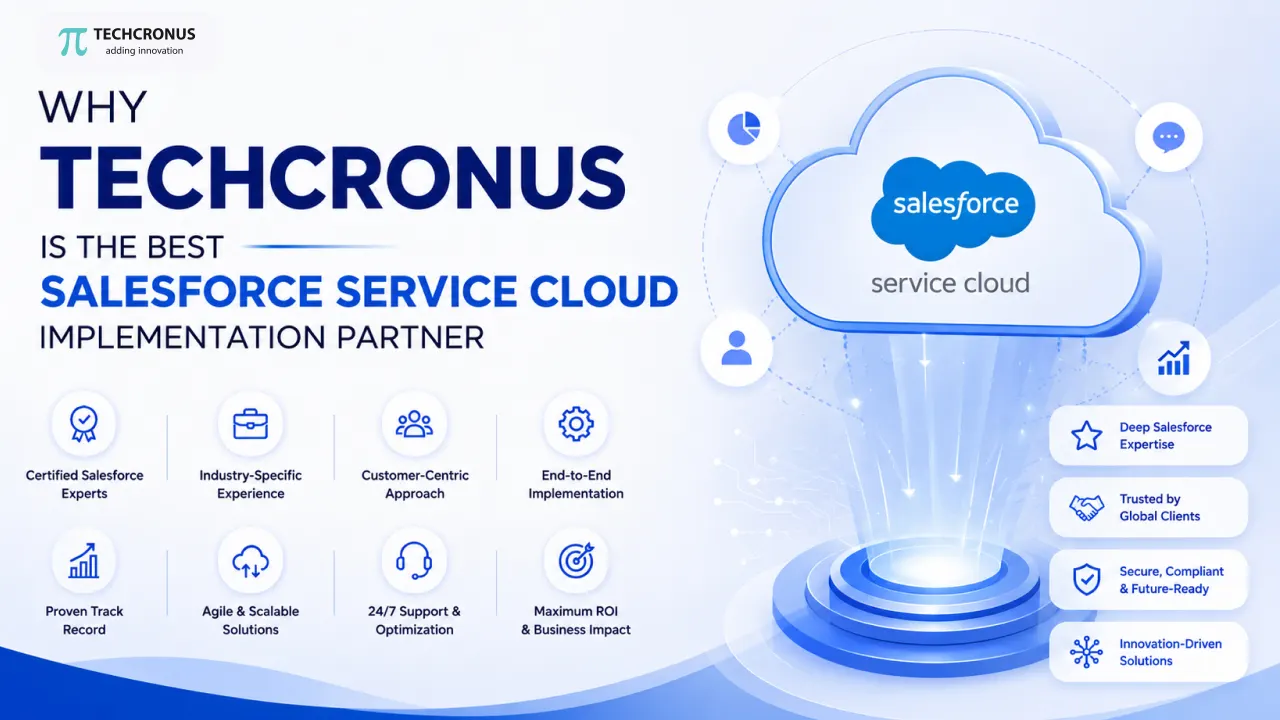
We are not chasing a badge on a slide deck. We are the team CEOs call when their support CRM is quietly costing them renewals, and nobody in the building can prove it yet, until the churn report lands.
If you are evaluating it for your business, here’s what 200+ implementations have taught us: the platform is never the hard part. Discipline in scoping, honest pricing conversations, and a partner who tells you what to skip that’s the hard part, and that’s where we live.
Customers are giving your competitors a 78% average CSAT score right now, and they are not telling you why they left. A properly implemented customer support CRM turns that silence into signal — before it becomes your next quarter’s revenue problem.
Talk to Techcronus today. Let’s audit your current support stack, show you exactly where the leak is, and build a Salesforce Service Cloud implementation that earns back the customers your current system is losing without a word.
Frequently Asked Questions
How much does Salesforce Service Cloud implementation actually cost?
Depends heavily on team size and complexity, but budget beyond just licenses. Setup, data migration, and training all add real, unavoidable cost. Most rollouts run six to twelve weeks. Complex integrations push closer to four months.
How long does Salesforce implementation take?
Most mid-market rollouts run six to twelve weeks. Anyone promising it faster is skipping discovery entirely.
Is it worth it for a small or growing team?
Yes, if support volume is already straining your current tools. Not yet, if you’re under ten agents.
Do we need a certified implementation partner?
Technically no, practically yes. DIY builds usually get rebuilt within a year anyway. Techcronus helps you avoid the hit-and-trial approach.
Can we migrate cleanly from Zendesk without losing case history?
Absolutely, clean data migration is standard practice for us.
What ROI should we realistically expect?
Businesses typically see lower support costs and stronger retention within twelve months of go-live.
Will it actually reduce support costs?
Yes, mainly through automation and deflection, not layoffs.
How do we get started?
Book a thirty-minute audit call. We’ll show you the gap before you spend anything.