+1 (415) 234 7510
 +971 52 901 6677
 +91 8780928142
 WhatsApp
 Email
Email


































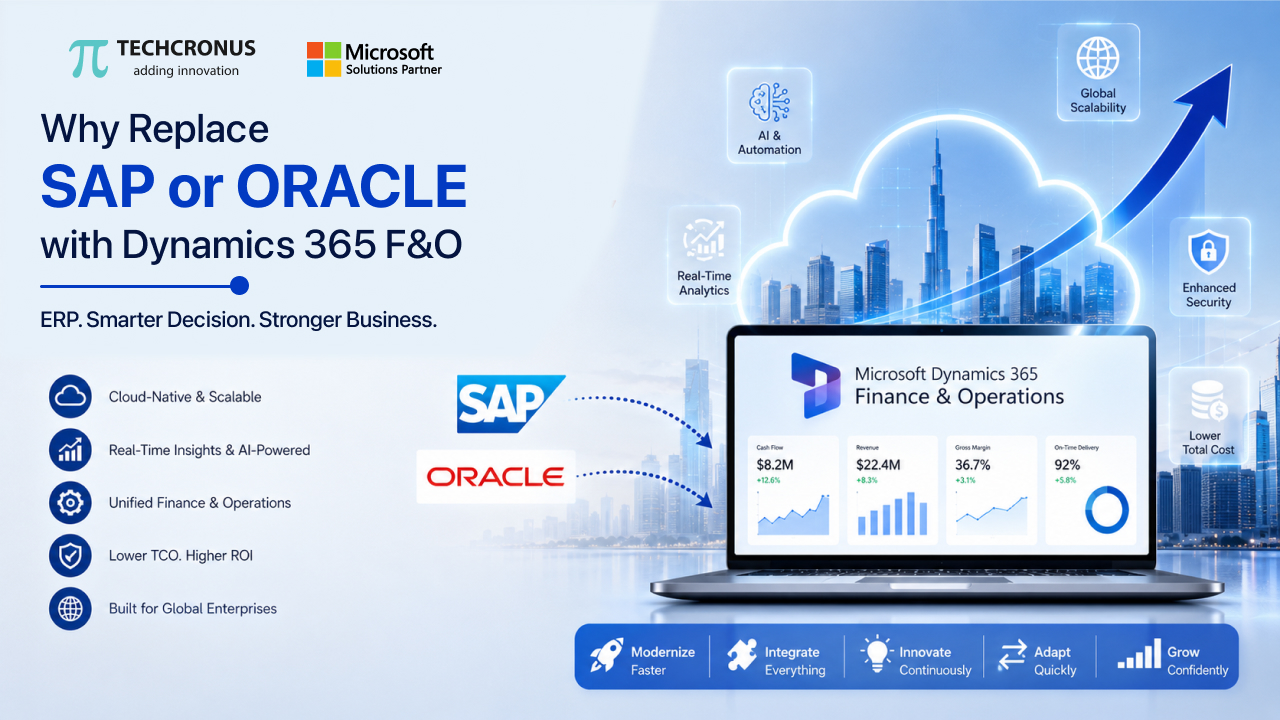
Table of Contents
Every ERP eventually reaches a tipping point because it stops supporting growth. Whether you’re comparing Dynamics 365 F&O vs Oracle Fusion vs SAP, the real question isn’t just which platform has more features;
It’s the one that delivers the best long-term value, scalability, and return on investment. The problem is that every month you postpone ERP modernization, your business quietly pays the price through rising operational costs, inefficient processes, and missed growth opportunities.
- Through hundreds of small operational inefficiencies.
- Manual reporting delays.
- Rising infrastructure costs.
- Duplicate business processes.
- Costly integrations.
- Limited AI capabilities.
- Slower acquisitions.
- Poor visibility across finance and supply chains.
For global enterprises, these hidden costs often exceed the investment required for modernization. No wonder, today CEOs, CFOs and CIOs are evaluating ERP as a business growth strategy rather than a software replacement.
Across boardrooms, enterprise leaders are asking tougher questions. Can our ERP support AI? Can we expand into new markets faster? Can finance close books earlier? Can supply chains react instantly? Can we reduce operating costs without increasing IT complexity?
For many organizations running legacy ERP environments, the answer is increasingly “NO.”
That’s why enterprise ERP modernization has become a strategic business initiative.
Why Traditional ERP Is Becoming a Business Bottleneck
Many global enterprises invested in SAP or Oracle years ago. Those investments delivered value.
- Business expectations have now changed.
- Organizations operate across countries.
- Supply chains face constant disruption.
- Compliance requirements evolve rapidly.
- Artificial intelligence depends on clean, connected business data.
Meanwhile, heavily customized ERP systems often become difficult to upgrade, expensive to maintain and slow to adapt.
That is why many CIOs now begin their evaluation with Dynamics 365 Finance and Operations vs SAP. The objectives are simple.
- Remove operational friction.
- Increase business agility.
- Prepare for AI-driven decision-making.
Why Microsoft’s ERP Strategy is Winning Enterprise Confidence
Today’s enterprises need one intelligent business platform. Microsoft Dynamics 365 enterprise ERP unifies finance, procurement, manufacturing, warehouse management, project operations, supply chain, analytics, and AI within Microsoft’s cloud ecosystem.
This big ecosystem extends naturally into Microsoft 365, Azure, Power Platform, and Copilot. The result is connected business intelligence instead of isolated departmental software.
Organizations beginning a Dynamics 365 Finance and Operations implementation are redesigning how decisions are made.
Recent research highlights why this conversation has accelerated. A 2026 Forrester Total Economic Impact™ study commissioned by Microsoft projects that enterprises adopting Dynamics 365 ERP can achieve 101% ROI over three years and a $12.9 million net present value. They did so by consolidating fragmented systems, standardizing processes, and reducing infrastructure costs.
What Actually Drives ERP Replacement?
Technology rarely convinces a board, but business outcomes do. Most ERP replacement projects are approved for business reasons.
- Executive leadership wants measurable outcomes.
- Faster financial close.
- Better cash-flow visibility.
- Lower inventory carrying costs.
- Quicker post-merger integration.
- AI-ready business data.
- Predictable compliance.
- Standardized global operations.
These priorities are evidence of the growing demand for enterprise ERP cloud migration in 2026 across manufacturing, retail, logistics, and professional services.
Enterprise Case Study from the United States
A large industrial manufacturer has been operating multiple facilities across North America. But they struggled with disconnected finance and production systems.
We gave the business Dynamics 365 Finance and Operations for a large enterprise in the USA. We helped them standardize finance, procurement, and manufacturing processes across every facility. Instead of recreating outdated workflows, leadership redesigned core operations before migration.
The outcome was greater reporting consistency, faster post-acquisition integration, and stronger operational governance.
How Much Does Dynamics 365 Finance & Operations Really Cost?
Every CFO’s first question, right? But then there is no universal answer.
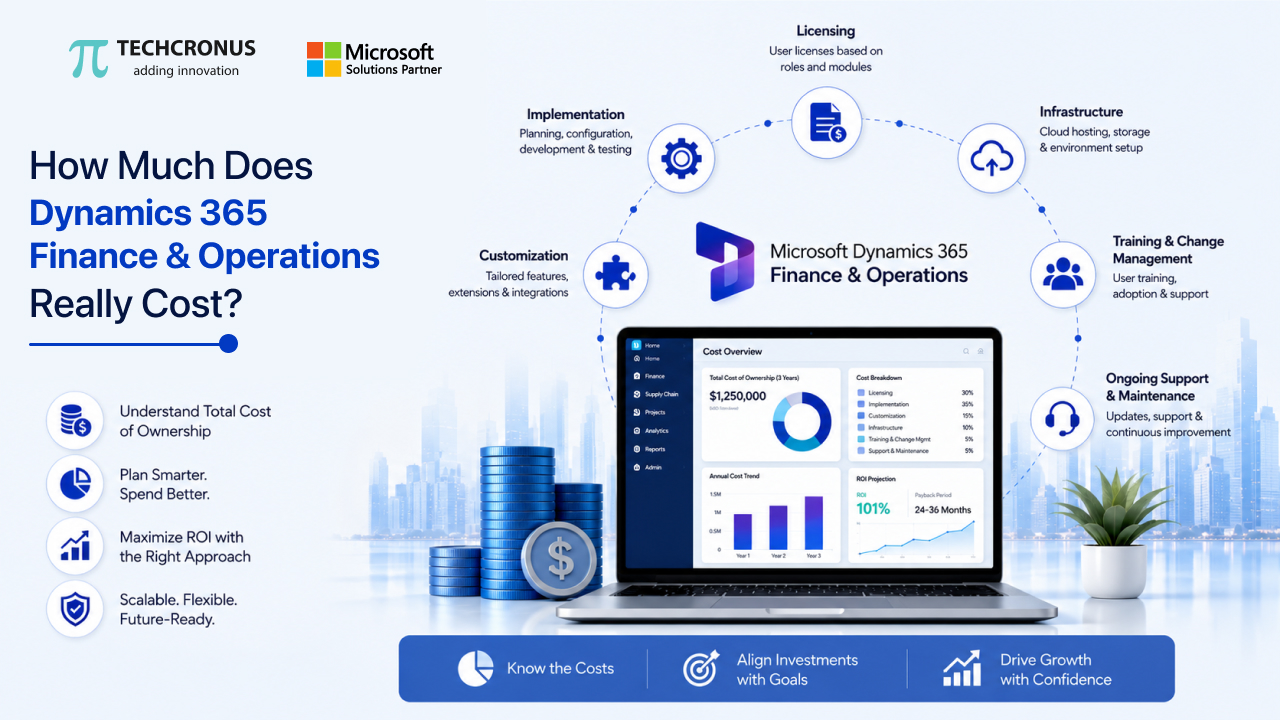
When estimating Dynamics 365 F&O cost, we help you assess far more than software subscriptions.
- How big is your business/ organisation?
- Implementation scope.
- Legal entities.
- Historical data.
- Industry compliance.
- Custom integrations.
- Business process redesign.
- User training.
Independent implementation benchmarks show Finance & Operations projects commonly range from $200,000 to more than $2 million, with implementation services often representing 40–50% of total first-phase investment. Typical enterprise payback occurs within 24–36 months, depending on adoption and operational improvements.
Many organizations underestimate these costs, but the top ones plan for them.
Licensing is Only One Part of the Investment
Understanding Dynamics 365 Finance and Operations licensing cost requires more than comparing subscription prices.
Microsoft uses role-based licensing, so costs vary according to finance users, operations teams, warehouse staff, executives, and Team Members.
Another frequent question is how much Dynamics 365 Finance and Operations costs per user. The answer depends on the mix of user roles and workloads rather than a single enterprise-wide price. Official licensing guidance is available from Microsoft
Business ROI Matters More Than Feature Lists
Choosing an ERP should never become a checklist exercise. It should become a business strategy discussion.
A detailed Dynamics 365 Finance and Operations vs SAP S/4HANA comparison 2026 should evaluate implementation flexibility, AI readiness, integration capabilities, scalability, security, and long-term operating costs instead of simply comparing modules.
Likewise, many organizations planning to replace Oracle with Dynamics 365 F&O mid-market enterprise are motivated by modernization, simplified cloud operations, and stronger integration with Microsoft’s business ecosystem.
Case Study from Australia
A national distributor operating across Australia managed finance, warehousing, and procurement through disconnected applications.
After assessing the D365 F&O implementation cost for Australian enterprises, leadership approved a phased transformation rather than a full replacement in one go. The project focused on process standardization before technology deployment.
- Inventory accuracy improved.
- Procurement cycles became shorter.
- Executive reporting became more reliable.
- The biggest gain came from better business visibility.
Enterprise Case Study from the United Arab Emirates
We partnered with a diversified business group operating across several Gulf countries. They wanted stronger financial governance without sacrificing local compliance.
Using Dynamics 365 Finance and Operations for a large enterprise, the organization consolidated reporting across multiple subsidiaries. This was done while supporting regional tax requirements and local regulations.
- Management gained real-time financial insights across every entity.
- Expansion into new markets became significantly easier.
Why Global Enterprises Need Global ERP
Many organizations compare implementation budgets. Few calculate the cost of waiting. Supporting this complexity requires a Dynamics 365 F&O multi-entity, multi-country implementation planned from the beginning rather than added later.
Every year spent on an aging ERP can increase technical debt, delay upgrades, and reduce operational efficiency.
International organizations rarely operate within one legal entity.
- They manage multiple companies.
- Multiple currencies.
- Multiple tax rules.
- Multiple compliance frameworks.
Hidden costs of not taking the right steps often include:
- Higher application support expenses
- Customization maintenance
- Manual reconciliation
- Delayed financial reporting
- Disconnected supply chain data
- Duplicate integrations
- Reduced employee productivity
- Slower acquisition integration
- Limited AI adoption
What you do not know is….
Manufacturers benefit from Dynamics 365 F&O for manufacturing
Distributors gain greater visibility through the Dynamics 365 Finance Operations supply chain management enterprise. It helps in reducing inventory risks and improving demand planning.
Is Your Enterprise Ready for Dynamics 365 Finance & Operations?
A realistic Dynamics 365 F&O implementation timeline for an enterprise normally includes discovery, business process mapping, solution design, configuration, data migration, integrations, user acceptance testing, training, pilot deployment, go-live, hypercare, and continuous optimization. Microsoft recommends structured implementation methodologies.
Many organizations searching for D365 F&O go-live failure – what went wrong, eventually locate the same root causes. You should seriously evaluate ERP modernization if your organization:
- Operates across multiple companies or countries.
- Plans mergers or acquisitions.
- Relies heavily on spreadsheets for reporting.
- Struggles with disconnected finance and supply chain data.
- Faces expensive ERP upgrades every few years.
- Wants to leverage AI using trusted enterprise data.
- Expects significant business growth within the next three to five years.
D365 Finance and Operations Implementation Partner: Why Techcronus?
Techcronus begins every engagement by understanding business objectives before discussing technical architecture.
Our USP & Strength = Our engagement model that focuses on:
- ERP readiness assessment
- Business process discovery
- Solution blueprinting
- Integration architecture
- Data migration planning
- Governance framework
- Security and compliance
- User adoption strategy
- Executive steering committee support
- Hypercare after go-live
- Continuous optimization
Modernize Before Costs Escalate
Many enterprises are already migrating from SAP to Dynamics 365 Finance and Operations because they want an agile platform that supports AI, automation, and global growth.
Research also shows that Microsoft Dynamics 365 Finance and Operations ROI for enterprises can be substantial when organizations standardize processes, improve adoption, and align technology with business strategy.
At Techcronus, we help enterprise leaders reduce implementation risk, build realistic transformation roadmaps, and maximize long-term business value through practical, phased deployments.
Book a Free D365 F&O Enterprise Assessment. Get a Scoped Implementation Plan
Frequently Asked Questions (FAQs)
1. What is Microsoft Dynamics 365 Finance & Operations (Dynamics 365 F&O)?
Microsoft Dynamics 365 Finance & Operations is a cloud-based enterprise ERP solution that helps organizations manage finance, supply chain, manufacturing, procurement, project operations, and global business processes from a single integrated platform. It also connects seamlessly with Microsoft 365, Power Platform, Azure, and Microsoft Copilot.
2. How much does Dynamics 365 Finance & Operations cost?
The cost of Dynamics 365 Finance & Operations depends on several factors, including:
- Number of users
- Licensing model
- Business size
- Implementation scope
- Data migration
- Customizations
- Third-party integrations
- Training and ongoing support
Enterprise implementation projects typically vary based on organizational complexity and business requirements.
3. How does Dynamics 365 Finance & Operations compare with SAP S/4HANA?
Both platforms offer comprehensive ERP capabilities, but Dynamics 365 Finance & Operations is often chosen for its seamless integration with Microsoft 365, Power Platform, Azure, and Copilot. Organizations also value its cloud-first architecture, flexible deployment approach, AI capabilities, and user-friendly experience. The best choice depends on your industry, business processes, and long-term digital transformation goals.
4. Can businesses migrate from Oracle or SAP to Dynamics 365 Finance & Operations?
Yes. Many organizations successfully migrate from Oracle ERP or SAP to Dynamics 365 Finance & Operations to modernize legacy systems, simplify operations, improve reporting, reduce infrastructure costs, and take advantage of cloud-based AI and automation capabilities. A structured migration strategy helps minimize business disruption.
5. How long does a Dynamics 365 Finance & Operations implementation take?
Implementation timelines vary depending on project size and complexity. Most enterprise projects take 6 to 18 months, including business process analysis, solution design, configuration, data migration, testing, user training, deployment, and post-go-live support.
6. Which industries benefit the most from Dynamics 365 Finance & Operations?
Dynamics 365 Finance & Operations is widely used across industries such as:
- Manufacturing
- Distribution
- Retail
- Logistics
- Professional Services
- Construction
- Healthcare
- Financial Services
- Public Sector
Its scalability makes it suitable for both growing enterprises and multinational organizations.
7. What are the key benefits of implementing Dynamics 365 Finance & Operations?
Organizations implementing Dynamics 365 Finance & Operations can benefit from:
- Real-time financial visibility
- Supply chain optimization
- Multi-company and multi-currency management
- AI-powered insights
- Automated business processes
- Improved regulatory compliance
- Enhanced reporting and analytics
- Better decision-making with Microsoft Copilot