+1 (415) 234 7510
 +971 52 901 6677
 +91 8780928142
 WhatsApp
 Email
Email

































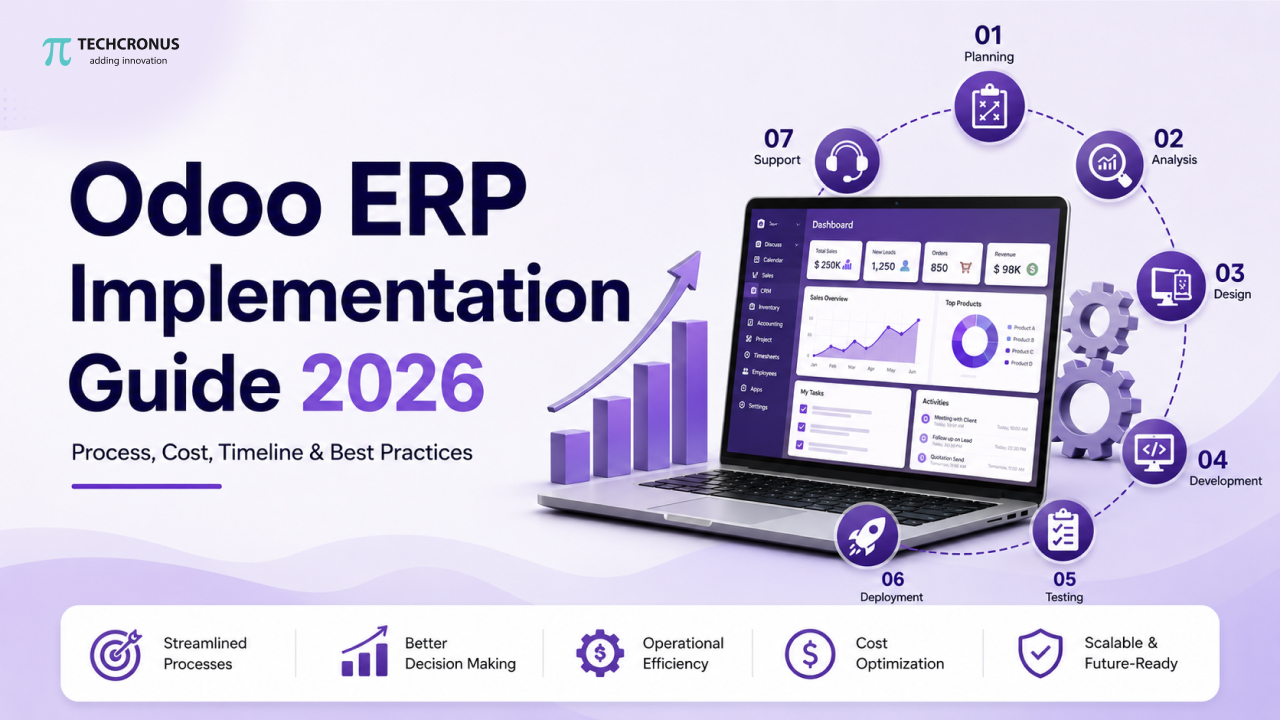
Table of Contents
I have spent years on the other side of the table inside SEO and growth strategy for B2B software buyers, and I have watched the same pattern play out in boardrooms from Dubai to Dallas: leadership approves an ERP budget, then loses six figures and a full fiscal quarter to a rollout that stalls. So let’s skip the fluff. This Odoo ERP Implementation Guide is written the way I would brief a CFO or a Head of Sales before they sign a statement of work – with numbers, not adjectives.
If you are assessing ERP platforms this year, you already know Odoo has become the default answer for mid-market and enterprise teams that want SAP-grade functionality without the SAP-grade invoice. What most leaders don’t have is a clear map of the process, the real cost, and the timeline that separates a smooth go-live from a stalled one.
What Is Odoo ERP Implementation?
At its core, Odoo ERP implementation is the structured process of configuring, customizing, migrating data into, and deploying Odoo’s suite of business applications. It covers sales, inventory, accounting, manufacturing, HR, and CRM so they run as one connected system instead of a dozen disconnected tools. In simple words, it is a business re-engineering project that happens to use software as the delivery mechanism.
That distinction matters because it’s exactly where most in-house IT teams underestimate scope. Buying an Odoo license takes an afternoon. Implementing it properly — with clean data, trained users and workflows mapped to your actual operations – takes a partner who has done it dozens of times before.
Why B2B Leaders Are Moving Faster on This in 2026
Odoo’s global footprint has now crossed 16 million users across more than 120 countries. Its open, modular architecture is precisely why manufacturing, logistics, retail and professional-services companies keep choosing it over rigid legacy platforms.
The regional picture backs this up.
Odoo’s own adoption data shows the UAE and Saudi Arabia among its strongest markets globally, alongside its European base.
In the UAE, Dubai’s Digital Economy push and mainland free-zone expansion have pushed mid-sized trading and manufacturing firms to formalize systems ahead of VAT audits and cross-border compliance.
In the UK, Making Tax Digital and post-Brexit customs complexity have made real-time financial visibility non-negotiable for any company moving goods across borders.
In Australia, single-touch payroll and multi-state compliance are pushing distribution and logistics companies toward unified platforms.
And across the USA, private-equity-backed mid-market firms are under pressure to standardize systems ahead of M&A due diligence a fragmented tech stack is a valuation problem, not just an IT problem.
But then enterprises often get stuck with the question: How to implement Odoo ERP?
What are the Phases of Odoo implementation That Actually Matter?
Ask any experienced systems integrator on how to implement Odoo ERP, and you’ll get some version of the same five phases. What separates an excellent partner like Techcronus from a risky one is how honestly they scope each phase before the contract is signed.
Phase 1 — Discovery & Process Mapping. Every functional department gets interviewed. Current-state workflows are documented, not assumed. This is where 80% of scope creep gets prevented before it starts.
Phase 2 — Solution Design & Module Selection. Which native Odoo modules cover your needs out of the box and where custom development is genuinely required — not just recommended because it bills more hours.
Phase 3 — Configuration, Customization & Data Migration. This is the technical core, and it’s also where legacy data quality problems surface. Clean migration from your existing accounting or CRM system prevents the single most common cause of go-live failure: bad data in a new system.
Phase 4 — Testing, Training & UAT. Real users, real transactions, real edge cases – before go-live, not after.
Phase 5 — Go-Live & Hypercare. The first 30 to 60 days post-launch determine whether adoption sticks or whether teams quietly revert to spreadsheets.
How Much Does Odoo ERP Implementation Cost in 2026?
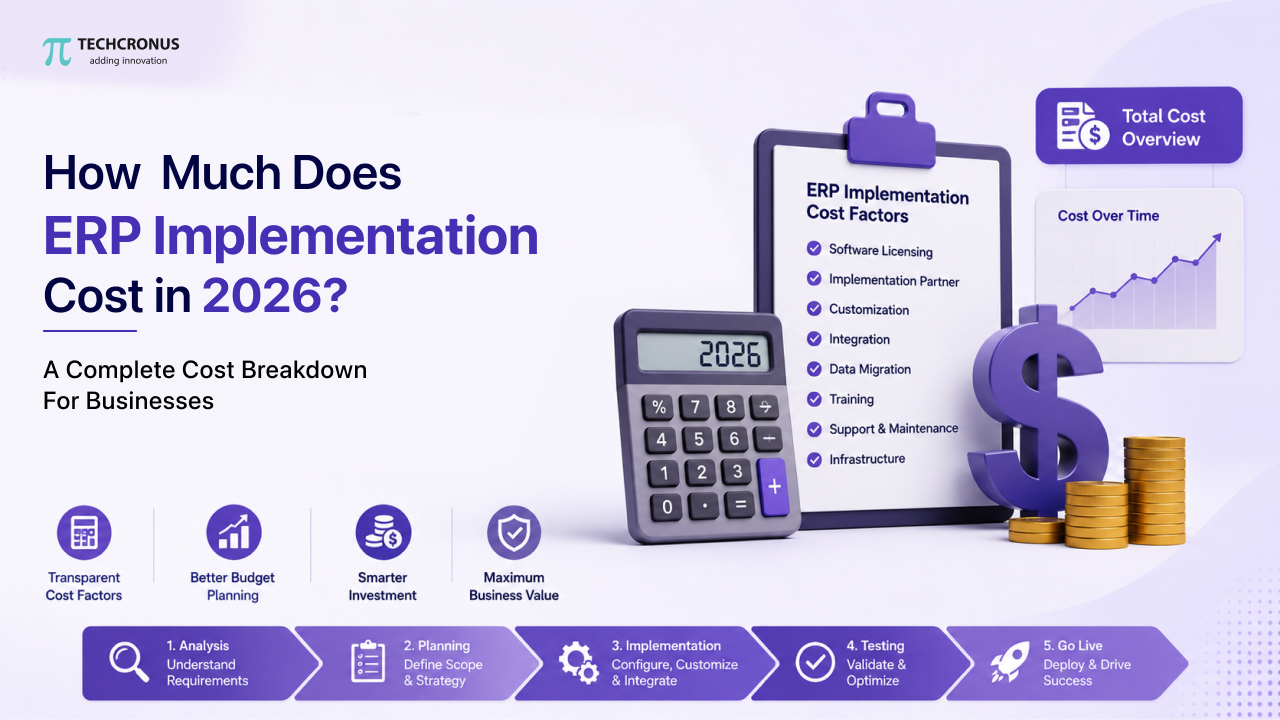
| Implementation Type | Users / Complexity | Expected Odoo Implementation Cost | Key Cost Drivers |
| Small Business | 10–25 users; standard modules | $15,000–$40,000 | Standard configuration with limited customization |
| Mid-Market | Customization, multi-entity accounting, manufacturing or inventory complexity | $50,000–$150,000 | Custom development, data migration, and business process complexity |
| Enterprise | Multiple countries, currencies, and legal entities | $200,000 and beyond | Localized entities, advanced customization, integrations, and scale |
| Major Variables | Applicable to every implementation | Costs vary significantly | Custom development depth; data migration volume and quality; third-party integrations such as payment gateways, e-commerce platforms, and logistics APIs; and the number of localized entities |
| Accurate Estimation | Scope-based discovery | More reliable than generic online estimates | A proper Odoo implementation cost calculator, built on scoped discovery rather than a flat per-user rate, provides a materially more accurate estimate than any published price list. This is why generic online estimates are unreliable for real-world Odoo implementation planning and
budgeting.
|
How Long Does Odoo Implementation Take?
| Odoo Implementation Scope | Typical Timeline |
| Small business / basic setup | 1–3 months |
| Mid-sized business | 3–6 months |
| Large enterprise / complex integrations | 6–12+ months |
Timeline depends on: number of modules, customisation, data migration, integrations, users, and business complexity.
What Delaying Oddo ERP Implementation Actually Costs You
- Manual reconciliation consumes 15–20 monthly finance hours.
- Disconnected finance and inventory tools increase workload.
- Spreadsheet inventory systems commonly carry 5–10% excess.
- Untrusted inventory numbers prevent leaner safety stock.
- Acquisitions face due-diligence flags from fragmented tech stacks.
- Investment rounds may slow because systems remain fragmented.
- Franchise expansion suffers when technology lacks integration.
- Delayed implementation costs more than implementation invoices.
None of that shows up on an implementation invoice. All of it shows up on next year’s P&L.
Choosing the Right Odoo ERP Implementation Partner
Here’s the part nobody tells you in the sales pitch: your outcome depends more on the partner you choose than on the software itself. Odoo is genuinely excellent technology. It is also genuinely easy to implement badly.
When you assess an Odoo ERP implementation partner, look past the logo wall and check three things: vertical experience in your industry, a documented data migration methodology, and post-go-live support commitments in writing. Never go by what was verbally promised.
This is also where region matters more than most buyers expect, and Techcronus serves it all with perfection.
- As a learned Odoo ERP implementation partner USA, we understand multi-state tax and PE-driven M&A readiness.
- An Odoo ERP implementation partner UK needs fluency in Making Tax Digital and UK VAT nuances. Our experts are aware of these and more with changing times.
- As the top Odoo ERP implementation partner UAE, we have hands-on experience with VAT compliance, Arabic-English bilingual invoicing and free-zone regulatory structures.
- As an ideal Odoo implementation partner Australia, we already understand GST, single-touch payroll and state-based compliance out of the gate. We do not learn it on your project timeline.
- For companies operating across the wider Gulf, working with an Odoo gold partner in the Middle East signals something concrete: certified expertise verified directly by Odoo. Gold Partner status requires proven project volume, certified consultants and ongoing quality audits from Odoo itself.
Beyond geography, ask about depth. Can you actually hire certified Odoo developers? Or will your project be staffed by generalists learning Odoo on your budget? Do they offer real Odoo customization and migration services, with a track record of migrating from platforms like QuickBooks, SAP Business One, or legacy on-premise systems without data loss?
Real-World Case Solved by Techcronus Via Affordable Odoo ERP Implementation
Now, I will walk you through a composite example built from patterns. I have seen it repeatedly across real implementations, because it illustrates the stakes better than any statistic can.
A mid-sized industrial parts manufacturer had a 140-employee company with operations spanning the UK and UAE. They had already burned through one failed ERP attempt with a generalist IT vendor. Inventory counts didn’t match the warehouse floor. Finance was still closing the books in spreadsheets. Leadership was, understandably, skeptical that any implementation partner could fix what felt like a fundamentally broken process.
When they brought in Techcronus, the engagement started differently: two weeks of pure discovery before a single module was configured, mapping every warehouse and finance workflow as it actually existed.
Techcronus’s team scoped a phased rollout UK finance and inventory first, UAE sales and VAT-compliant invoicing second, with certified developers handling the custom manufacturing BOM logic that the previous vendor had never gotten right. Data migration ran in parallel with UAT so errors surfaced in testing, not production.
10 weeks later, this company went LIVE across both regions with under 2% data discrepancy and full user adoption inside the first month, a stark contrast to their prior nine-month failed attempt. The finance team closed the month-end in three days instead of twelve. This is the version of “Odoo ERP implementation” that actually delivers ROI, and it’s the version B2B leaders should be scoping for from day one.
What are the best practices for an Odoo ERP implementation guide? The Techcronus Way
Define global process standards before local customisations.
- Map country-specific tax, accounting, and compliance requirements.
- Plan multi-company, multi-currency structures before configuration.
- Establish data ownership before migration begins.
- Clean master data before importing anything.
- Test integrations using real-world business scenarios.
- Build an upgrade strategy before custom development.
- Choose hosting based on users and regulations.
- Create rollback plans before every major deployment.
- Train key users through actual process simulations.
- Test localization, taxes, currencies, and fiscal years.
- Plan post-go-live support before launch day.
- Track adoption, not merely technical completion.
- Review custom modules before every Odoo upgrade.
- Run full end-to-end testing before production launch.
Why Techcronus Is the Partner Serious B2B Leaders Choose
If you are still weighing an Odoo ERP Implementation Guide against an actual decision, here’s the honest pitch: Techcronus has spent years delivering exactly the kind of phased, regionally-aware, certified-developer-led implementations described above — across the USA, UK, UAE, wider Middle East and Australia. This combination of Gold Partner-level technical certification, genuine vertical experience and post-go-live accountability is rare. And that’s where the real difference lies between an ERP project that becomes a case study and one that becomes a cautionary tale.
The businesses winning market share in 2026 are the ones with the most disciplined Odoo ERP implementation.
Your next step is a 30-minute free scoping call, not another vendor deck. Bring your current pain points — inventory mismatches, month-end close time, multi-entity VAT headaches — and Techcronus will map them against a realistic phased plan and cost range before you sign anything. Talk to Techcronus before you finalize your ERP budget, not after your first rollout attempt stalls.