+1 (415) 234 7510
 +971 52 901 6677
 +91 8780928142
 WhatsApp
 Email
Email
































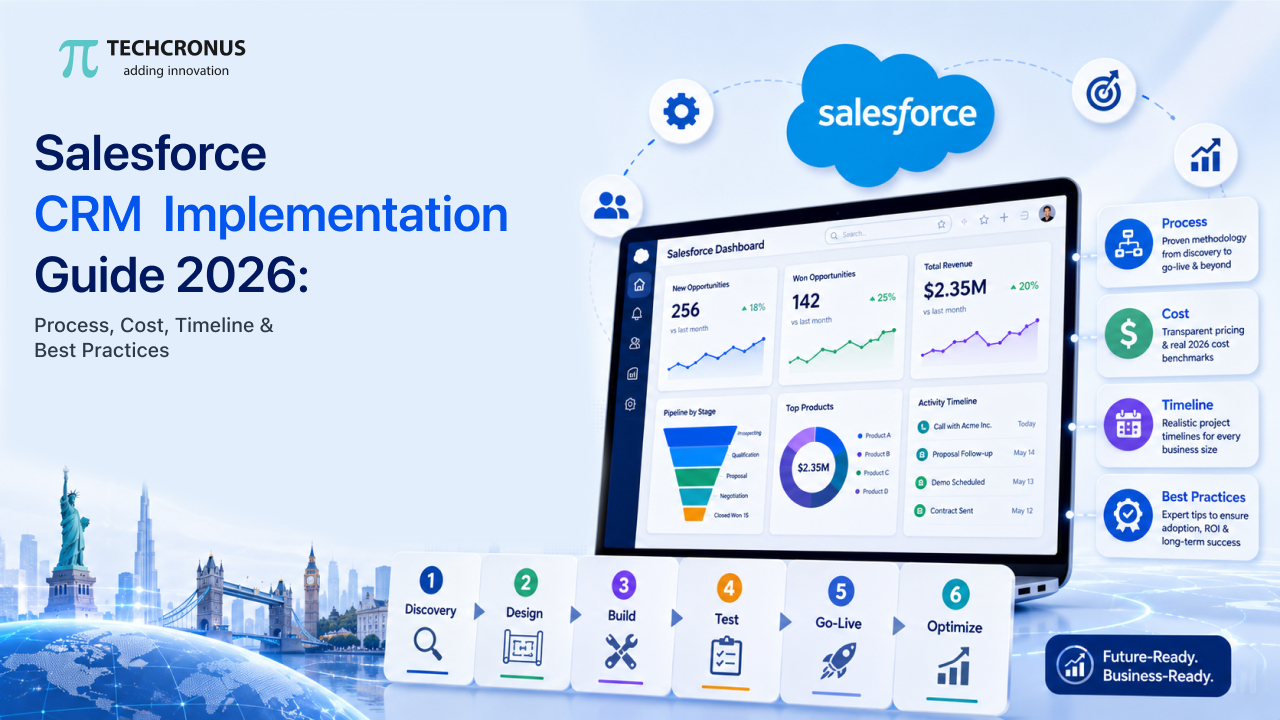
Table of Contents
Salesforce has held the #1 spot in global CRM market share for over a decade. In 2026, the real question B2B leaders face to implement Salesforce is: How to implement Salesforce without blowing the budget, missing the timeline, or landing in the majority of projects that under-deliver on adoption.
This guide covers everything B2B leaders need before buying Salesforce implementation services: the implementation methodology, a realistic Salesforce implementation project timeline, real 2026 cost benchmarks, the mistakes that sink most projects, and how to choose a partner — whether you are scoping this from Los Angeles, London, or Dubai.
If you would rather skip the research and talk to a certified partner directly, Techcronus offers a free scoping call for teams across the US, UAE, UK and Australia.
What Is Salesforce CRM Implementation?
Salesforce CRM implementation is the structured process of configuring, customizing, integrating, and rolling out Salesforce. Done so that it matches how your sales, service and marketing teams actually work. It’s a business transformation project delivered through software, not a purchasing event. Buying a license gets you access to the platform; implementation is what turns that platform into a system your revenue team will actually use every day. Businesses that buy Salesforce implementation services are really buying that structured process. Most projects start as a Salesforce Sales Cloud implementation before expanding into Service Cloud or Marketing Cloud.
Salesforce Implementation Methodology & Lifecycle
Experienced Salesforce implementation partners like Techcronus follow a phased methodology.
| Phase | What Happens | Typical Owner |
| 1. Discovery | Business goals, pain points, current-state process mapping, stakeholder alignment | Business analyst + your leadership |
| 2. Solution Design | Cloud/edition selection, data model, integration architecture, security model | Solution architect |
| 3. Configuration & Development | Objects, fields, record types, automation (Flow), validation rules, custom development where needed | Salesforce consultant/developer |
| 4. Data Migration | Extraction, cleansing, deduplication, mapping, load into Salesforce | Data engineer |
| 5. Integration | Connecting Salesforce to ERP, marketing automation, telephony, e-commerce, WhatsApp/finance tools | Integration developer |
| 6. Testing (UAT) | Functional testing, user acceptance testing with real sales/service teams | QA + end users |
| 7. Training & Change Management | Role-based training, sandboxes, documentation, adoption champions | Training lead |
| 8. Go-Live & Hypercare | Production cutover, 2–6 week monitoring window, rapid-fix support | Full delivery team |
Salesforce Implementation Lifecycle & Project Timeline in 2026 and Beyond
Every Salesforce implementation project timeline is driven by scope and by how fast your organization makes decisions, not by geography. A mid-market Sales Cloud rollout takes roughly the same number of weeks whether the buyer is in California, Dubai, or London.
| Business Size / Scope | Realistic Timeline |
| Small business, single cloud, under 20 users | 4–8 weeks |
| Mid-market, single cloud, under 50 users | 8–14 weeks |
| Mid-market, two clouds, moderate integrations | 14–22 weeks |
| Multi-cloud, complex integrations, compliance requirements | 5–9 months |
| Enterprise, global rollout, heavy customization | 9–18 months |
Add a 2–6 week hypercare period after go-LIVE to every range above. It’s when integration edge cases and adoption friction actually surface. And go-live isn’t the finish line: meaningful adoption and measurable ROI typically take another 2–3 months of reinforcement and governance beyond that.
Salesforce Implementation Cost Breakdown 2026
Here’s the number every B2B buyer actually wants for a Salesforce Sales Cloud implementation, broken down by size, by cost driver, and by region.
Cost by Company Size
| Company Size | Total Implementation Cost | Timeline |
| Small business (1–20 users) | $5,000 – $25,000 | 4–8 weeks |
| Mid-market (20–100 users) | $25,000 – $150,000 | 8–22 weeks |
| Enterprise (100–200+ users) | $150,000 – $500,000+ | 5–18 months |
| Complex multi-cloud enterprise | $500,000+ | 9–18 months |
What Actually Drives Enterprise CRM Implementation Cost
Licensing is the starting line, not the total. Salesforce Sales Cloud editions run from roughly $25/user/month for Starter Suite up to $165–$330/user/month for Enterprise and Unlimited editions, but license fees are typically a fraction of total project cost. The bigger cost drivers:
- Customization depth — the more your process diverges from Salesforce’s standard configuration, the more development and testing time is required
- Number and complexity of integrations — a simple webhook is a few days of work; a bidirectional ERP sync with conflict resolution and error handling is weeks
- Data migration complexity — clean, single-source data migrates in days; legacy data spread across multiple systems with duplicates can consume as much time as configuration itself
- Compliance and security requirements — healthcare, finance and multi-region organizations carry additional architecture work
- Change management and training scope — larger user bases need structured, role-based training, not a single onboarding session
Salesforce Implementation Cost by Region
| Region | Typical Mid-Market Range | Reasons |
| USA (including California) | $50,000 – $150,000 | Highest onshore consulting rates; strong demand for Salesforce implementation consulting services USA-wide |
| UK / London | Roughly £25,000 – £100,000 | Data residency and financial-services compliance requirements often add architecture work upfront |
| UAE / Dubai | $30,000 – $120,000 | Rising demand for a Salesforce CRM integration partner UAE-based, especially in real estate, logistics and trading |
| Blended onshore/offshore delivery | 30–50% lower than pure onshore | Client-facing teams in your time zone backed by an offshore delivery center — the model that keeps enterprise CRM implementation cost predictable without sacrificing governance |
Salesforce implementation mistakes to avoid: Budgeting mistake: Planning for the license fee and underestimating data migration, integration, and training as separate cost categories. Build a line item for each of those three, not one lump “implementation” number, and your budget will hold.
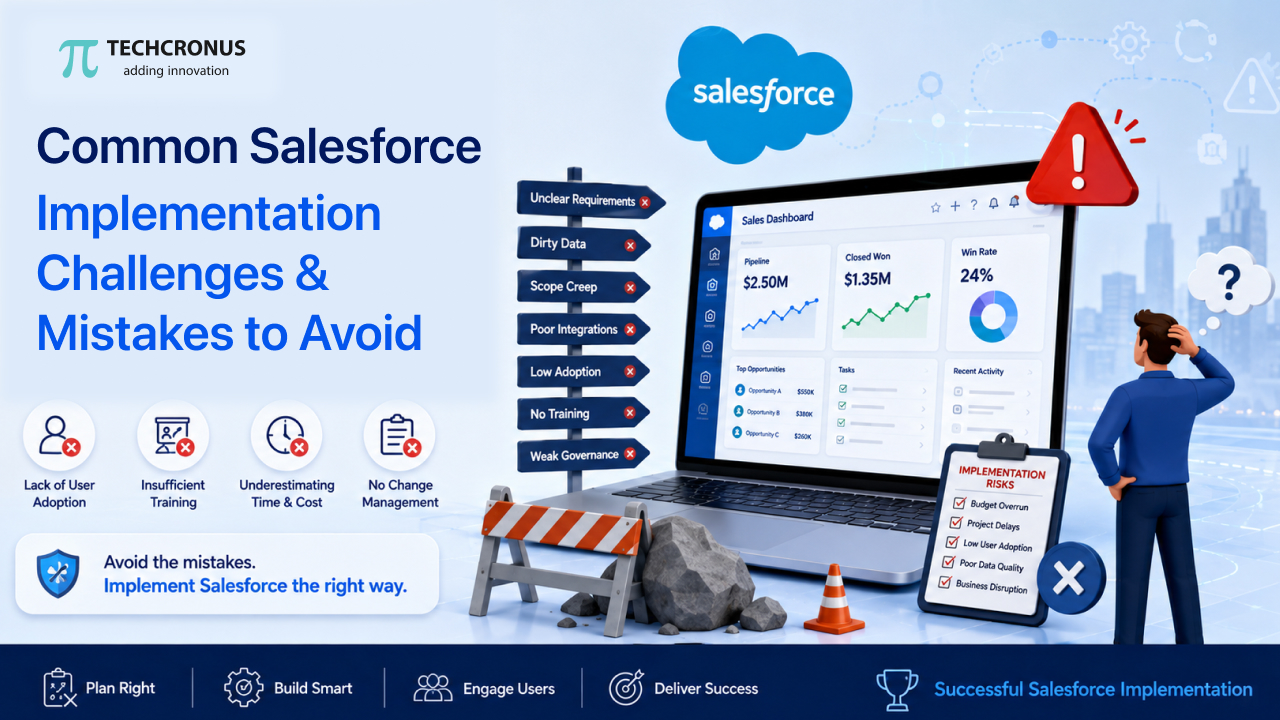
Common Salesforce Implementation Challenges & Mistakes to Avoid
Industry analysis consistently puts CRM implementation failure or major rework rates as high as 70%. The causes behind the most common mistakes & threats repeat across company size and geography; the technology is rarely the actual problem.
- Starting configuration before goals are locked. Teams build settings for weeks with no agreement on what “done” looks like, then rebuild once real requirements surface.
- Underestimating data quality work. Migrating dirty, duplicated or inconsistent data into a new system just moves the chaos — it doesn’t fix it.
- Scope creep without a change process. An 8-week project becomes a 6-month project when new requirements get added without renegotiating timeline and budget.
- Treating training as a one-time event. A perfectly configured org is worthless if the sales team won’t use it consistently.
- Skipping hypercare. Issues that surface in production need a defined resolution path with SLAs, not an ad-hoc scramble after the partner has moved on.
- Over-customizing too early. Salesforce is designed to be configured before it’s heavily customized. Forcing an exact legacy process into custom code — instead of adapting to Salesforce’s standard capabilities where reasonable — creates maintenance costs for years.
- No empowered internal decision-maker. Projects stall when no single person on the client side can approve scope and sign off on milestones.
How to Choose a Salesforce Implementation Partner
It starts with this checklist. What matters is certification and process maturity, not zip code. Use the tips below when evaluating a Salesforce implementation partner anywhere in the US, UAE, UK or beyond:
- Are they a certified Salesforce Partner? Verify directly on the Salesforce AppExchange consulting listing — don’t take the claim at face value.
- What’s their track record, in numbers? Years in business, number of completed Salesforce projects and industries served should be verifiable, not vague.
- Do they offer a defined hypercare period with SLAs? A partner who disappears after go-live isn’t delivering a complete implementation.
- What does their discovery process actually document? Ask to see a sample discovery deliverable — a partner without one doesn’t have a real methodology.
- How do they handle data migration and cleansing specifically? This is where most timeline and cost overruns originate.
- What’s their onshore/offshore delivery model? For US, UAE and UK buyers, a blended model — local project management with offshore execution — is often the difference between enterprise-quality delivery and enterprise-level pricing.
- Can you talk to a reference client in your industry and region? A partner with genuine multi-region experience will have this ready.
Why B2B Leaders in the US, UAE and UK Work With Techcronus
Techcronus is a certified Salesforce Partner (listed on the Salesforce AppExchange) and a Microsoft Solutions Partner, operating since 2013:
- 500+ businesses served across manufacturing, distribution, healthcare, retail, professional services and education
- 800+ completed projects spanning Salesforce, Microsoft Dynamics 365 and Odoo implementations
- 15+ countries served, with active clients across the US, UAE, UK, Australia and Europe
- Local presence, global delivery — offices in Los Angeles, California; Dubai, UAE; Sydney, Australia; and delivery centers in India and Denmark supporting clients on their own time zones
- Full Salesforce service stack — Sales Cloud, Service Cloud, Marketing Cloud, Commerce Cloud, Data Cloud, Agentforce and CPQ implementation, plus managed services and health checks for orgs that need to rescue a stalled or underperforming implementation
Global Salesforce Implementation: Case Studies from Techcronus
A California SaaS scale-up was drowning in five disconnected sales tools. A Salesforce sales cloud implementation from us a the trusted Salesforce partner in California – we unified pipeline, forecasting, and renewals into one view — reps stop re-entering data twice.
Another Dubai trading firm was running deals through WhatsApp and invoices through a separate ERP. As Salesforce implementation partner Dubai, we wired both into Salesforce, giving leadership one real-time pipeline instead of three disconnected ones.
A London financial services firm was stuck on GDPR data-residency rules. Salesforce consulting companies London businesses trust design compliance into the data model from day one, no audit surprises later. We do that.
We also worked with another multi-state US enterprise needing consistent rollout across regions. Our Salesforce implementation consulting services USA-wide standardized the build once, deployed everywhere. And as the top Salesforce CRM integration partner UAE-based, we mirrored that same discipline for GCC operations.
Book a free Salesforce implementation scoping call with Techcronus →
Best Practices for a Successful Salesforce CRM Implementation
Whatever your Salesforce CRM implementation plan looks like on paper, these are the habits that separate projects that hit their timeline, budget and adoption goals from the ones that don’t:
- Lock scope before configuration starts, with a formal change-request process for anything added afterward
- Assign one internal project owner with real authority to make decisions, not a committee
- Clean data before migration, not during it; treat data hygiene as its own workstream with its own timeline
- Configure before you customize; use Salesforce’s standard capabilities wherever your process can reasonably adapt
- Build training around actual daily workflows, not a generic platform tour
- Insist on a hypercare period with SLAs in any implementation proposal; treat it as non-negotiable
- Plan a 90-day post-launch optimization cycle adoption gaps only become visible once real usage begins
- Verify your partner’s certifications and completed-project count directly, not just their pitch deck
Frequently Asked Questions
How do I choose a Salesforce implementation partner?
Verify their Salesforce AppExchange certification, ask for a documented discovery methodology, check their track record by completed-project count and industries served, and confirm they include a hypercare period with defined SLAs.
What are the most common Salesforce implementation mistakes to avoid?
Starting configuration before requirements are locked, underestimating data cleansing, allowing scope creep without renegotiating timeline, treating training as a single event, and skipping a hypercare period.
How long does a typical Salesforce CRM implementation project take?
Small business rollouts take 4–8 weeks, mid-market single-cloud projects take 8–14 weeks, two-cloud mid-market projects take 14–22 weeks, and multi-cloud enterprise projects take 5–18 months.
What is the average Salesforce enterprise CRM implementation cost in 2026?
Enterprise, multi-cloud Salesforce implementations typically run $150,000–$500,000+, mid-market implementations $25,000–$150,000 and small business rollouts $5,000–$25,000 — all before annual license fees.
Get Your Salesforce Implementation Right the First Time
Salesforce implementation services are only as good as the discovery work behind them. Whether you need a Salesforce partner in California, a compliance-fluent team among the Salesforce consulting companies London businesses evaluate, or a Salesforce implementation partner Dubai teams can rely on for GCC-specific integrations, Techcronus scopes it properly before writing a single line of configuration. Talk to the Techcronus Salesforce team →